Ice sticks to your skin because the thin film of moisture on your fingers or tongue freezes on contact. Very cold ice (well below 0 °C/32 °F) chills that moisture below freezing faster than your body can rewarm it, so it turns to ice and bonds the two surfaces with hydrogen bonds. The colder the ice, the stronger the grip.
You’ve probably noticed that while taking a frosty cold container out from the freezer, your fingers tend to stick to the ice; not only on the container itself, but also to the deposits of ice that form when you haven’t defrosted your freezer in a while.
Why do our hands decide to be sticky when they come in contact with ice?
Factors Affecting The Adherence Between Skin And Ice
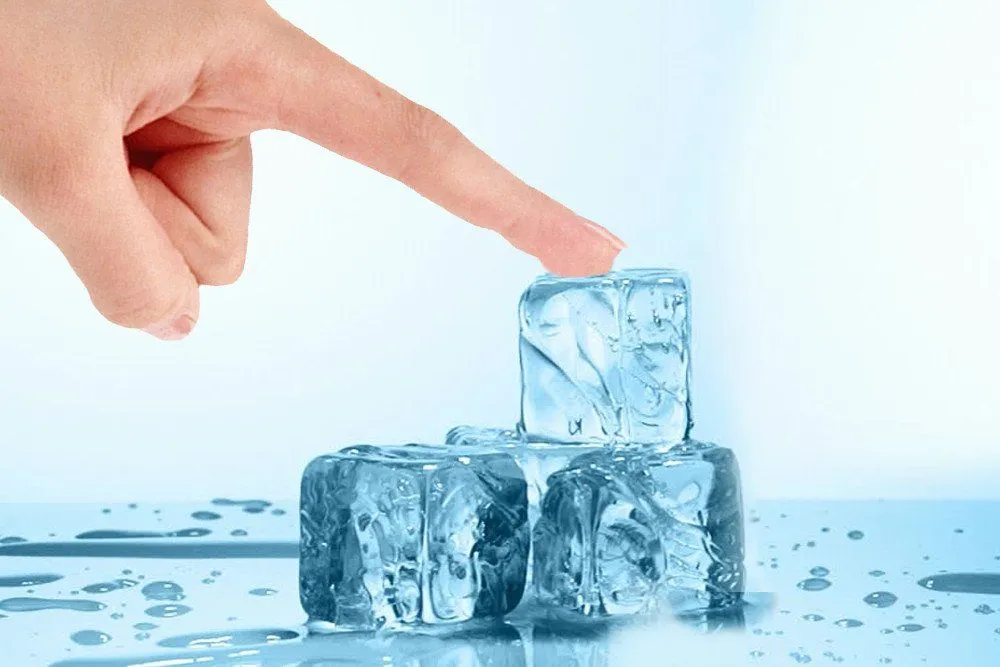
Ice tends to stick to our skin, but it doesn’t always have this unusual attraction. Whether or not a piece of ice will stick to our skin depends on two important factors: moisture of the body part (that’s in contact with the ice) and the temperature of the ice.
Moisture On Your Hands
Most of us always have some water on our hands, arms, legs, etc. in the form of moisture, whether or not we realize it. Your tongue, for example, remains wet all the time due to the saliva in our mouth, so it also becomes a very good candidate for sticking to ice.
Temperature Of The Ice
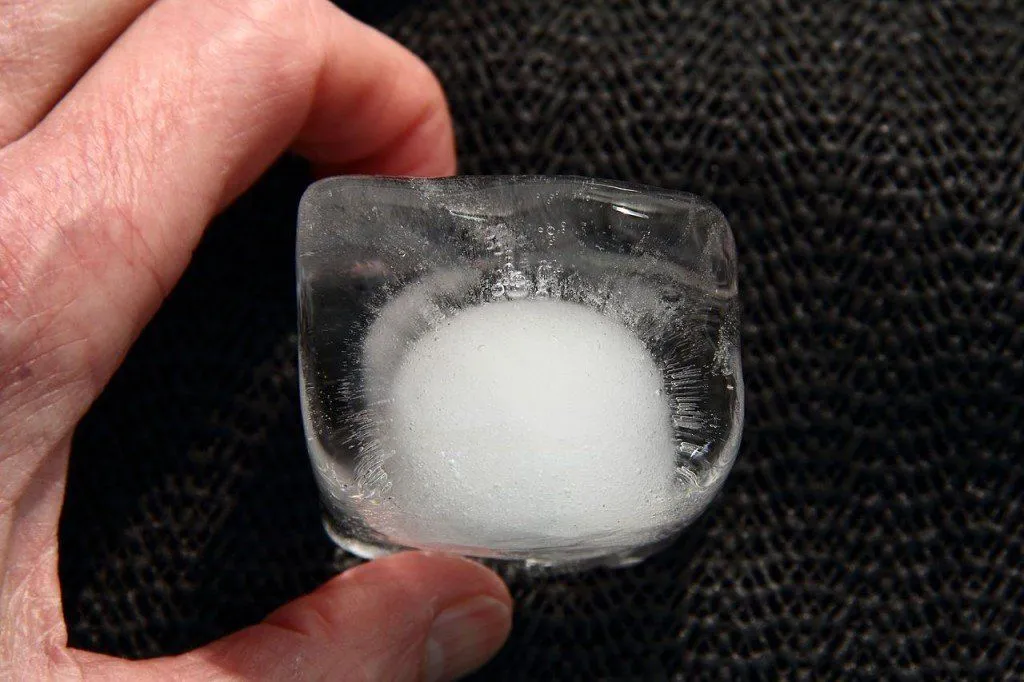
We’re talking about ‘ice’ here, so it’s logical that it must be at 0 degrees Celsius (32 Degrees Fahrenheit), i.e. the freezing temperature of water. However, this may not necessarily be so in every case. Although water does freeze at 0 degrees Celsius, the temperature of the piece of ice in question (including the ice cubes you take out from the freezer) might be even lower than 0 degrees Celsius. Once you take the ice cubes out from the freezer and keep them out (at room temperature) for some time, they begin to thaw, meaning that their temperature starts to climb.
The main takeaway here is that the colder ice is, the more it will tend to stick to your hand or any other exposed body part.
Role Of Hydrogen And Oxygen Atoms
Now that you know the two essential factors needed for sticking ice to skin, let’s see how the process actually occurs.
In its liquid form, water molecules can break connections with their fellow molecules and form new ones instantly, granting water the ability to flow easily. However, when it comes to ice, these molecules are stuck in place due to the cold temperature. The structure of ice, if you think about it, makes some water molecules (that consist of hydrogen and oxygen atoms) line up along the surface facing outwards.
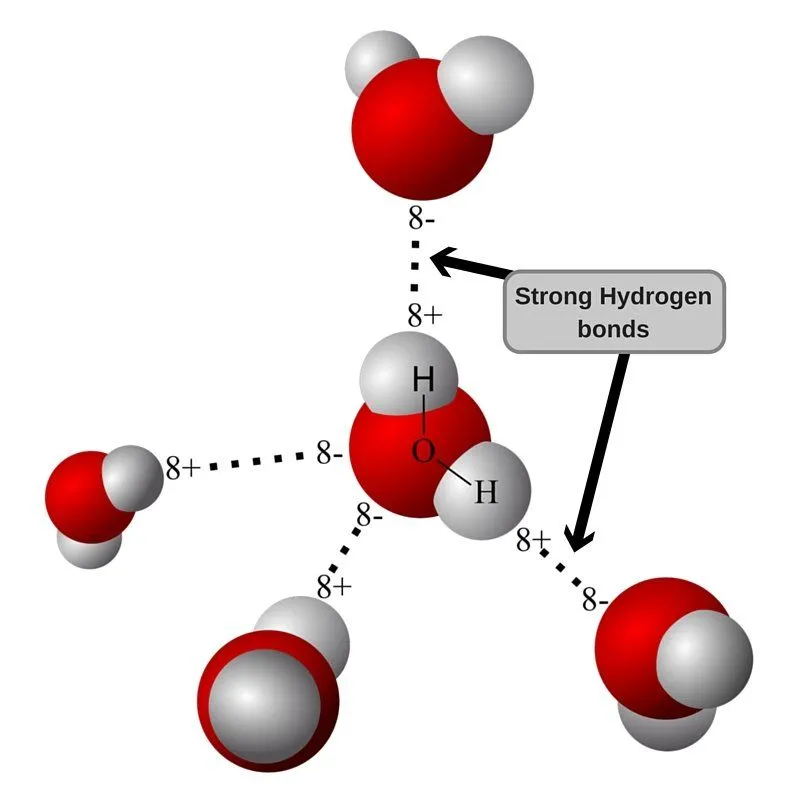
The oxygen atoms present still want to form hydrogen bonds with hydrogen atoms in their fellow water molecules. But alas… they can’t, for they are on the surface and are therefore destined to stay away from the water molecules that can bond with them.
This is where the water present on your hand in the form of moisture comes to the rescue. When your warm, damp skin meets very cold ice, the thin film of moisture on your hand quickly loses its heat to the ice. If the ice is cold enough (well below freezing), that moisture itself freezes solid. As it does, oxygen and hydrogen atoms in the newly frozen water lock onto the hydrogen and oxygen atoms waiting on the surface of the ice, knitting the two together with a web of hydrogen bonds.
So the “glue” here is really a little patch of fresh ice, and it’s held in place by hydrogen bonds. And there’s one thing you should know about hydrogen bonds…

This is what causes your hand to stick to ice. The colder the ice, the stronger the adherence between the two. However, this can be easily undone by pouring some warm water over the contact point.
Therefore, when you’re in a laboratory conducting an experiment that involves ice, you would be wise to keep your fingers gloved and your tongue safely inside your mouth.
Why Does Your Hand Feel Cold When You Touch Ice?
While we’re on the subject, here’s a closely related puzzle: why does grabbing an ice cube make your hand feel cold in the first place? It feels like the ice is pushing cold into you, but that’s not what happens. There’s no such thing as “cold” flowing anywhere; only heat moves, and it always travels from the warmer object to the cooler one.
Your hand sits at roughly 37 °C (98.6 °F), while the ice is at 0 °C (32 °F) or colder. The moment they touch, heat flows out of your skin and into the ice by direct contact, a process called conduction. The nerve endings in your skin don’t actually detect temperature; they detect heat leaving. That outward rush of warmth is exactly what your brain reads as “cold.” It’s also why the same ice cube feels far colder than air at the same temperature: water (and ice) pulls heat out of your skin much faster than air does. And that draining of heat is precisely what melts, then refreezes, the moisture that glues your finger in place.
What If You Get Stuck? (And Why You Should Never Pull)
If you grew up watching A Christmas Story, you already know the scene: a kid takes a dare, presses his tongue to a frozen flagpole, and ends up firmly attached. It is not just a movie gag. A tongue or a wet finger really can freeze fast to very cold metal or ice, and every winter playgrounds and freezers deliver a few real-life re-enactments.
So what do you do when it happens to you? The single most important rule is this: do not yank yourself free. The clinical advice from health services is blunt about it: "Don't pull or tug. This can cause an injury." When the wet layer between your skin and the ice has frozen solid, pulling does not break the ice; it tears your skin away from itself instead, which is why a stuck tongue can bleed once it is freed.
The right move is to melt the glue, not fight it. Have someone pour warm (not hot) water over both the stuck body part and the surface it is clinging to. The warmth liquefies that thin patch of fresh ice, the hydrogen bonds let go, and the two surfaces slide apart on their own. No helper and no water nearby? Cupping your hands and breathing warm, damp air onto the spot works too, just more slowly. Reach for warm rather than scalding water for a reason: the chilled tissue is already vulnerable, and very hot water can scald it.
It is also worth knowing why speed matters. Lingering against something that cold is not harmless. Prolonged contact with ice or sub-zero metal can cause an "ice burn", where the cold damages skin much the way heat does, disrupting blood flow and even forming ice crystals inside the cells. If a patch of skin does end up cold and numb, rewarm it gently in lukewarm water, roughly 37 °C to 39 °C (98.6 °F to 102.2 °F), and resist the urge to rub it, since friction only adds to the injury. For anything beyond a brief sting, or if the skin tears, it is a job for a doctor, not a brave tug.
References (click to expand)
- Why is ice Sticky? | Physics Van | UIUC. The University of Illinois Urbana-Champaign
- Why do we stick to ice? | Questions - The Naked Scientists. The Naked Scientists
- Why does ice become sticky the colder it gets? [duplicate]. Stack Exchange
- Thermal Energy Transfer (Classroom Connection). NASA
- Frozen or Stuck Tongue or Other Body Part. Kaiser Permanente Health Encyclopedia
- Ice Burns. Cleveland Clinic
- Frostbite. Cleveland Clinic