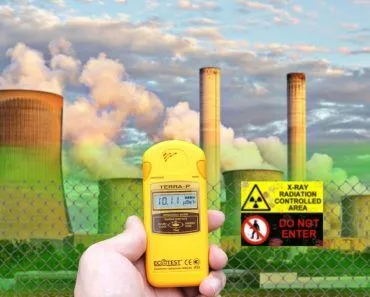
Unstable isotopes (also called radioisotopes) shed excess nuclear energy as alpha particles, beta particles, or gamma rays. Each of these carries far more than the ~10 eV needed to knock electrons off atoms, so the emission is ionizing by definition. Lower-energy "regular" radiation, like visible light or radio waves, simply cannot come out of nuclear decay.
Do you ever find yourself wondering how an X-ray machine gives us the images of our bones and soft tissues? Or how a microwave oven warms up frozen food in mere minutes?
This “invisible light” that seemed to pass through screens baffled scientists for years, until several hypotheses and experiments later, when the term “radioactivity” was coined.
What Is Radiation?
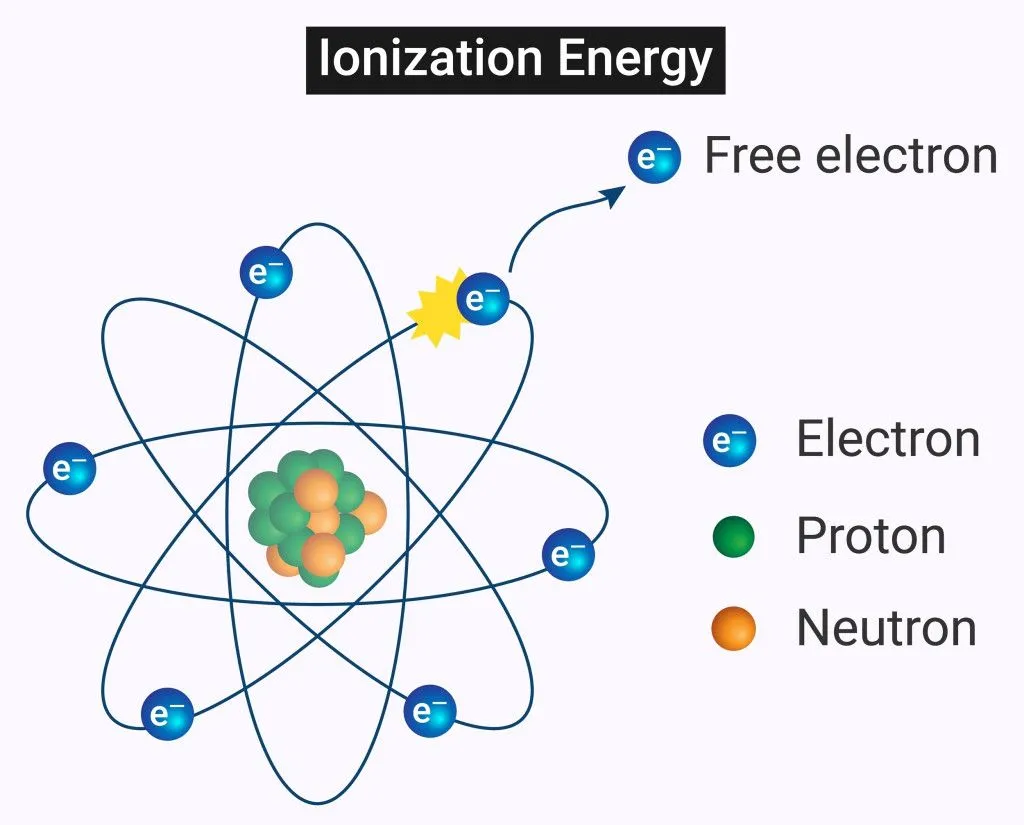
Radiation is simply energy in transit, carried either by electromagnetic waves or by tiny moving particles. It can travel through a medium like air or water, or even through a vacuum. The energy itself comes in two flavors: ionizing and non-ionizing radiation.
Ionizing radiation is the high-energy kind. Above roughly 10 electronvolts (eV), a photon or particle has enough punch to rip an electron clean off an atom or molecule, breaking chemical bonds in the process. The atom or molecule that loses the electron is left with a net charge, and we call it an ion. Non-ionizing radiation falls below that threshold, so it can jiggle and warm matter but cannot ionize it.
The Discovery Of Radiation
On 8 November 1895, the German physicist Wilhelm Röntgen was experimenting with cathode rays in a darkened Würzburg lab when he noticed something odd: a chemically coated screen on a nearby bench was glowing, even though the discharge tube was wrapped in heavy black cardboard. Whatever was making the screen fluoresce was clearly not a cathode ray, since it crossed a distance the cathode rays could not.
Over the next few weeks, Röntgen ran experiment after experiment with this mystery emission, eventually producing the now-famous radiograph of his wife Anna Bertha's hand, ring and bones in stark relief. Because he had no idea what the rays actually were, he gave them a placeholder name borrowed from mathematics: X-rays.
How Was The Term “Radioactivity” Coined?
In 1896, the French physicist Henri Becquerel discovered that uranium salts emit a similar penetrating "invisible light" of their own. He first guessed the salts were soaking up sunlight and re-emitting it, but a famously cloudy week in Paris (with the salts shut in a drawer beside a photographic plate) showed they were glowing in the dark all on their own. The energy was coming from the uranium atoms themselves.
A young Polish-French physicist working in Paris, Marie Skłodowska Curie, took up Becquerel's puzzle for her doctoral research and coined the term "radioactivity" for the phenomenon. In 1898, she showed that thorium was radioactive too (the German chemist Gerhard Schmidt reported the same finding independently that year), and with her husband Pierre Curie she went on to isolate two new radioactive elements: polonium (named after her native Poland) and radium. She won the Nobel Prize in Physics in 1903 (shared with Pierre and Becquerel) and a second, in Chemistry, in 1911.
During World War I, Marie Curie equipped a fleet of about 20 mobile radiography vans (nicknamed the petites Curies) and trained around 150 women to operate them, bringing X-ray imaging right up to the front lines so surgeons could locate shrapnel and bullets before operating on wounded soldiers.
What Are Isotopes And Radioisotopes?
Isotopes are variations of an element that have slightly different masses. One can imagine them as twins, triplets, quadruplets, etc., so while they share a similar identity, their age, weight and other characteristics might differ from each other.
Isotopes of an element have the same number of protons in their nuclei, but the number of neutrons differs from one isotope to the next.
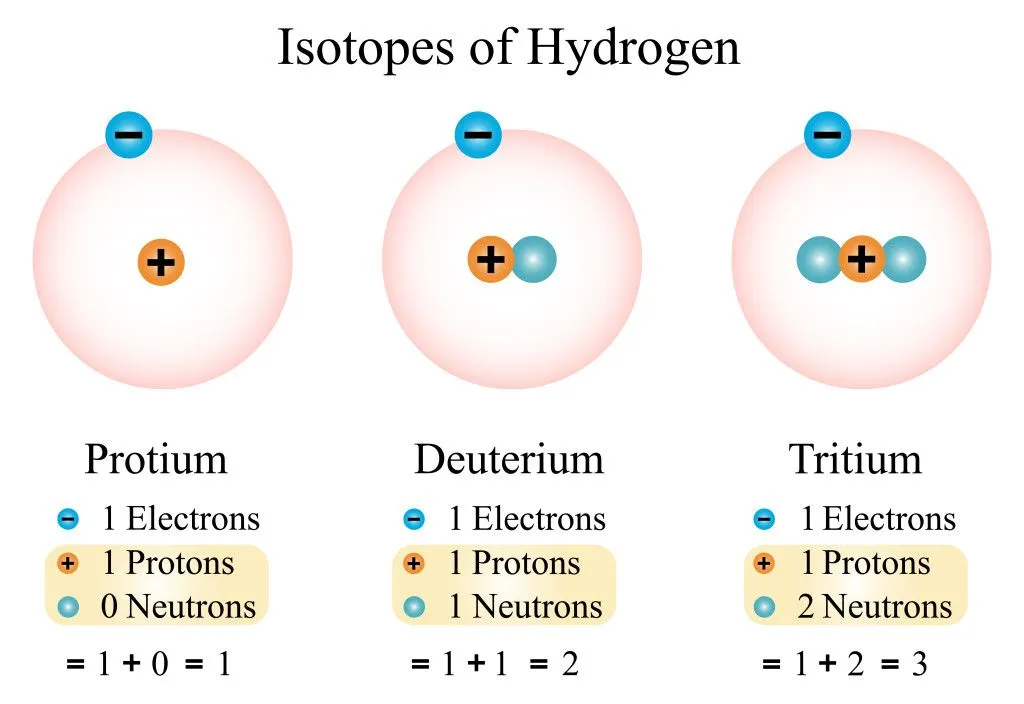
In this image above, we see the isotopes of hydrogen, where although they have the same atomic number (1), their atomic mass number differs (1, 2, 3). Every isotope has unique properties and characteristics that enable a wide range of uses in scientific and industrial fields.
Stable And Unstable Isotopes
Isotopes split neatly into two groups: stable and unstable. The nucleus of a stable isotope stays intact essentially forever, because the balance of protons and neutrons sits in a low-energy "sweet spot" the nuclear forces can comfortably hold together. Carbon-12 (12C) and nitrogen-14 (14N) are everyday examples, and stable isotopes are widely used as tracers in geochemistry, biology, and medicine.
Unstable isotopes (also called radioactive isotopes, or radioisotopes) are the opposite. Their proton-to-neutron ratio sits outside that comfortable zone, so the nucleus carries excess energy it cannot hold onto indefinitely. Sooner or later it sheds that energy through spontaneous radioactive decay, throwing off particles or high-energy photons until a more stable configuration is reached. Common examples include uranium-235 (the fissile isotope used in reactors), carbon-14 (used for radiocarbon dating), cobalt-60 (cancer radiotherapy), iodine-131 (thyroid imaging and treatment), and technetium-99m (the workhorse of nuclear-medicine imaging). Prolonged exposure to the radiation these isotopes emit can damage living tissue, but the very same emissions power nuclear reactors and a long list of medical diagnostic and treatment tools.
What Does Radioactivity Mean?
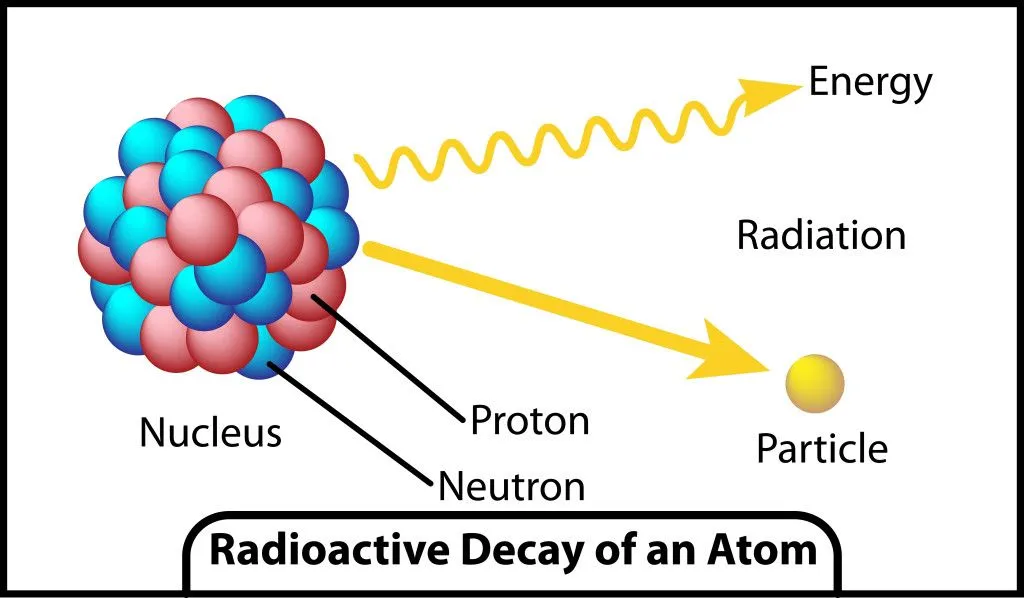
When an unstable nucleus decays, it sheds its excess energy by ejecting fast-moving particles or a burst of electromagnetic energy. Depending on the isotope, that ejection might be an alpha particle (two protons plus two neutrons, essentially a helium-4 nucleus), a beta particle (an electron, or its antimatter twin the positron, created the instant a neutron flips into a proton or vice versa), or a gamma ray (a high-energy photon released as the leftover nucleus settles into a calmer state). This whole process of energy release from the nucleus is what we call radioactivity.
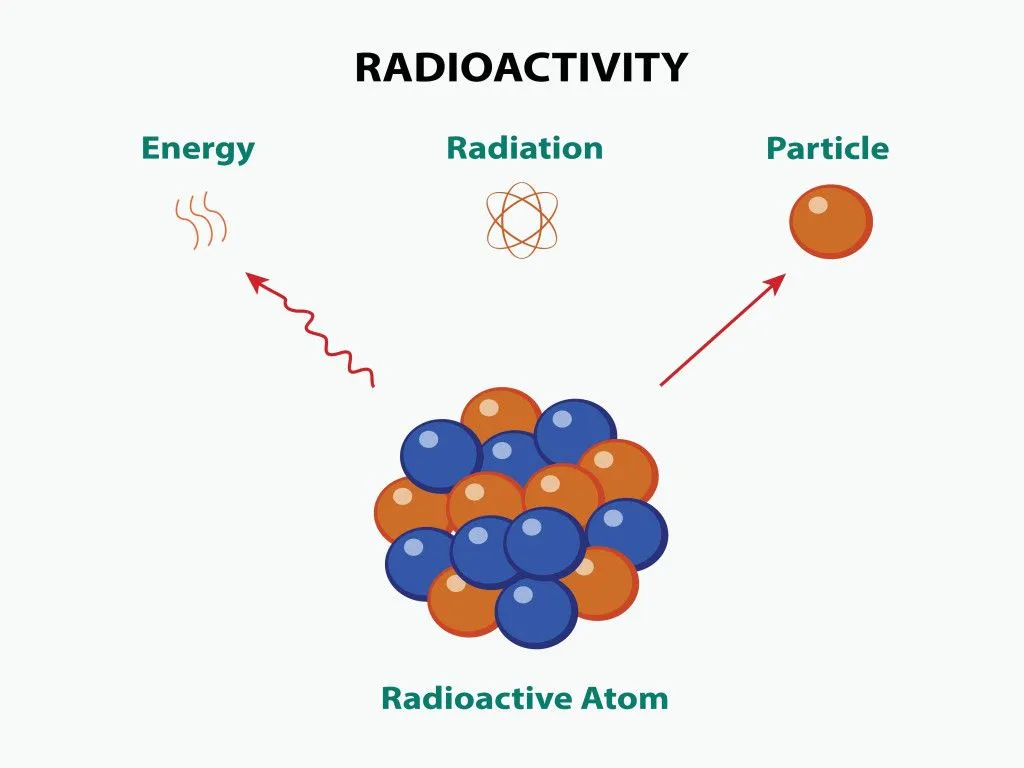
Whatever is emitted, it leaves the nucleus with so much energy that it can knock electrons clean out of any atoms or molecules it runs into along the way. An atom or molecule that has lost an electron is left with a net positive charge, and that's what we mean by an ion. Decays are sorted into three flavors, not by how many particles fly out, but by what flies out: alpha decay (an alpha particle), beta decay (a beta particle, with an antineutrino or neutrino along for the ride), and gamma decay (a gamma-ray photon).
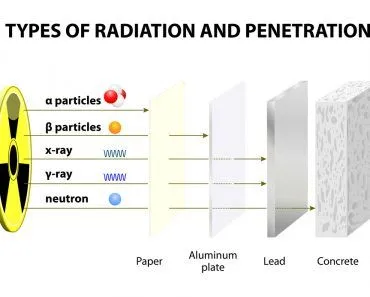
The image above sums up the contrasting properties of alpha, beta, and gamma emissions: alphas are heavy and slow and stopped by a sheet of paper, betas are lighter electrons or positrons stopped by a few millimeters of aluminum, and gamma rays are massless photons that punch through almost everything short of dense lead or thick concrete. What matters for our question is that all three carry far more energy than the ~10 eV needed to ionize atoms, so every kind of radioactive decay produces ionizing radiation.
Why Do Unstable Isotopes Emit Only Ionizing Radiation And Not “Regular” Radiation?
It all comes down to energy. The forces that hold a nucleus together work at energy scales of millions of electronvolts, so when a nucleus rearranges itself, the particle or photon it spits out also carries energies in the keV-to-MeV range. That is hundreds of thousands to millions of times the ~10 eV needed to ionize an atom, so the emission is, by definition, ionizing radiation.
Even the "gentlest" beta emitters bear this out: carbon-14 tops out at about 156 keV per beta and phosphorus-32 at about 1.71 MeV, both still vastly above the ionization threshold. Their radiation is genuinely ionizing; the reason they are considered relatively safe to handle in labs is not that they are non-ionizing, but that the beta particles barely penetrate skin or a sheet of plastic. Both isotopes are widely used in biomedical research and medicine.
This is also why ionizing radiation, in large doses, is biologically dangerous. When it interacts with matter, it kicks electrons out of their orbits, breaks chemical bonds, and damages DNA, which can trigger the cellular changes that lead to cancer.
The flip side of "ionizing" is "non-ionizing" radiation: visible light, infrared, microwaves, and radio waves. Their photons each carry only a few eV or less, so they can warm matter or set molecules vibrating but cannot rip electrons off them. That is why we sit calmly under lamps and use Wi-Fi every day, while X-ray techs stand behind shielding. And it is also why the very same ionizing emissions that need to be respected can, in carefully measured doses, image broken bones, kill tumor cells, and trace biochemistry inside the human body. Radiation is intimidating in the abstract, but harnessed wisely, it is one of the most useful tools in science and medicine.
References (click to expand)
- DOE Explains...Radioactivity. U.S. Department of Energy, Office of Science.
- About Ionizing Radiation. Centers for Disease Control and Prevention.
- Radiation Basics. U.S. Environmental Protection Agency.
- What are Radioisotopes? Australian Nuclear Science and Technology Organisation (ANSTO).
- Marie Curie - Biography, Nobel Prize, Accomplishments, & Facts. Encyclopaedia Britannica.
- Wilhelm Conrad Röntgen - Biographical. The Nobel Prize.
- Mousseau, T. A., & Møller, A. P. (2020). Plants in the Light of Ionizing Radiation: What Have We Learned From Chernobyl, Fukushima, and Other "Hot" Places? Frontiers in Plant Science.
- Morgan, W. F., & Sowa, M. B. (2007). Non-targeted bystander effects induced by ionizing radiation. Mutation Research/Fundamental and Molecular Mechanisms of Mutagenesis.