Table of Contents (click to expand)
- Forces That Hold The Constituent Particles Together
- Why Does Stirring Help To Dissolve Sugar Faster In Water?
- Is Dissolving Sugar In Water A Physical Or Chemical Change?
- Where Does The Sugar Go, And Is It Still There?
- Does Sugar Break Apart Into Ions Like Salt Does?
- How Much Sugar Can Water Actually Dissolve?
When sugar is mixed in water, the intermolecular forces that are holding the sugar together are weaker than the forces of the water molecules. The water molecules surround the individual sugar molecules, pull them free from the crystal, and carry them into the solution. Stirring the mixture helps to dissolve the sugar faster by bringing more particles in contact with the water.
I recently found myself at a child’s birthday party surrounded by a dozen kids having an absolute blast (and admittedly, giving the hosts a hard time). It just so happened that while I was eating my fair share of cookies, I found myself beside a couple of kids who were talking about the sugar that had been added to their juice. They were wondering where it had gone, because it seemed to magically vanish after stirring it.
I wanted to tell them that the sugar disappeared because it dissolved. Obviously, all of us know that when sugar is mixed in water, it quickly disappears after stirring the liquid for a moment or two. The question cannot be completely answered just by saying “because it dissolves”, along with an eye roll and a shrug.
So, let’s get down to the bottom of this. Where on Earth does the sugar go after being dissolved?
Forces That Hold The Constituent Particles Together
The physical state (or phase) of any matter is determined by the forces that hold its constituent particles together, i.e., its intermolecular forces. Take solids, for example. The constituent molecules that make up solids are held together by strong intermolecular forces in a rigid structure (a lattice). This imparts a number of physical properties to solids, including strength, rigidity, incompressibility and others.
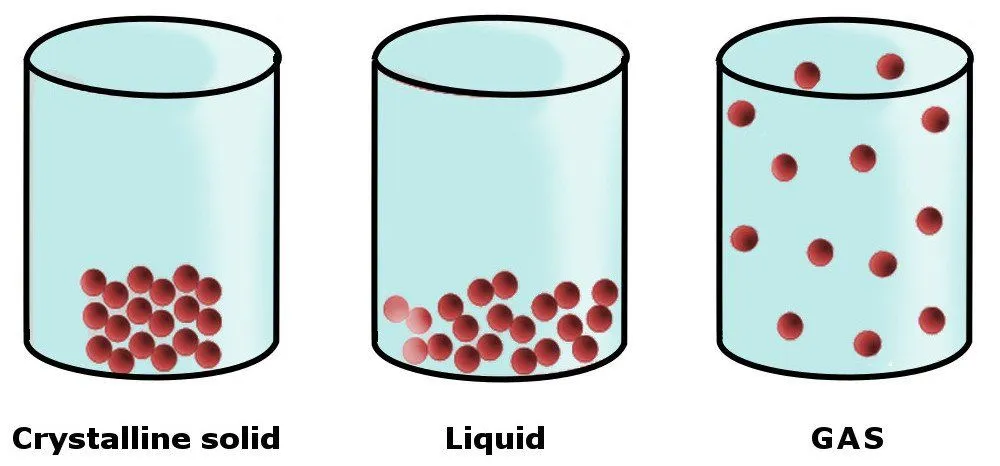
In liquids, the intermolecular forces are weaker than solids, which is why liquids don’t have a definite shape of their own. Instead, they take the shape of the container in which they’re kept.
Being a solid (and thus having a lattice structure), a sugar cube’s shape and appearance are attributed to the strong attractive forces that hold its constituent particles together. However, when the cube comes in contact with water, these forces are meddled with and the cube loses its shape, quickly disintegrating.
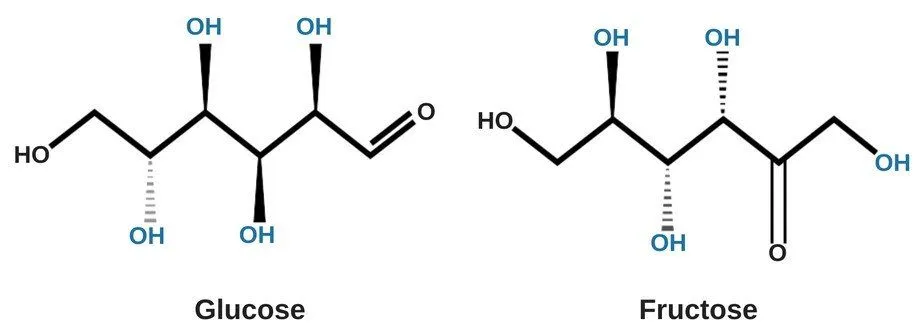
You see, a sugar molecule consists of hydroxyl groups (OH) that readily make hydrogen bonds with the water molecules surrounding them. Now, one thing you should know about hydrogen bonds is that they’re very strong.
In fact, hydrogen bonds are among the strongest intermolecular forces in nature, second only to ion-dipole interactions. When sugar comes in contact with water, multiple water molecules simultaneously form hydrogen bonds with individual sucrose molecules on the crystal surface. Their combined pull overcomes the forces holding the sucrose molecules in the lattice and draws them into the solution. Furthermore, this dissolution is driven by entropy: the increase in disorder when ordered crystal molecules disperse into solution provides the thermodynamic driving force. This process goes on for a while (depending on a few factors, such as the temperature of water, saturation, stirring etc.) until the sugar molecules fully disperse and disappear from view.
Why Does Stirring Help To Dissolve Sugar Faster In Water?
If you simply drop a lump of sugar in a glass filled with water, the dissolution will be notably slower, as water molecules can only come in contact with the particles on the surface. However, when you stir a solution, you essentially bring more particles in contact with the water, making the process of dissolution significantly faster.
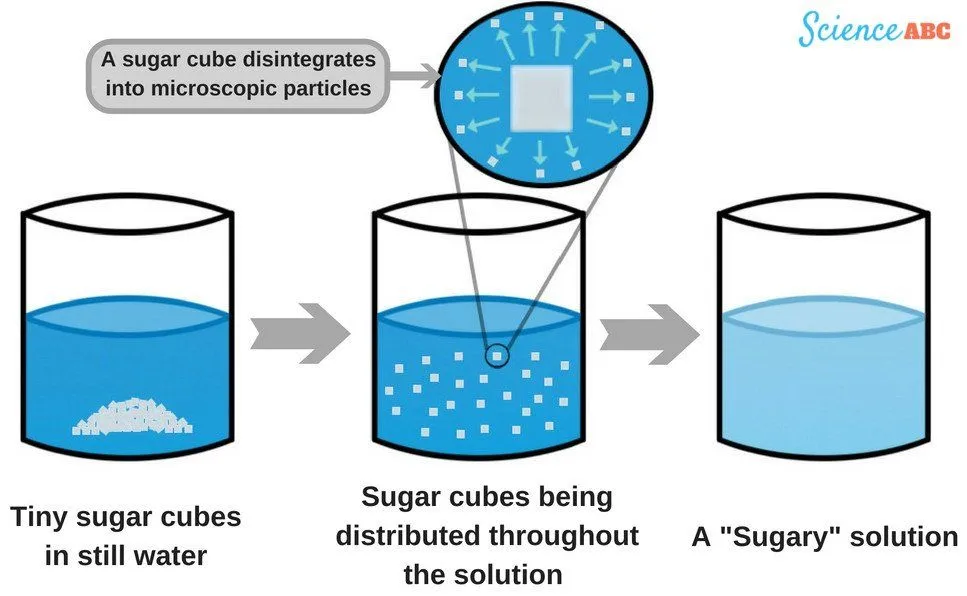
Another question that befuddles many is whether the dissolution of sugar is a physical change or a chemical one. Note that it’s a physical change, because for it to be a chemical change, something new would need to be produced as a result of the dissolution. By the way, this doesn’t happen. All you get after dissolving sugar in water is a ‘sugary’ solution, no more and no less. The identity of the constituents remains unchanged.
Is Dissolving Sugar In Water A Physical Or Chemical Change?
This is probably the single most common follow-up question, and it trips up a lot of students. The short answer is that dissolving sugar in water is a physical change, not a chemical one.
The test for a chemical change is simple: has a brand-new substance been formed, one with different properties from what you started with? When you burn wood or rust an iron nail, the answer is yes. But when sugar dissolves, nothing new is made. The sucrose molecules separate from one another and spread out among the water molecules, yet each sugar molecule stays exactly the same molecule it was on the spoon. As chemists put it, in a physical change no chemical bonds within the sugar are broken or formed, so the same compounds that went in are still there at the end.
The giveaway is that the change is fully reversible. If you boil or simply leave the solution out until the water evaporates, the sugar comes right back as crystals. You could never reverse a fire and un-burn a log that way. Contrast this with dissolving an antacid tablet that fizzes: that bubbling means a true chemical reaction is producing carbon dioxide gas, a genuinely new substance. Sugar in water does no such thing, which is exactly why it counts as a physical change.
Where Does The Sugar Go, And Is It Still There?
Back to those kids at the birthday party. The sugar looks like it has vanished, but it has done nothing of the sort, and a kitchen scale can prove it. Because dissolving is a physical change, the law of conservation of mass applies: matter is neither created nor destroyed. Weigh the glass of water, add a known mass of sugar, stir until it disappears, and weigh again. The total mass is exactly the sum of the two. Every sugar molecule is still in the glass.

So why can you not see it anymore? When the sugar dissolves it forms a homogeneous solution, meaning the molecules disperse so evenly and at such a tiny scale that the mixture looks identical throughout. Individual sugar molecules are far smaller than the wavelength of visible light, so light passes straight through the clear solution without scattering off any visible specks. The sugar is no longer visible, but it is very much still there. You can taste it, you can weigh it, and, as we will see, you can get it back.
Does Sugar Break Apart Into Ions Like Salt Does?
Here is a subtlety that catches many people out. When table salt dissolves, it dissociates: each sodium chloride unit splits into a positively charged sodium ion and a negatively charged chloride ion, because salt is held together by ionic bonds that water can pull apart. Sugar behaves differently. Sucrose is a covalent (molecular) compound, and when it dissolves it simply separates into whole, intact sucrose molecules. It does not ionize or dissociate into charged particles.

The many hydroxyl (–OH) groups dotted around the sucrose molecule are what let it form hydrogen bonds with water and dissolve so readily, but those bonds form between the sugar and the water and are not strong enough to break the sugar molecule apart. That single difference has a neat, testable consequence: a salt solution conducts electricity because its free-roaming ions carry charge, while a sugar solution does not. Sucrose is a classic nonelectrolyte, a compound that dissolves happily yet leaves the liquid essentially non-conducting. If you have ever wondered whether water itself conducts electricity, this is the same principle at work: it is the dissolved ions, not the water, that do the conducting.
How Much Sugar Can Water Actually Dissolve?
Water is remarkably greedy for sugar, but it does have a limit. At about 25 °C (77 °F), roughly 200 grams of sucrose will dissolve in just 100 millilitres of water, which is about twice the mass of the water itself. Keep adding sugar past that point and the extra simply settles at the bottom, undissolved. At that stage the solution is saturated: it is holding all the sugar it can at that temperature.
Temperature is the lever that changes everything. Like most solids, sugar grows far more soluble as the water gets hotter, which is why a hot cup of tea swallows sugar effortlessly while iced tea leaves a stubborn layer of grains at the bottom. Heat the water toward boiling and it can dissolve well over double the room-temperature amount. This is exactly how cooks make simple syrup and candy: dissolve a large load of sugar in hot water, then let it cool into a supersaturated syrup that holds more sugar than it normally could. Stirring, by the way, does not change how much sugar can dissolve. As we saw earlier, it only speeds up the process by bringing fresh water into contact with the crystal surface.
And if you ever want to separate the sugar back out, you do not need any chemistry at all. Just let the water evaporate, and the sugar is left behind as crystals, perfectly intact, the clearest proof yet that it never really disappeared.
Next time you come across a curious kid asking about the sugar cubes that vanish when stirred, this information could come in pretty handy. Most of all, just remember not to wrap up the discussion by simply saying ‘sugar dissolves in water’.
References (click to expand)
- Solubility. Purdue University
- Solubility - ScienceDaily. Science Daily
- Why Does Sugar Dissolve in Water? - www.reference.com
- Changes in Matter: Physical and Chemical Changes. Chemistry LibreTexts
- Electrolytes and Nonelectrolytes. Chemistry LibreTexts
- General Properties of Aqueous Solutions. Chemistry LibreTexts
- Solubility Limit and Saturation. Chemistry LibreTexts
- Sucrose (CID 5988). PubChem, National Library of Medicine