Table of Contents (click to expand)
Money does buy happiness, and for most people it keeps doing so well past the famous $75,000 mark. Kahneman and Deaton found in 2010 that day-to-day mood flattened around $75,000 a year (in the USA), but Killingsworth later showed happiness rising with income with no plateau. A 2023 study reconciled the two: only the unhappiest people stop gaining much above roughly $100,000.
This eternal question is a long-debated topic that remains unanswered. Those who have the means say it cannot and does not buy happiness, but those who aren’t as fortunate can’t help but feel that it will solve all their problems. How do we know who is right and who is wrong?
One place we might get some answers is in the place where economics, psychology, and biology meet – behavioral economics. Behavioral economics is the study of how humans and our psyche interact with money. So, what has the field found out about money and happiness? Let’s find out.
How Much Money Makes Us Happy?
One landmark study published in 2010, carried out by Daniel Kahneman and Angus Deaton, gave us the famous figure of around $75,000 per year (in the USA). To arrive at it, the researchers analyzed more than 450,000 responses from U.S. citizens, who reported both their income and how they felt. Importantly, they split “happiness” into two parts: emotional well-being, meaning your everyday mood, and life evaluation, meaning how you rate your life overall on a scale of 0 to 10.
The often-misquoted finding was this: emotional well-being rose with income but flattened out around $75,000 a year. People earning less than that reported lower mood and more upset in stressful situations, but past that point, a fatter paycheck didn’t seem to brighten the average day. Life evaluation, on the other hand, kept climbing with income with no ceiling at all. So the $75,000 plateau only ever applied to your day-to-day feelings, not to how satisfied you felt with your life as a whole.
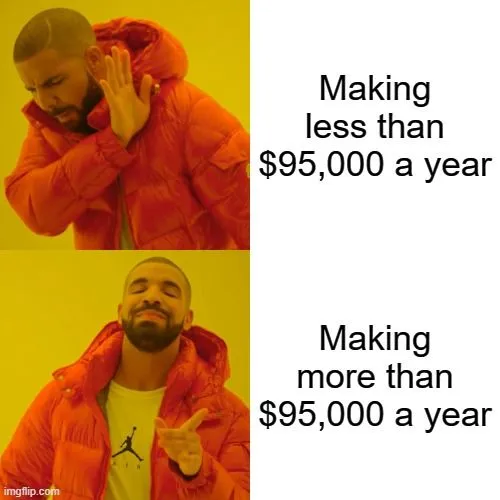
A study published in Nature Human Behaviour in 2018 used Gallup World Poll data to put rough numbers on both. Globally, it pegged emotional well-being satiation at $60,000–$75,000 and life evaluation satiation closer to $95,000, while noting the thresholds run higher in wealthier regions like North America.
Then things got interesting. In 2021, Matthew Killingsworth at the University of Pennsylvania ran a much larger real-time study, collecting over a million mood reports through a smartphone app. His paper, pointedly titled “Experienced well-being rises with income, even above $75,000 per year,” found no plateau at all: happiness kept climbing steadily as income grew. The famous ceiling, it seemed, might have been an artifact of how the earlier data was measured.
So who was right? In a refreshing twist, Kahneman and Killingsworth teamed up to settle it, working with a third referee, Barbara Mellers, in what researchers call an “adversarial collaboration.” Their 2023 paper found that both were partly right. For most people, happiness does keep rising with income. The old plateau holds only for the unhappiest roughly 20% of people, whose mood stops improving once they earn around $100,000. For everyone else, more money keeps nudging happiness upward, and for the happiest group it even accelerates above that point. As Killingsworth put it, if you’re rich and miserable, more money won’t help; but for most of us, it still does.
Need Theory
There was a theory proposed in the 1940s that agrees with the findings of Daniel Kahneman known as need theory. It states that an increase in money has the strongest effect when it allows people to fulfill basic needs. These include having enough food, clothing, sanitation and shelter. Once these needs are met the additional money doesn’t affect happiness levels that much. Although that could also be because higher-order needs aren’t materialistic and are geared more towards feelings of belonging, love, esteem and developing a self-identity.
More Money Doesn’t Always Mean More Happiness
Even where more money does buy more happiness, it tends to do so with diminishing returns. Each extra dollar buys a little less joy than the dollar before it, because what counts is roughly the percentage change in income, not the raw amount.
Let’s take two people, A and B. If A makes $50,000 a year and B makes $250,000 a year, and they both get a bonus of $5,000, person A will likely appreciate it more. That $5,000 is a 10% raise for A but only a 2% bump for B, who already covers the necessities and comforts that matter most for their emotional well-being. The bonus simply moves the needle further for the person who has less.
Adaptation Theory
However, there is one theory proposed that talks about why happiness levels don’t increase after a certain point, rather they decrease slightly. This is termed the adaptation theory, which says a rise in income will temporarily increase people’s happiness, but over time they will get used to living on a higher income, and raise their sights higher. Adapting to a new high, and chasing the next big thing can lead to dissatisfaction. As such, their happiness levels go back to what it used to be.

Material Vs Experiential Purchases
On the contrary, one study suggested that spending on experiences rather than on material possessions is more likely to increase psychological satisfaction, partly because experiences invite less social comparison. Another study concluded that people with more financial security were happier and their higher-order needs were met more easily as a result.
This doesn’t necessarily mean that if someone earns less income, they are sure to be unhappy. It’s just that there are greater chances of people going through more emotional pain and stress if they don’t earn a substantial income.
Social Comparison Theory
Another theory that comes into account is the social comparison theory. This theory suggests that people compare their income and achievements with their peers. So if a person’s friend is earning a higher income, that person may feel more low or upset about their situation, leading to a decrease in life satisfaction.
Differences In Culture
Studies show that culture influences happiness levels too. Different cultures have different values. In cultures that value money, a higher level of income will make individuals happier.
A study reported that for Europeans, the threshold value is 27,913 Euros (around $35,000). That’s quite a difference from the American estimates. It’s because a person’s culture, personality, upbringing and life experiences influence their overall happiness levels. However, it’s hard to put an exact number on the impact of culture on a person’s happiness because people’s dispositions vary.
Similar research was further carried out in other cities too such as Turkey, where they found that Turkish citizens also reported an increase in happiness levels if they earned more money. Interestingly though, they reported that women cared less about material statuses or income levels compared to men.
Focusing Illusion
Studying money’s relationship to happiness has many grey areas. One of them is the focusing illusion. By asking participants to rate their happiness along with their income, they are making participants overestimate the degree of happiness money can buy.
A Final Word
Now, to answer the main question: yes, money does buy happiness, and the latest research suggests it keeps doing so for most of us far longer than the old $75,000 headline implied. The catch is that the returns shrink as you climb, and if you’re already deeply unhappy, a bigger paycheck does little to lift your mood. For everyone else, more money still helps, though perhaps not as much as we imagine. Maybe it’s not just how much you make, but how you spend it.
Money matters for living a comfortable life, covering the necessities and comforts, and buying a measure of security. Beyond that, the slope flattens for some and keeps rising for others, but it never quite delivers the all-or-nothing fix we hope for. As the saying often attributed to Mahatma Gandhi goes, “The world has enough for everyone’s needs, but not for everyone’s greed.”
References (click to expand)
- Kahneman, D., & Deaton, A. (2010, September 7). High income improves evaluation of life but not emotional well-being. Proceedings of the National Academy of Sciences. Proceedings of the National Academy of Sciences.
- Diener, E., Oishi, S., & Lucas, R. E. (2003, February). Personality, Culture, and Subjective Well-Being: Emotional and Cognitive Evaluations of Life. Annual Review of Psychology. Annual Reviews.
- Howell, R. T., & Howell, C. J. (2008). The relation of economic status to subjective well-being in developing countries: A meta-analysis. Psychological Bulletin. American Psychological Association (APA).
- Diener, E., & Biswas-Diener, R. (2002). []. Social Indicators Research. Springer Science and Business Media LLC.
- Headey, B., Muffels, R., & Wooden, M. (2007, July 12). Money Does not Buy Happiness: Or Does It? A Reassessment Based on the Combined Effects of Wealth, Income and Consumption. Social Indicators Research. Springer Science and Business Media LLC.
- (2007) An Explanation for the Easterlin Paradox and Other Puzzles. The IZA - Institute of Labor Economics
- Deaton, A. (2008, March 1). Income, Health, and Well-Being around the World: Evidence from the Gallup World Poll. Journal of Economic Perspectives. American Economic Association.
- Ye, D., Ng, Y.-K., & Lian, Y. (2014, September 6). Culture and Happiness. Social Indicators Research. Springer Science and Business Media LLC.
- Natali, L., Handa, S., Peterman, A., Seidenfeld, D., & Tembo, G. (2018, April). Does money buy happiness? Evidence from an unconditional cash transfer in Zambia. SSM - Population Health. Elsevier BV.
- Muresan, G. M., Ciumas, C., & Achim, M. V. (2019, February 19). Can Money Buy Happiness? Evidence for European Countries. Applied Research in Quality of Life. Springer Science and Business Media LLC.
- Proto, E., & Rustichini, A. (2013, November 27). A Reassessment of the Relationship between GDP and Life Satisfaction. (M. Sigman, Ed.), PLoS ONE. Public Library of Science (PLoS).
- Jebb, A. T., Tay, L., Diener, E., & Oishi, S. (2018). Happiness, income satiation and turning points around the world. Nature Human Behaviour. Springer Science and Business Media LLC.
- Howell, R. T., & Hill, G. (2009). The mediators of experiential purchases: Determining the impact of psychological needs satisfaction and social comparison. The Journal of Positive Psychology. Taylor & Francis.
- Killingsworth, M. A. (2021). Experienced well-being rises with income, even above $75,000 per year. Proceedings of the National Academy of Sciences.
- Killingsworth, M. A., Kahneman, D., & Mellers, B. (2023). Income and emotional well-being: A conflict resolved. Proceedings of the National Academy of Sciences.