Fearful avoidant attachment (also called disorganized attachment) is one of the four adult attachment styles. People with this style crave close relationships yet fear them, holding a negative view of both themselves and others. It usually traces back to childhood trauma and is linked to anxiety, depression, and conditions like borderline personality disorder.
Forming relationships and connecting with others is a critically important part of life. Whether you are the type of person who meets dozens of new people every day, holds tight to a close circle of dear friends, leaps from one relationship to another, or constantly feels left out in the cold, it is likely tied to your attachment style.
What Is An Attachment Style?
Just as there are various attachment styles (e.g., to parents, siblings, peers) that children move through on their developmental path, there are also attachment styles that are commonly seen in adults. Over the course of our adult lives, it is not uncommon to embody more than one or even all of these attachment styles. These styles describe how we view relationships, what their place is in our individual lives, and the confidence, commitment and concern that we have for interpersonal connections.
Although there are countless shades of overlapping gray between all of these attachment styles, the four main styles are Secure, Anxious-Preoccupied, Dismissive-Avoidant, and Fearful-Avoidant. This four-category map of adult attachment was laid out by psychologists Kim Bartholomew and Leonard Horowitz back in 1991. The fearful-avoidant style is the one you may also see called disorganized attachment, especially when psychologists are talking about how it first takes shape in childhood.
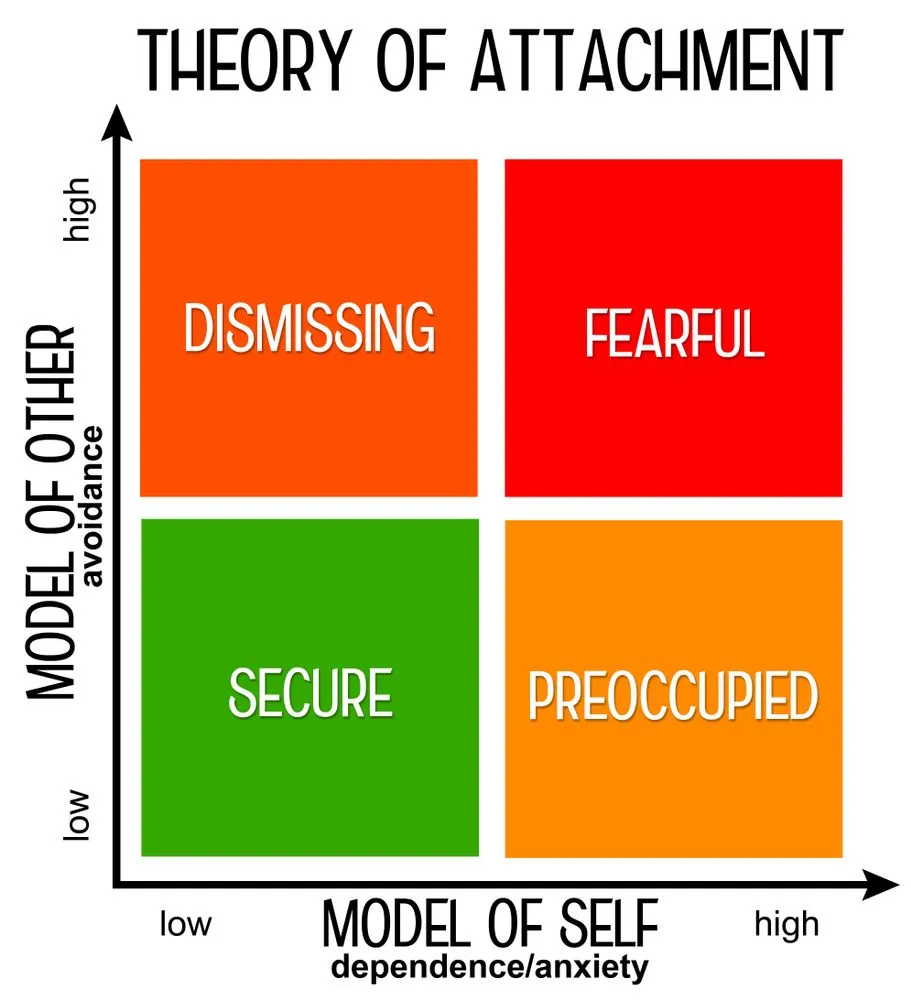
Each of these attachment styles deserves its own devoted article, as they are each complex and revelatory about an individual’s psychology, but the final style (fearful avoidant) is perhaps the most challenging to manage, both for a person identifying with this attachment style, as well as for their friends, acquaintances and romantic partners.

What Is Fearful Avoidant Attachment?
This particular form of adult attachment can primarily be described as insecure. While these individuals seek out love and need the validation of others, they also consider themselves unworthy of love, or undeserving of a partner. This can manifest in low self-esteem and fear of getting too close, as that only increases the risk of being betrayed and hurt. This contradictory attachment style has elements of two other styles: anxious-preoccupied and dismissive-avoidant.
People who exhibit fearful-avoidant attachment often struggle to appear “normal” in relationships, as they are often struggling with competing feelings, with love and need fighting against fear and mistrust. This attachment style will often develop in children who have experienced emotional or physical trauma as a young child. When we are children, our brains are still very malleable, as is our personality. Exposure to trauma or emotional starvation as a child can manifest in the form of certain triggers as adults. A heightened awareness of threat cues and difficulties with emotional intimacy are common signs of childhood difficulties, and these are often seen in people displaying this attachment style. The way we are treated as children sets the tone for what we expect, and fear, in relationships as adults.

Unfortunately for many who fall within this attachment category, maintaining healthy and long-term relationships can be difficult. With the two contradictory sides in frequent conflict, it can be difficult to achieve closeness, as the other partner may perceive the fearful avoidant individual as secretive, noncommittal or disinterested. However, most experts believe that it is possible to alter one’s behavior and attachment style, both through intense self-work and the natural crucible of experience in life. One might say that the fearful avoidant attachment style is merely a temporary state of being, albeit a painful and challenging one that requires self-assessment and hard work to change.
Common Signs And Symptoms Of Fearful Avoidant Attachment
If you are uncertain where you fall in terms of attachment style, but fear that you may be fearful avoidant, these are some of the most common signs and behaviors that define this particular style.
- People will go out of their way to avoid conflict, even if they know that they are correct. This is linked to a fear of angering their partners or friends and increasing the risk of being abandoned.
- Somewhat submissive personality style, with small or carefully guarded behaviors. Accompanied by carefully chosen words and insecurity about the value of their contributions.
- May self-sabotage the relationship with tests, probing to see whether a potential partner can be trusted in difficult situations; this may be perceived negatively by those same possible partners.
- Dependency on the relationship or partner for validation, due to their own low self-esteem or fear of inadequacy in the relationship.
- Pushing back when a partner shows too much affection, or wants to take a relationship to a new level.
- Distrusting or suspicious behavior, as though they are expecting to be betrayed or deceived.
- Heightened reactivity to threat situations and rapid mood swings. This attachment style has been linked to Borderline Personality Disorder in some cases, as well as PTSD (Post-Traumatic Stress Disorder).
- Difficulty in ending relationships or friendships, even to their personal detriment.
- These individuals often pour much of themselves into the relationship, creating a disparity in the level of investment and love, which can lead to additional conflict.
- Highly sensitive to moments of perceived abandonment or changes in the energy of a relationship/connection.
What Causes Fearful Avoidant Attachment?
If the styles around it (anxious-preoccupied, dismissive-avoidant) tend to grow out of one consistent type of parenting, the fearful avoidant style usually comes from something messier: a caregiver who was both the source of comfort and the source of fear. Picture a child running to a parent for safety, only to find that the same parent is sometimes warm and sometimes frightening, neglectful, or unpredictable. The child is left with an impossible problem, because the person they are wired to seek out for protection is also the person they have learned to brace against.
This is why researchers often label the childhood version of this pattern disorganized attachment. There is no single strategy that works, so the child develops a contradictory one: approach and retreat at the same time. Childhood trauma, abuse (emotional or physical), neglect, or growing up around a caregiver who was themselves overwhelmed or struggling with their own mental health can all set the stage. Because a young brain is still being wired, these early experiences become a kind of template for what closeness is supposed to feel like, and that template tends to follow us into adulthood.
The same roots help explain what triggers a fearful avoidant adult. Moments that signal possible rejection or engulfment, a partner pulling away, a partner getting too close, an unanswered text, a raised voice, can all flip the same old alarm. The closeness they crave is precisely the thing that activates the fear, which is what makes the push-and-pull so exhausting for everyone involved.
Can You Heal A Fearful Avoidant Attachment Style?
Here is the genuinely hopeful part: yes, attachment styles can change. They are learned patterns, not a fixed life sentence, and what was learned can, with effort, be relearned. The goal is not to magically erase the fear, but to slowly build what psychologists call "earned security", a more grounded, trusting way of relating that you develop through experience rather than being handed in childhood.
Therapy tends to be the most reliable route, simply because it offers a safe, steady relationship in which to practice. Approaches like cognitive behavioral therapy (CBT), psychodynamic therapy, and trauma-focused work can help you notice the old triggers, question the automatic story that closeness equals danger, and learn to regulate the big emotional swings rather than be swept away by them. This matters all the more because the fearful avoidant pattern overlaps with conditions like borderline personality disorder and PTSD, where good professional support makes a real difference.
Plenty of progress also happens outside the therapy room. Being in a steady relationship with a more securely attached partner can act as a living counterexample, gently teaching your nervous system that closeness does not have to end in betrayal. So can practicing honest communication, setting boundaries you can actually hold, and getting better at spotting your own triggers before they hijack the moment. None of it is a quick fix, but the direction of travel is firmly on your side.
A Final Word
As mentioned, your adult attachment style is not a permanent designation, and there are countless ways to change your approach and expectations when it comes to relationships. That being said, the way that our brains are formed in our earliest years is very powerful, so don’t be discouraged if you can’t simply change yourself overnight. It is not as easy as flipping a light switch.
 Being in a loving and supportive relationship with someone who falls under a different attachment style can function as a guide and template for other ways of thinking about and dealing with relationships. Remember, healthy change is almost always a gradual process, one that won’t always be easy, but will often be worth it.
References (click to expand)
- Fearful Avoidant Attachment Style: Signs & How To Cope. Simply Psychology.
- Fearful Avoidant Attachment: Definition, Causes, and Signs. PsychCentral.
- Early experience, structural dissociation, and emotional dysregulation in borderline personality disorder: the role of insecure and disorganized attachment. NCBI/PMC.
- Levy, K. N., Blatt, S. J., & Shaver, P. R. (1998, February). Attachment styles and parental representations. Journal of Personality and Social Psychology. American Psychological Association (APA).
- Kafetsios, K. (2004, July). Attachment and emotional intelligence abilities across the life course. Personality and Individual Differences. Elsevier BV.
- Bartholomew, K. (1990, May). Avoidance of Intimacy: An Attachment Perspective. Journal of Social and Personal Relationships. SAGE Publications.
- Zuroff, D. C., & Fitzpatrick, D. K. (1995, February). Depressive personality styles: Implications for adult attachment. Personality and Individual Differences. Elsevier BV.
- Cozzarelli, C., Karafa, J. A., Collins, N. L., & Tagler, M. J. (2003, July). Stability and change in adult attachment styles: associations with personal vulnerabilities, life events. and global construals of self and others. Journal of Social and Clinical Psychology. Guilford Publications.