Table of Contents (click to expand)
Being obsessed with selfies does not make you a narcissist. Research links posting lots of selfies to higher everyday (trait) narcissism, but the connection is modest and correlational. True Narcissistic Personality Disorder is a rare clinical condition, marked by a grandiose sense of self-importance, a need for admiration, and a lack of empathy, that affects roughly 1 in 100 people.
The word “narcissism” has trickled down into our everyday vocabulary, and we hear the word all the time, but what does it really mean? Let’s dive into the psychological definition of the word and discover what it means to us in the present information-fueled generation.
Definition
Psychologists have studied narcissism extensively, so if you think it’s just a personality type that you hear about in advice columns, then you would be wrong. It’s a real trait that consists of specific tendencies that have been carefully studied and measured by psychologists. Also, it is important to remember that healthy self-esteem is completely different from unhealthy self-absorption.
Narcissism is generally understood as a state of mind that leads an individual to think that their existence is more valuable than that of other people. Crucially, it sits on a spectrum: most of us carry a little, and everyday narcissism is a personality trait, not a diagnosis. Psychologists even have a questionnaire for the trait version, the Narcissistic Personality Inventory (NPI), which measures “normal” narcissism and is not used to diagnose any disorder. Narcissism itself manifests in two ways – grandiose narcissism and vulnerable narcissism.
Types Of Narcissism
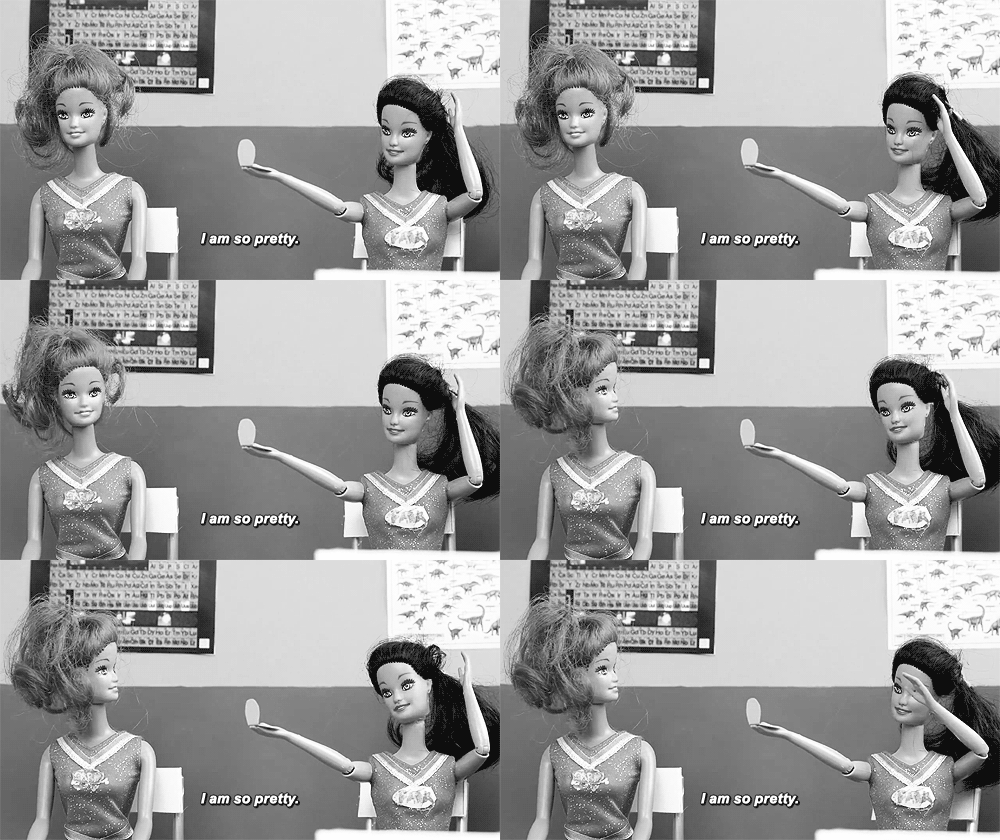
Grandiose Narcissism has all the classic features that we associate with narcissism. These include extroversion, a desperate need to be the center of attention, and a tendency to dominate every relationship. A person suffering from grandiose narcissism is more likely to pursue avenues of power, such as being a celebrity or a politician. I’m not insinuating that all people who pursue these occupations are narcissistic. Most of them pursue these careers for positive reasons, such as achieving their full potential or helping the community. However, narcissists seek out these platforms simply to increase their own status and find validation through the approval of strangers.

Vulnerable Narcissism, on the other hand, is very different. Vulnerable narcissists are quiet and reserved, but have a very strong sense of entitlement. They feel easily slighted if someone challenges their perspective. Vulnerable narcissists have trouble holding on to any healthy relationship because they expect too much from their significant others.
Either way, narcissism has a negative impact on a person’s life. Grandiose narcissists tend to make riskier and more dangerous decisions, as they lack compassion for others. People with vulnerable narcissism usually become unfaithful in a relationship, as they feel that they deserve better.
Narcissistic Personality Disorder
Just to be clear, common everyday narcissism is different from Narcissistic Personality Disorder. The latter proves detrimental not only to the people who have it, but also everyone around them. In other words, the next time a selfie-obsessed friend of yours praises his own photograph, please don’t label him with the scary psychological word ‘Disorder’. As a matter of fact, NPD is fairly rare. Estimates vary, but US community surveys put it anywhere from 0% to about 6% of the population, and one large national survey found a lifetime rate of 6.2% (7.7% for men and 4.8% for women). So it does tend to affect men more than women.

The fifth edition of the American Psychiatric Association’s Diagnostic and Statistical Manual (DSM-5) lists nine traits of narcissistic personality disorder, and a person has to show at least five of them, persistently and across situations, before clinicians will even consider the diagnosis. Several of those traits are:
- Narcissistic personality disorder is characterized by a highly elevated sense of self. A narcissist has a strong belief in the idea that he is far more important than anyone else. He considers himself to be the smartest and most attractive individual in most situations.
- He lacks empathy for other people, as he does not recognize them as worthy of his time. He considers everyone beneath him and only seeks other high-status individuals.
- He is occupied with fantasies of unlimited power, beauty or ideal love.
- He requires excessive admiration from everyone around him.
- His sense of entitlement is intense. He automatically assumes that every one of his expectations will be fulfilled.
- He is often envious of others. He also believes that other people are equally as envious of him as he is of them.
Causes
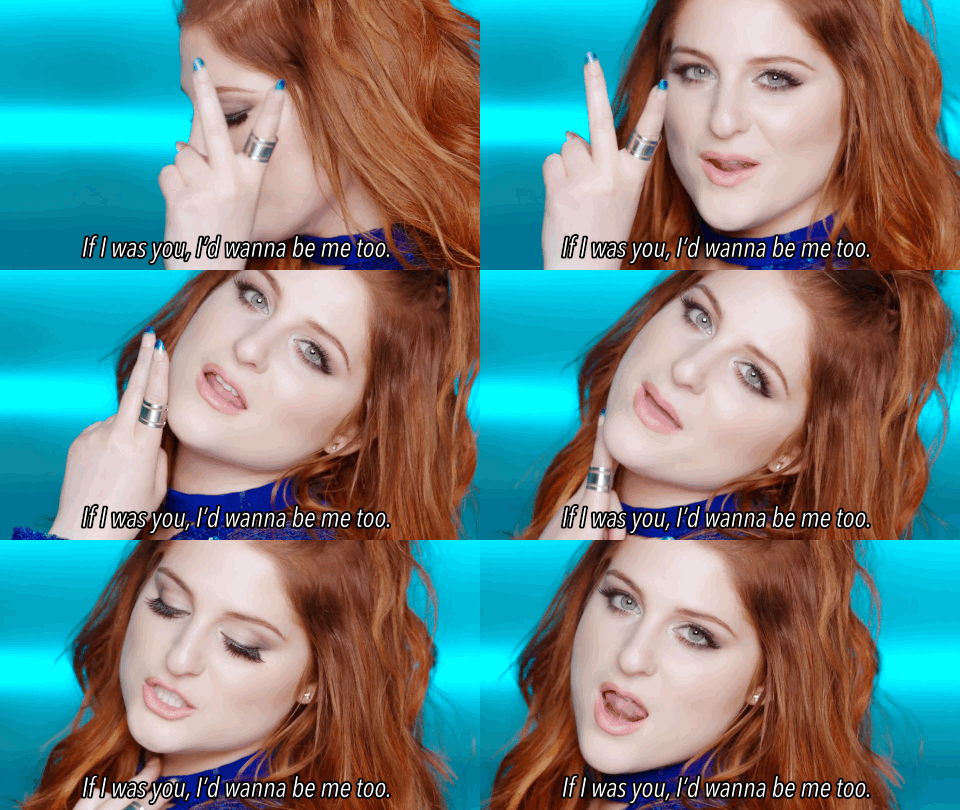
Through studies of twins, certain genetic links have been established that explain the occurrence of narcissistic personality disorder. However, no genes have been isolated as a specific cause.
Genes may be the realm of “nature”, but “nurture” also seems to play an important part in causing this disorder. If parents put their child on a pedestal all of her life, she is more likely to develop grandiose narcissistic traits. Similarly, cold and unemotional treatment of a child can lead to vulnerable narcissism.
Culture creates as much of an impact as the family environment does. A culture that encourages individuality over group dynamics is more likely to have narcissistic individuals. For example, in America, the number of people suffering from narcissistic personality disorder has significantly increased since the 1970s. However, the America of the 1960s – the one that celebrated communal living – was far less burdened by narcissism.
Many psychological studies have tried to explore the link between the rise of social media and the rise of narcissism, and yes, there is a connection, but a modest one. A large 2018 review that pooled 62 studies (more than 13,000 people) found that grandiose narcissism is reliably, if only weakly, related to spending more time on social media, racking up more friends and followers, and posting more selfies. Vulnerable narcissism showed no such link. And remember, these are correlations: it has never been shown that social media creates narcissism in the first place. It would be more appropriate to say that social media platforms simply offer narcissists a stage on which to perform, something they had previously lacked.

Narcissism is like a disease that permeates a person’s life, and spreads outward, making other people suffer even more than the bearer of the disease. Fortunately, it can be treated through careful psychotherapy, but this tends to be difficult, considering narcissists’ predisposed hatred for self-criticism. Even so, that shouldn’t stop narcissists from trying to become a bit more compassionate and self-aware!
References (click to expand)
- Narcissistic Personality Disorder. StatPearls. NCBI Bookshelf.
- Narcissistic Personality Disorder (NPD). Merck Manual Professional Edition.
- Narcissus, Greek Mythology. Encyclopaedia Britannica.
- McCain, J. L., & Campbell, W. K. (2018). Narcissism and Social Media Use: A Meta-Analytic Review. Psychology of Popular Media.
- Narcissistic Personality Inventory. Wikipedia.