Table of Contents (click to expand)
Billionaires pay little tax because the law taxes income, not wealth. Most of their fortune sits in unsold stock that is never taxed until it is sold, and the gains they do realize are taxed at the low long-term capital gains rate (top 20%) rather than the 37% top rate on wages. Many also borrow against their shares to spend tax-free.
According to the Forbes Billionaires List, the United States is home to more billionaires than any other country, followed by China. So when people ask why the richest Americans seem to skip the tax bill that the rest of us cannot, they are asking a fair question. In 2021, the investigative outlet ProPublica obtained a trove of IRS data and found that the 25 wealthiest Americans paid a "true tax rate" of just 3.4% on their roughly $401 billion increase in wealth between 2014 and 2018. The trick is not illegal accounting; it is the way the tax code itself is written.
The cumulative net worth of a billionaire comprises several components. The salary they draw is just one of them. It also includes their investments in real estate, the company shares they hold, and many other forms.

Is A Wealth Tax The Way Out?
The crucial distinction to understand here is that there is a difference between net worth and income. A billionaire’s income might be as low as $1 per year, but that doesn’t define their net worth.
Taxes are paid on income, not wealth, but several countries have tried policy measures to tax wealth directly. A handful in Europe (Norway, Spain and Switzerland) still levy an annual net wealth tax once an individual's assets cross a set threshold, often at progressive rates tied to predefined wealth brackets. The United States has debated a federal wealth tax (Senator Elizabeth Warren's 2020 proposal being the best-known example) but has never enacted one, and the United Kingdom, Australia and Canada have no broad wealth tax either.
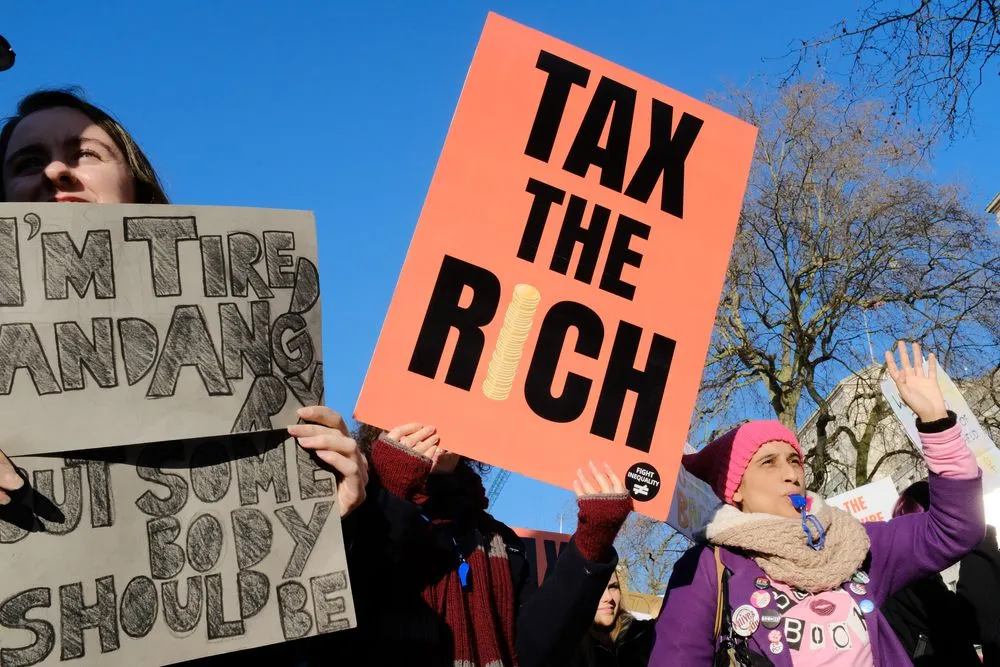
The main reason wealth taxes have not caught on more widely is that they are difficult to administer. Valuing illiquid assets, such as private companies, art and real estate, every single year is expensive and easy to dispute, and several countries that once levied a wealth tax (Germany, France, Sweden and India among them) have since dropped it. India, for example, scrapped its wealth tax in 2015 after the cost of calculating it ended up exceeding the revenue it brought in. There is also a fear that taxing wealth directly would reduce investors’ ability to reinvest, since idle money loses value and the wealthy are expected to put their capital to work.
The growth of factories, start-ups and even funding for research and development, for instance, could be affected if a wealth tax were imposed, potentially hampering overall productivity in the economy.
Some policymakers argue that idle wealth ultimately transforms into investments that boost productivity, and that the benefits would eventually trickle down to other sections of society. A good deal of empirical evidence, however, shows that these trickle-down effects often do not materialize. The outcome depends on several factors, such as the investment climate and the strength of demand in the economy.
How Is Taxable Income Calculated?
Income tax is a direct tax levied by governments. It is called direct as the deduction is levied on an individual’s personal income.
Indirect tax, on the other hand, is imposed on the consumption of goods and services.
Income is what one receives when one provides services. Salary, and wage rate, are some terms that we use in our daily lives when we refer to our incomes. There are other sources of income too. For instance, when someone sells the shares they own of a company, they could earn a profit or incur a loss based on the difference between the selling price and the buying price. This profit, known as a capital gain, is also considered a form of income. Here is where the system quietly favors investors: in the United States, profit on an asset held for more than a year is a long-term capital gain, taxed at a top rate of 20%, far below the 37% top rate that applies to wages and salaries. Hold the asset for less than a year and the gain is taxed as ordinary income instead. Because billionaires earn most of their money through long-held investments rather than a paycheck, they are taxed at the lower rate.
Therefore, the income of any individual takes various forms, such as wages received, profits earned, interest earned, and rents received. The exact rules for calculating income tax differ from one country to the next, but in every case taxation of income is a key source of revenue that governments use to finance public spending.
Taxpayers everywhere look for legal ways to lower their tax bill! Governments actively encourage some of this by offering breaks for certain investments, such as retirement accounts, municipal bonds, mutual funds and other financial instruments.
Through this type of encouragement via tax rebates, governments try to reduce transfer payments through subsidies, pensions and allowances, so that citizens are less dependent on them for healthcare, education, old age costs, and so on.
Are Billionaires An Exception To Paying Taxes?
Keeping aside the various creative tax-saving methods adopted by billionaires, let’s attempt to understand their position structurally.
Very few billionaires earn their wealth by drawing a salary alone. Their salary is not even a significant contributor to their net wealth itself! As mentioned above, most of their wealth is invested in various assets.

This begs the question of how they can spend to maintain their lifestyle. Well, they borrow! Since their net worth is so high, banks are happy to lend to them, using their shares as collateral, because that net worth is a proxy for their creditworthiness. Crucially, a loan is not income, so the cash they borrow is not taxed. This lets them fund their spending without ever selling assets and triggering a tax bill. Tax experts have a name for the playbook: “buy, borrow, die.” The wealthy buy assets that appreciate, borrow against them to spend, and because their holdings are so large, they can usually secure favorable loan terms (though rising interest rates have made this borrowing more expensive than it once was).
This does not mean billionaires pay no taxes at all. When they do realize income, they tend to pay something, but often at strikingly low effective rates. That is partly because much of their income comes from long-term investments and stock sales taxed at the lower capital gains rate. Some also benefit from specific provisions like the carried interest rule, which lets private equity and hedge fund managers treat a large share of their pay as capital gains rather than ordinary income.
A significant portion of their wealth is also stored in the shares they own of the companies they run. Unless those shares are sold, the gain in their value is not recognized by law as income, yet it steadily adds to their wealth and power. And here is the final piece of the puzzle: under the U.S. step-up in basis rule, when an owner dies, the cost basis of their assets resets to the market value on the date of death. Any capital gain that built up during their lifetime can therefore pass to heirs untaxed, completing the “die” step in “buy, borrow, die.”
References (click to expand)
- Adam, S., & Miller, H. (2021, September). The economic arguments for and against a wealth tax. Fiscal Studies. Wiley.
- A Wealth Tax Is Not A Solution For Income Inequality - www.forbes.com
- Thoresen, T. O., Ring, M. A. K., Nygård, O. E., & Epland, J. (2022, October 22). A Wealth Tax at Work. CESifo Economic Studies. Oxford University Press (OUP).
- Ten Ways Billionaires Avoid Taxes on an Epic Scale. ProPublica
- The Secret IRS Files: Trove of Never-Before-Seen Records Reveal How the Wealthiest Avoid Income Tax. ProPublica.
- Topic No. 409, Capital Gains and Losses. Internal Revenue Service (IRS).
- Publication 551, Basis of Assets. Internal Revenue Service (IRS).
- "Buy-Borrow-Die": Options for Reforming the Tax Treatment of Borrowing Against Appreciated Assets. The Budget Lab at Yale.
- What is carried interest, and how is it taxed? Tax Policy Center.