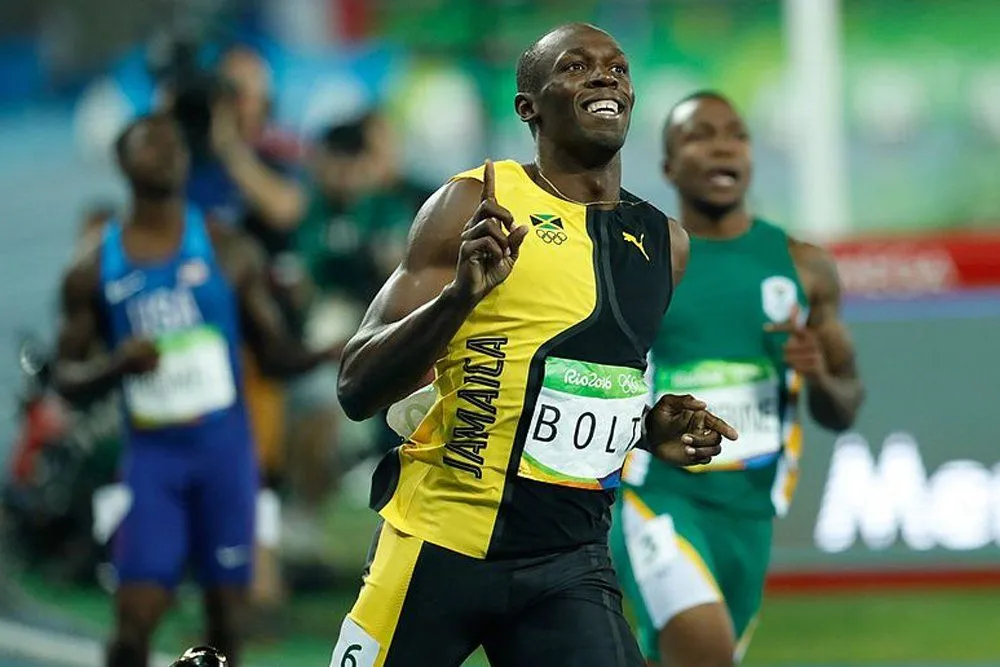
No human can outrun a cheetah. A cheetah sprints at around 100 to 110 km/h (about 60 to 70 mph), while the fastest human ever, Usain Bolt, peaked at just 44.7 km/h (27.8 mph). Cheetahs are packed with fast twitch muscle fibers built for explosive bursts, whereas humans carry more slow twitch fibers tuned for endurance, not raw speed.
It is common knowledge that the cheetah is the fastest land animal on Earth. Sprinting at speeds of roughly 100 to 110 km/h (60 to 70 mph), these magnificent creatures can outrun Usain Bolt any day. In 2009, Bolt set a new world record in the 100 meters, and during that run he hit the highest speed ever measured for a human: an astonishing 44.7 km/h (27.8 mph). While those numbers may sound big, they are pretty modest compared to those of a cheetah.
How Do Cheetahs Run So Fast?
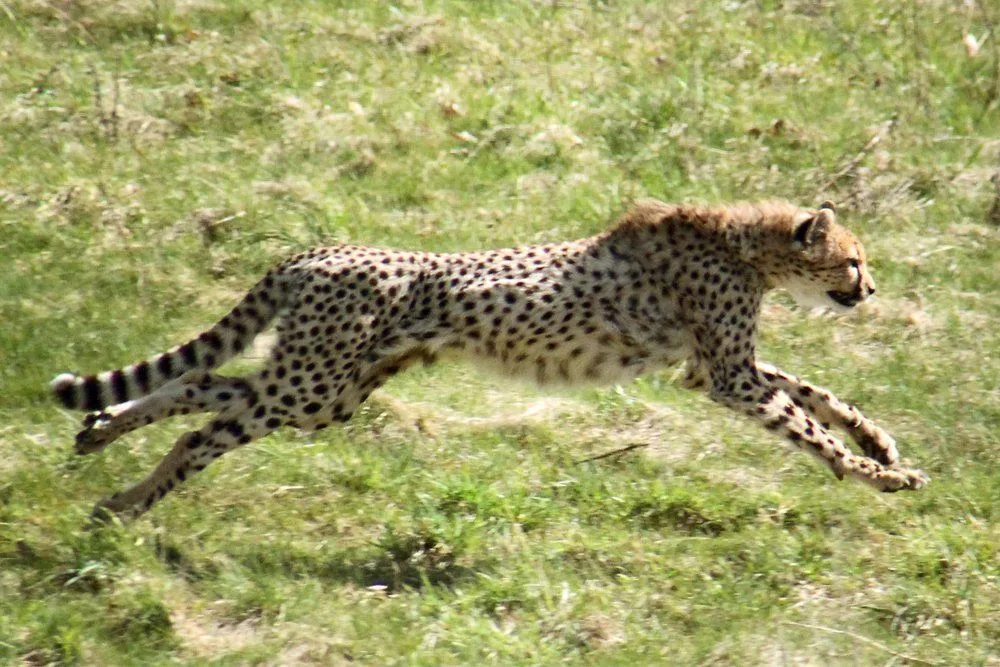
It is said that if humans were in a race with 50 of the fastest land animals on the planet, we would barely scrape into the top 30. Obviously, the cheetah would take first prize. In fact, the cheetah has held the title of fastest land animal for millions of years. There are certain factors which enable it to run so fast. A cheetah’s body is light, so its legs don’t waste much energy carrying weight, and that saved energy can be channeled into acceleration instead. Cheetahs also have a flattened rib cage and a small head, which helps reduce air resistance.
During each stride, the paws of the cheetah spend more time in air than on the ground itself. Cheetahs are the only members of the cat family whose claws are not completely retractable, thus giving them a better grip. Their tail acts as a rudder to stabilize the animal while running.
They also have a very flexible spine, and the shoulder blades are not attached to the collar bone. This enables them to extend their legs and stretch their body more, thus covering more distance per stride. While running, a cheetah’s feet touch the ground one at a time, instead of all together or in pairs.
Why Can’t Humans Run Faster Than Cheetahs?
As mentioned above, humans are no match for a cheetah, and several features of our bodies hold us back. As primates, we have large hands and broad, flat feet. These give us excellent balance and dexterity, but they are not built for sprinting. We are also comparatively heavy, so more of the energy we generate goes into hauling our own weight around, and our heads are large relative to our bodies compared with a cheetah’s. On top of that, we run flat-footed (plantigrade), with the whole sole striking the ground, whereas a cheetah runs up on its toes (digitigrade). Running on the toes lengthens the effective limb and lets the foot act like a spring, both of which add speed that our flat-footed gait simply cannot match.
One major factor that affects our speed is our muscles. Humans have two broad categories of skeletal muscle fiber: slow twitch (Type I) and fast twitch (Type II), and the fast twitch group includes an even quicker, more explosive subtype. Fast twitch fibers deliver speed and power but fatigue quickly, while slow twitch fibers contract more slowly and are far better suited to endurance than to speed. The average person’s leg muscles are roughly an even split of slow and fast twitch fibers, with only a small fraction of the explosive fast twitch subtype. Cheetahs, on the other hand, are dominated by fast twitch fibers, with studies finding that around 60 to 70% of their major running muscles are the fastest, most powerful type. This is a big part of why cheetahs are so fast and humans are so much slower by comparison.
Endurance And Speed
While humans may not fare very well in an all animals race, we are not a lost cause. The key, again, lies in our muscles.
We have already established the mind blowing speed of cheetahs. They can accelerate from 0 to 96 km/h (0 to 60 mph) in roughly three seconds, quicker than most sports cars. However, while cheetahs can run extremely fast, they can only do so in short bursts. They overheat and tire out within a few hundred meters, which is why a cheetah hunt is a brief sprint rather than a drawn-out chase.
Since they have so many fast twitch muscle fibers, cheetahs can accelerate explosively but cannot hold that speed for long. Humans, on the other hand, can keep going for hours thanks to our abundance of slow twitch muscle. In fact, it is thought that if all the animals were to run an ultramarathon of 200 km or more, humans would stand a genuinely good chance. The cheetah may win the sprint, but we win the long haul, a bit like the hare and the tortoise. Need proof? The Welsh town of Llanwrtyd Wells has hosted an annual Man versus Horse Marathon since 1980, in which runners race horses over roughly 35 km (22 miles) of rough terrain. Horses usually win, but human runners have beaten the leading horse on foot, most famously in 2004 and 2007, a reminder of just how good we are at distance running.
Scientists believe that our endurance running may be a result of evolution. It is known that our ancestors would often catch their prey by chasing and tiring them out.
Cheetah Vs Human: Who Would Win In A Fight?
Speed is one thing, but plenty of people really want to know how the two animals stack up head to head. In a flat-out race over any short distance, it is no contest: the cheetah wins easily, and no human, not even Usain Bolt, can outrun one.
A fight is a little more nuanced, though still lopsided in the cat’s favor. An adult cheetah weighs only about 34 to 64 kg (75 to 140 lb), so it is not much heavier than an average person, and it is the lightest and most lightly built of the big cats. Its skull and jaws are small, and its bite force (roughly 475 psi) is modest next to a lion or tiger. Even so, a cheetah is armed with sharp teeth, dewclaws that can hook into prey, and reflexes and acceleration far beyond anything a human can manage, so an unarmed person would almost certainly come off worse.
The reassuring part is that this scenario is largely hypothetical. Cheetahs are famously timid and are built to chase down small, fast prey such as gazelles, not to tangle with something as large as a human. They avoid people whenever they can, and unlike lions, leopards or tigers, wild cheetahs are not considered a meaningful threat to humans. In short, the cheetah would win, but in the real world it would much rather run away than fight.
Is A Cheetah Stronger Than A Human?
Speed aside, a lot of readers want to know the simpler question: in pure muscle, is a cheetah actually stronger than a person? The honest answer surprises people. An adult cheetah weighs only about 34 to 64 kg (75 to 140 lb), so it sits in roughly the same weight class as an average human, yet almost everything about its body has been tuned for velocity rather than power.

The cheetah is the lightest and most lightly built of all the big cats. It carries light bones, very little body fat and lean, whippy muscle, none of the heavy slabs of power you see on a lion or a leopard. Even its skull is compromised in the name of speed: the large nasal passages that feed its lungs with oxygen leave little room for the long roots needed to anchor big teeth, so its bite and overall fighting ability are modest for a predator of its size, as the Smithsonian’s National Zoo points out.
You can watch this weakness play out in the wild. Unlike a leopard, a cheetah simply does not have the strength to drag a kill up into a tree, and it cannot stand its ground against bigger rivals. Lions, hyenas and even flocks of vultures routinely bully cheetahs off their hard-won meals, and a cheetah will usually surrender its dinner rather than risk a fight it would lose. By some estimates it forfeits up to half of its kills this way.
So in a tug-of-war sense, a cheetah is the weakest of the big cats and, pound for pound, not dramatically stronger than a fit, well-trained human. What makes it dangerous is not brute force but its toolkit: hooked dewclaws, sharp teeth and an acceleration no person can match. A human might hold their own in a pure grappling contest, but those built-in weapons still tip a real confrontation in the cat’s favor.
Can You Become Faster?
The exact ratio of slow twitch to fast twitch muscles are not fixed. They differ from person to person. This ratio determines the speed of a person. Unfortunately, this ratio cannot be altered to a great extent. Obviously, regular training and exercise can help in building and activating our muscles, but it cannot affect the amount of fast twitch muscles to a large extent.
Studies have shown that fast sprinters have a larger amount of fast twitch muscles, while those who can run for longer amounts of time have more amount of slow twitch muscles.
While it may be impossible to de-throne the cheetah as the fastest land animal, we can take solace in the fact that we can run for longer. Maybe not first prize, but we can get the consolation prize!
References (click to expand)
- Smithsonian Channel (2012). This Is Why You Can't Outrun a Cheetah | Smithsonian Channel. Youtube
- CE Buckley. Speed is Relative (Human and Animal Running Speeds). Illinois State University
- Running paced human evolution - Harvard Gazette. Harvard University
- How Much Faster Can We Run? - Scienceline. scienceline.org
- Cheetah. Smithsonian's National Zoo and Conservation Biology Institute
- Cheetah: Description, Speed, Habitat, Diet, Facts. Encyclopaedia Britannica
- Wilson AM et al. Locomotion dynamics of hunting in wild cheetahs. Nature (2013)
- Cheetah. San Diego Zoo Wildlife Alliance