No, going underwater will not save you from a grenade. In fact, an underwater explosion is usually more dangerous than the same blast on land. Water is essentially incompressible, so the shockwave loses very little energy as it travels and slams almost undiminished into your body, where it tears through the air-filled lungs, sinuses and intestines (a pattern military medics call primary blast injury). On land, air absorbs much of the shockwave by compressing, which is why simply lying face-down with your feet toward the blast already gives you a high chance of surviving a hand grenade at five metres.
The whole premise of this debate revolves around the fact that some day, you might have to survive a grenade explosion, and the only thing you can choose between is diving underwater or trying your luck on land. Chances of that happening are pretty low, unless you work with the military or you’re a coyote trying to kill the roadrunner. However, some information might help someone who’s curious about which choice would be wiser. If you have a grenade explode 5 feet away from you, should you be underwater or on land?

Grenades are powerful explosives that shouldn’t be toyed with, so please note that grenades are deadly when used without proper training or supervision. Therefore, you should probably learn something about grenades so that you fully understand the physics involved and are better equipped to deal with such a dangerous situation.
Originally, grenades were simple shells filled with small spheres and gunpowder. The outer shell of the grenade, made of serrated cast iron, holds a chemical fuse mechanism, which is surrounded by a reservoir of explosive material. Grenades have been improved and upgraded over time to be more reliable and to cause more damage.
How Does A Grenade Work?
The most common type of grenade on the battlefield is a ‘time-delay fragmentation anti-personnel hand grenade’. We’ll go through every feature of this particular type of grenade one at a time. Military-grade grenades are normally ergonomically designed to fit perfectly in our palms. Most of them involve a trigger system to light the fuse, which ultimately causes the explosion. The only thing that the user needs to do to cause the explosion is pull out the pin out from the grenade and throw it.
The main function of the pin is to hold a spring-loaded lever in position. As long as you haven’t released the spring lever, you can reinsert the pin and save the grenade for another time. The spring lever, on the other hand, holds a striker inside the grenade, rendering it immovable when not in use. When the pin is removed by the user, the spring lever detaches itself automatically from the grenade, releasing the striker from its position. In turn, the striker free falls towards a percussion cap at the bottom, causing a small spark. The energy from this spark is used to light a fuse that leads all the way to the explosive material. 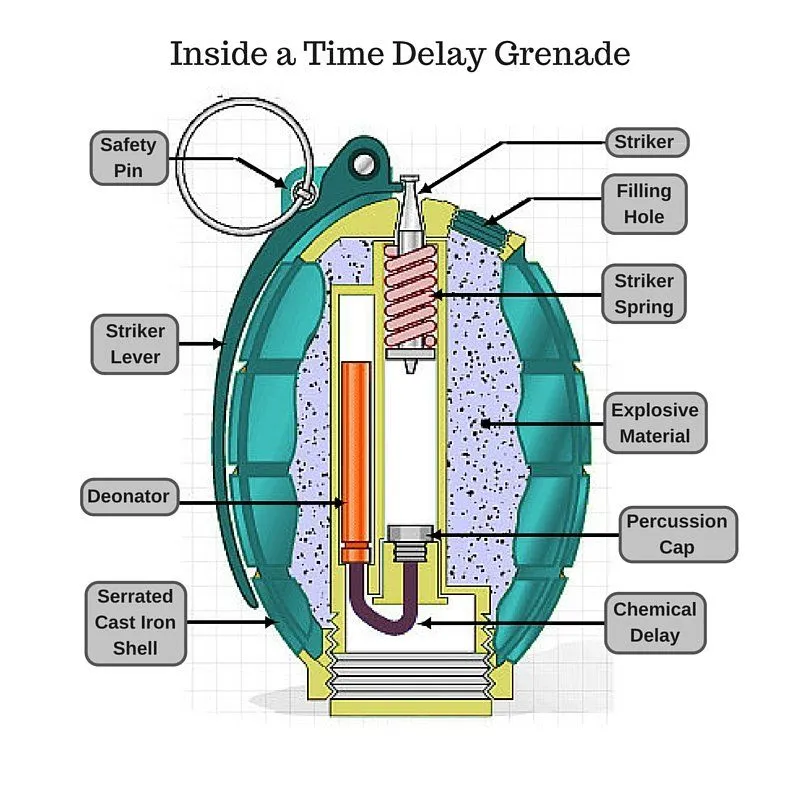 Time-delay grenades are very effective, but they also have some significant disadvantages. One problem is their unpredictability. In some chemical fuses, the delay time may vary from two to six seconds. The explosion ignites the explosive material around the sides of the grenade, creating a much larger explosion that blows the grenade apart. The grenade wall then separates into several smaller pieces along the weaker edges, turning them into multiple pieces of shrapnel moving in all directions. This is the main reason why the grenade’s exterior is waffle-shaped and why grenade explosions cause such a large blowout.

Now that we know what happens inside the grenade, let’s see how the explosion affects the environment around it.
How Far Does A Grenade's Blast And Shrapnel Reach?
Before we pit water against air, it helps to know just how much ground a single grenade actually covers. Take the M67, the steel-bodied fragmentation grenade that has been standard issue in the US military for decades. It packs about 180 grams (6.5 ounces) of Composition B explosive, the whole grenade weighs roughly 400 grams (14 ounces), and once the safety lever flies off, a pyrotechnic delay fuse burns for roughly 4 to 5.5 seconds before it detonates.

When it goes off, the army quotes a fatality radius of about 5 meters (16 feet) and a casualty-producing radius of about 15 meters (49 feet). In plain terms, anyone within 5 meters is likely to be killed, and anyone within 15 meters is likely to be wounded. The danger does not stop there, though. Individual fragments are thrown out so violently that stray pieces can travel as far as 230 meters (750 feet), which is exactly why soldiers are trained to throw a grenade and immediately take cover rather than stand and admire the bang.
This is why the 5 meter scenario in this article is so unforgiving. At that range you are deep inside the casualty radius, so your survival hinges almost entirely on shrinking your profile and on how the medium around you handles the blast. As we are about to see, water and air deal with that energy in very different ways.
Will A Grenade Still Go Off Underwater?
There is a fair question to settle before any of this matters: if you drop a live grenade into water, will it even explode? The short answer is yes. People often assume water would “drown” the explosion the way it smothers a campfire, but a burning log and a detonating grenade work in completely different ways.
A campfire pulls its oxygen from the surrounding air, which is precisely why dousing it with water (or simply cutting off the air) puts it out. A grenade carries its own oxygen supply baked right into the chemistry of the explosive. In high explosives, the fuel and the oxidizer are bound together in the same material, so the reaction does not need to borrow a single molecule of oxygen from its surroundings. The pyrotechnic delay element works the same way, and it burns sealed inside the grenade's metal body where water never even touches it.
So submerging a grenade does nothing to interrupt the chain of events once the striker falls. The fuse burns on schedule and the main charge detonates right on cue. Water changes what the explosion does to your body, but it has no say in whether the grenade goes off.
What’s Safer?
For the sake of comparison, imagine the target being two human beings standing 5 meters away from two grenades that are about to explode – one underwater and one on land.
On land, when the explosion occurs, the metal shells that are projected outwards will be the most dangerous aspect. Even if a single shell makes contact, the results could be fatal. Since there is much less drag force in air than in water, the shell would feel almost no resistance as the pieces fly towards the target. The only option for the target in this scenario is to decrease the exposed body surface to a minimum. This can be done by lying face down with your feet turned towards the explosion. At a distance of 5 meters, using a standard grenade, this position gives the target a whopping 99% chance of dodging a shell hit.
However, for a target who is underwater, the chances of being struck by a fragment drop to nearly zero, because drag in water is around 800 times greater than in air, so shrapnel from a hand grenade slows dramatically within just a few feet and rarely reaches a target five metres away. However, their shells are not the only reason why grenades are so deadly. The determining factor is the explosion shockwave, and the impact that the shockwave has on a target depends on the medium.
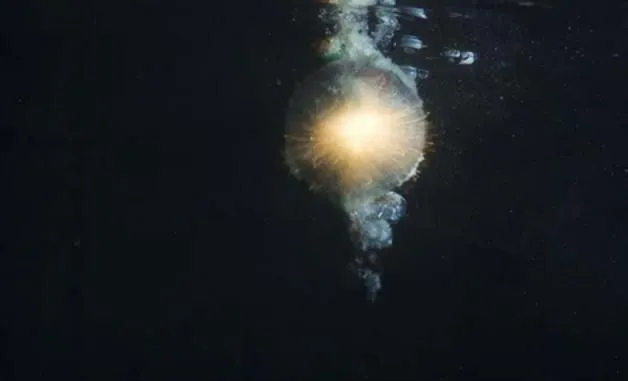
The main difference between water and air is that air is a gas, which is infinitely more compressible than liquid water. This makes the transfer of momentum underwater much easier as compared to air. Due to the compressible nature of air, the force from the explosion is used up in compressing the subsequent layers of gas, which absorb most of the impact.
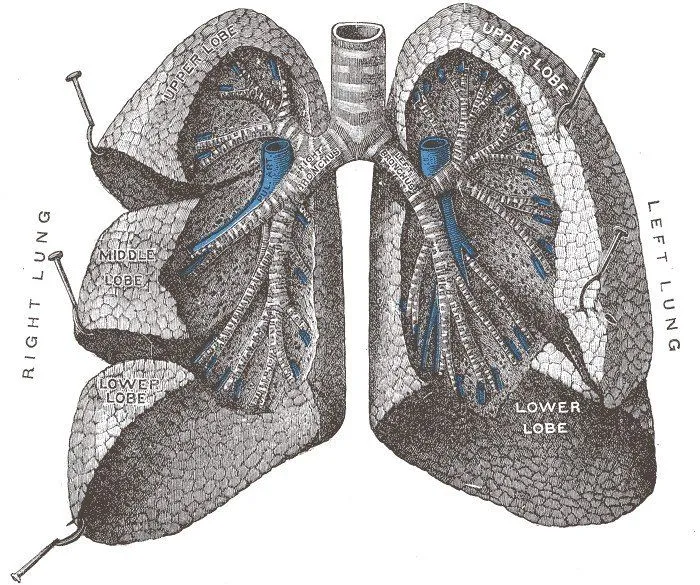
Water, on the other hand, completely transfers all of the momentum from the explosion to the target. This force would be harmless, if it wasn’t for the fact that the human body is filled with pockets of air. If our body was composed of 100% water with no hollow air-filled regions, such as our lungs, we would probably survive a grenade as the force from the explosion would be transferred through our bodies. Instead, when the explosion occurs, the shockwave compresses the air inside our bodies in a brutal manner, completely destroying our lungs. The parts of the body that are void of air, like the arms and legs, would remain unscathed.
So, there you have it. If you ever have to survive a grenade explosion, hope to God that you won’t have to do it underwater!
What If You Set Off A Grenade In Space?
If water makes a grenade more lethal and air makes it more survivable, it is only natural to wonder about the opposite extreme: the vacuum of space, where there is no medium at all. Because a grenade carries its own oxidizer, the chemistry does not care that there is no air around it. Trip the fuse, and the charge detonates in a vacuum just as readily as it does on Earth.
What changes is the aftermath. A blast wave is essentially a wall of violently compressed gas, so it needs a medium to travel through. In space there is no air to compress, which means there is no blast overpressure to slam into your air-filled lungs the way it would underwater. The grenade's own expanding detonation gases simply puff outward and thin into nothing almost at once. That leaves the shrapnel as the only real threat, and with no air to slow it down, each fragment sails off in a straight line until it strikes something. So a grenade in space would still be deadly, but it would behave as a pure shrapnel weapon rather than the lung-rupturing pressure bomb it becomes underwater.