Engine power is measured in ‘horsepower’ thanks to Scottish engineer James Watt, who coined the unit in the 1780s to sell his steam engines against draft horses. He pegged 1 horsepower at 33,000 foot-pounds of work per minute, or about 745.7 watts. The SI unit of power, the watt, is also named after him.
Engine power is measured in ‘Horsepower’ because of a Scottish engineer named James Watt. According to Watt’s observations, 1 horsepower = 33,000 foot-pounds of work per minute (in modern units, about 745.7 watts). The value of horsepower was clearly not absolute, but that didn’t really matter to Watt, nor the potential buyers. All the owner of a draft horse needed to know was that Watt’s steam engine could do the work of several horses at once.
The number of physical quantities that we deal with on a daily basis is almost too extensive to list – temperature, force, and distance are some of the most common ones, but that barely scratches the surface. The units of measurement for those forces (Celsius, Newtons and meters, respectively) also ‘sound’ pretty, now that we’ve gotten used to them.
Typically, the units of physical quantities are named after the scientist who either discovered them first or had made unparalleled contributions to their respective field. That all makes me think about another type of force, the one generated by an engine. More specifically, I wonder why we use ‘horsepower’ for the measurement of power? How did horses trot into the picture of power in the first place?
There’s actually a very interesting story behind that…
Watt’s Steam Engine
It all started when James Watt, the Scottish engineer credited with a number of inventions and discoveries, made the existing steam engine far more efficient. Before he introduced his design, the world had already grown used to the Newcomen engine, which was essentially the first practical machine to harness steam to do useful work.
However, Watt’s engine, along with other technical enhancements, generated the same amount of mechanical output by using only one-quarter of the fuel that the Newcomen engine required! Watt obviously wanted to market this dramatic practical advantage that his design was able to offer over the Newcomen engine.
Marketing this obvious technical advantage was simple enough to people who actually used steam engines. He could talk to them using a lot of ‘engine jargon’, or he could simply say, “Hey, my engine does the same thing as the Newcomen engine, but uses 75% less fuel!”
The thing was, not everyone used steam engines at that time; there was a large chunk of the populace that still used draft horses to get things done “mechanically”. Watt wanted to figure out a way to make those people understand the advantage of his machine through numbers, in order to explain how his engine was more productive than the draft horses they relied on to earn their livelihood. In order to achieve that, he obviously had to compare the efficiency of two completely different entities, i.e. his engine and horses, using a single unit.
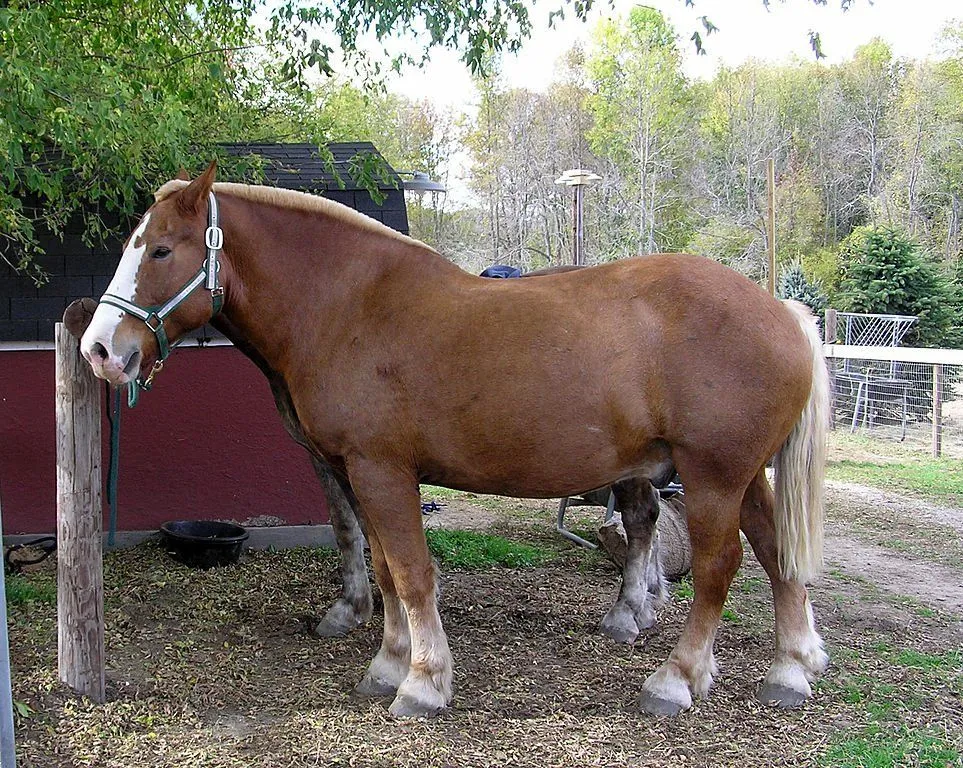
To achieve that comparison, he set about calculating the productivity of a typical draft horse by determining how much power a regular draft horse could generate in a given period of time. There are different accounts of the experiments that he ran, but in the end, he noted that a typical draft horse could do nearly 33,000 foot-pounds (lift a 33,000-pound weight 1 foot) of work in a minute and maintain the same rate throughout the day (which is a bit far-fetched as an assumption). Hence, a new unit was born – horsepower. According to Watt’s observations, the calculation was as follows:
1 horsepower = 33,000 foot-pounds of work per minute
The value of horsepower was clearly not absolute, but that didn’t really matter to Watt, nor the potential buyers. All the owner of a draft horse needed to know was that Watt’s steam engine could do several times as much work as his single draft horse. In other words, one engine was worth a small team of horses!
This apples-to-oranges comparison worked wonders and the Watt engine became one of the most valued tools of the Industrial Revolution. Even today, the term ‘horsepower’ is used as a supplementary unit while talking about output power of turbines, piston engines and other machines.
How Did James Watt Calculate One Horsepower?
So how did Watt arrive at such an oddly specific figure? The popular account has him studying horses harnessed to a mill, where the animal was tethered to a long beam and plodded in a wide circle to turn a heavy wheel. By Watt’s reckoning, a working horse made the rounds of that wheel about 144 times an hour, or roughly 2.4 times every minute. The wheel had a radius of about 12 feet (3.7 m), so in a single minute the horse trekked along 2.4 × 2π × 12 feet of its circular path. He also judged that the animal leaned into its harness with a steady pull of around 180 pounds-force (800 N).

Multiply that pulling force by the distance covered and you get the rate at which the horse does work:
180 lbf × (2.4 × 2π × 12 ft) ≈ 32,572 foot-pounds per minute
That sits tantalizingly close to a round 33,000, and the following year Watt (along with his business partner Matthew Boulton) settled on 33,000 foot-pounds per minute as the official figure. The exact arithmetic varies between different accounts of the experiment, but the takeaway is the same: horsepower was never meant to be a precise biological constant. It was a salesman’s yardstick, set deliberately on the generous side so that no buyer could ever grumble that Watt had flattered his own engines with the maths.
Can A Real Horse Actually Produce One Horsepower?
Here’s a fun twist: a fit horse can comfortably beat one horsepower. Because Watt pitched his unit at a pace a horse could keep up all day, roughly one horsepower really is a fair estimate of a draft horse’s steady, hour-after-hour output. The interesting part is what happens in a short, all-out burst.

In a 1993 letter to the journal Nature, biologists R. D. Stevenson and R. J. Wassersug crunched the numbers and concluded that a horse can briefly peak at around 14.9 horsepower, working from real measurements taken at a horse-pulling contest at the 1925 Iowa State Fair. In other words, for a few seconds of maximum effort, a single animal can do the work of nearly fifteen ‘horsepower’.
That gap is exactly why Watt’s unit can feel a little stingy. One horsepower is not the most a horse can ever muster; it is closer to the most a horse can manage without stopping. A sprinting horse, much like a sprinting human, can pour out far more power for a moment than it could ever sustain over a full working day. It is a neat reminder that the horsepower printed on a spec sheet, whether for a horse or for the internal combustion engines in modern cars, is a single headline number standing in for a much messier real-world performance.
How Many Watts Is One Horsepower?
Here’s the part that ties everything together. Power is the rate of doing work, and there’s a tidier, more scientific unit for it than the horse: the watt, named in honor of the very same James Watt. One watt is simply one joule of work done per second, and it’s the unit of power in the International System of Units (SI). So the man who borrowed the horse to sell his engines ended up with the modern unit of power carrying his own name.
The two units are easy to line up. Watt’s original definition of 1 horsepower = 33,000 foot-pounds of work per minute works out to 550 foot-pounds per second, and when you run that through the conversion, you get:
1 horsepower (mechanical) ≈ 745.7 watts
So a humble 100-horsepower car engine is putting out roughly 74,570 watts, or about 75 kilowatts (kW). You’ll also come across a slightly different figure in Europe: metric horsepower, sometimes labeled PS or CV, is defined as 735.5 watts, a hair under the mechanical version. The two are close enough that, for everyday purposes, people happily round 1 hp to about 746 watts and move on.
That’s why a single number can describe the muscle of a lawnmower, a sports car, and a power station alike. Whether the engineer reaches for ‘horsepower’ or ‘watts’, both are measuring the same thing, namely how fast energy is being turned into useful work.
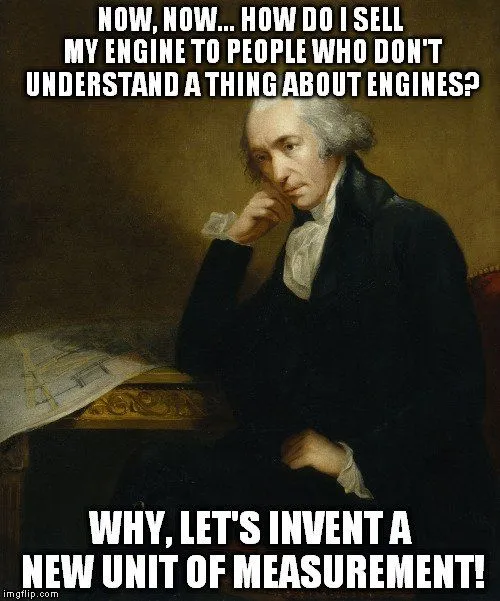
James Watt, as the entire world knows today, was a true genius. He not only created a steam engine that was much more efficient than what existed at that time, but also figured out a way to market it impressively to a populace that was still living in the past. In the process, he unwittingly gave the world a new unit of power that’s still commonly used to this day!
References (click to expand)
- Horsepower | Definition, Unit, and Facts. Encyclopaedia Britannica
- James Watt | Biography, Inventions, Steam Engine, Significance, & Facts. Encyclopaedia Britannica
- Is the watt named for James Watt? Encyclopaedia Britannica
- Horsepower. Wikipedia
- Stevenson, R. D. & Wassersug, R. J. Horsepower from a horse. Nature 364, 195 (1993). PubMed
- How much horsepower does a horse have? BBC Science Focus Magazine