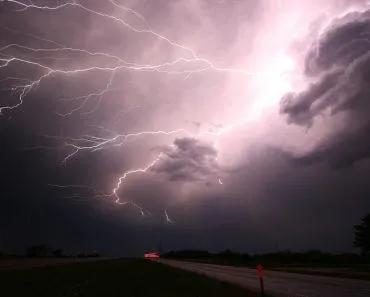
We cannot use lightning as a practical power source. A single bolt does carry about 5 billion joules (around 1,400 kWh, enough for one US home for six weeks), but it arrives at 100 million to 1 billion volts in a few milliseconds, which would instantly destroy any capture electronics. Lightning is also too sporadic and geographically concentrated to plan a grid around.
If you’ve ever watched the movie Back to the Future (1985), then you probably remember the way Doc Brown discovers a novel technique to send Marty from the year 1955 to the year 1985. In order to power the time machine, he needed an enormous amount of energy. With no plutonium available, he surmised that only lightning carried enough energy to adequately power the time machine. Since he knew precisely when and where a lightning strike would occur, he used the power of lightning to send Marty back to the future! Pretty neat, huh?
Thinking along those same lines, have you ever wondered whether we can harness energy from a resounding lightning strike?
Lightning
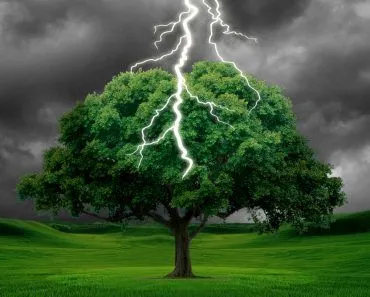
Every time you hear a rumble in the sky, seconds later, you invariably look up and see some flashy zig-zag patterns of lightning criss-crossing the sky. Basically, lightning is an electric current that primarily forms inside clouds, but sometimes forms between the clouds and the ground, resulting in what we call a bolt of lightning.
Power Of A Lightning Strike
Lightning is not only bright, but also hot. The temperature of a lightning channel reaches around 27,000 °C (50,000 °F), roughly five times hotter than the surface of the Sun! When a lightning strike occurs, it can burn the surrounding air due to its extreme temperature. A single bolt carries a few billion joules of energy, comparable to the chemical energy in roughly 30 to 150 liters (8 to 40 gallons) of gasoline.
Energy and power have a simple relation—electric power can be calculated by dividing the value of energy by time. Since a huge amount of energy is dumped through the air in a tiny window of time (the return stroke itself lasts only tens of microseconds, and the full discharge sequence wraps up in a few tens to a few hundred milliseconds), the instantaneous electrical power associated with lightning is staggering.
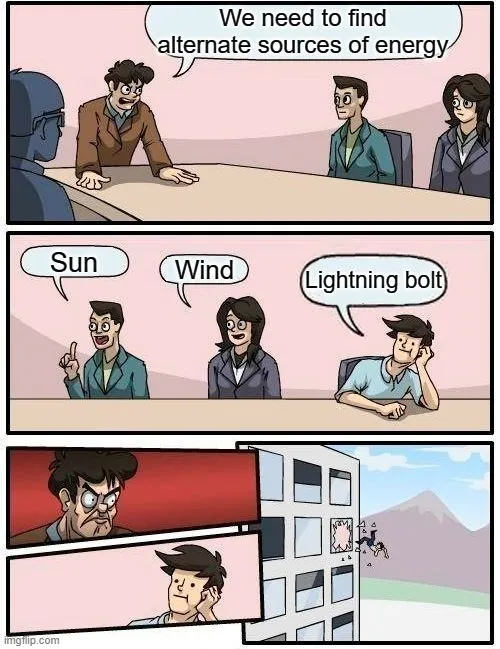
Despite being a carrier of a massive amount of energy, extracting energy from a thunderbolt to power our homes isn’t technically feasible.
Challenges Associated With Harnessing Energy From A Lightning Strike
Need To Install Highly Sophisticated High-power Electrical Systems
First of all, absorbing the incident lightning strikes and then smoothly converting them into electrical energy to easily power our homes and industries would be an arduous engineering task. To do so, we would need to redesign our electrical systems and install complex power systems for capturing lightning bolts. To attract and capture lightning, sophisticated equipment like tall metallic iron rods extending high above the ground would be required. This would be risky and entail numerous safety hazards.
However, the biggest challenge would be to absorb the humongous burst of energy per unit area that lightning brings with it. Present-day electronic components like capacitors, transistors, ICs, flywheels, etc. aren’t really designed to withstand sudden outbursts of electricity. On average, a lightning strike contains about 5 billion joules of energy, and the visible flash is over in well under a second. That makes it incredibly difficult to capture so much energy quickly enough before our electronics literally melt.
Wide Variation In Intensity
There is no constant power observed in lightning strikes. Although we mentioned about 5 billion joules, that is a rough estimate. In reality, this amount varies wildly. In some lightning strikes, the power can be much higher than the average, while in others, it can be ludicrously low. Therefore, this makes the idea of setting up a lightning-harnessing system quite unpredictable and impractical.
Sporadic Nature And Uneven Distribution
Then, there is the fact that lightning strikes are totally sporadic. Some areas receive far more lightning strikes, while others are nearly immune to such weather patterns.
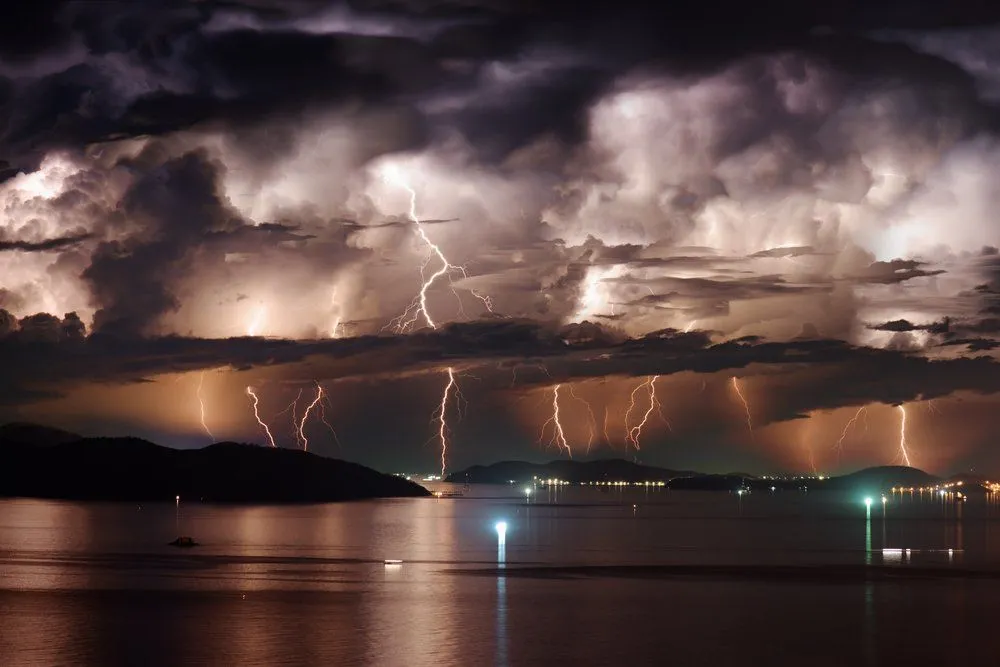
Earth sees about 1.4 billion lightning flashes a year, or roughly 44 every second, but their distribution is highly skewed. The single biggest hotspot is Lake Maracaibo in Venezuela (the famous Catatumbo lightning), followed by Kifuka in the Democratic Republic of the Congo and the Himalayan foothills. Most lightning is concentrated in tropical and remote mountainous regions. Designing and setting up state-of-the-art energy storage and conversion in such geographical locations is even more challenging from an economic standpoint. Furthermore, the task of distributing this energy to a populous region would entail its own set of operational challenges.
Too Much Power; All At Once
Another big problem with capturing lightning is the dynamics of electricity. According to NOAA, a lightning bolt carries an enormous potential difference, on the order of 100 million to 1 billion volts, and pushes peak currents of roughly 30,000 amps. Most of the electrical and electronic devices or appliances that we use work on tiny fractions of that. Hundreds of millions of volts appear and disappear almost instantaneously. This volatile nature of lightning is likely to damage equipment, as a huge amount of energy is deposited all at once. Our present-day electronic components aren’t really designed to withstand such sudden impulsive spikes in voltage. Batteries—a core electronic component—would also be susceptible to such an abrupt gush of energy. Conventionally speaking, batteries are designed to charge slowly and steadily.
Also, much of the energy of the lightning bolt is dissipated in the form of heat and light. The actual electric energy available for conversion is much less.
Understanding Infeasibility With An Example
Let’s try to understand why it is not that great of an idea to harness energy from a lightning strike with a rough calculation. A 5-gigajoule bolt works out to about 1,400 kilowatt hours of energy. The average American home uses around 855 kilowatt hours of electricity per month (US EIA, 2024). So in theory, a single, perfectly captured strike could power one household for about six weeks. But think about how likely it is that there would be a guaranteed lightning strike on the same patch of land every six weeks. Quite rare, right? And much of that 5 GJ is actually dumped as heat, light and sound, leaving only a small fraction as electrical energy you could even attempt to store. The volatility of lightning strikes is a hassle in itself, let alone the engineering constraints of capturing and storing electricity from a bolt that vanishes in milliseconds.
What Have Scientists Actually Tried?
Plenty of projects have tried, and largely failed, to harness lightning for grid power. In a structured 2020 review in Global Challenges, physicist Daniel Helman concluded that direct lightning capture remains technically and economically unviable, mostly because of the unpredictability and that brutal microsecond timescale.
The most striking control-side advance has happened recently. In January 2023, an EPFL-led team published a Nature Photonics paper showing that a terawatt-class high-repetition-rate laser, fired skyward from atop the Säntis mountain in Switzerland alongside a tall lightning tower, was able to guide an upward lightning leader along its beam for more than 50 meters. It is the first real progress in lightning control since Benjamin Franklin’s rod, but it’s still about steering bolts away from infrastructure, not feeding them into the grid.
A Final Word
Lightning, theoretically, is a tremendous source of energy. However, it’s best that you make use of it only when you’re in a very, very desperate situation, such as when you’re stuck in the wrong time and are fortunate enough to have a genius like Doc Brown standing beside you!
References (click to expand)
- Is there a way to harness electricity from lightning?. The MIT School of Engineering
- Storing Energy From Lightning | Physics Van | UIUC. The University of Illinois Urbana-Champaign
- Why can't we extract electricity from lightning? | The Independent. The Independent
- Helman, D. S. (2011, May). Catching lightning for alternative energy. Renewable Energy. Elsevier BV.
- Severe Weather 101: Lightning FAQ. NOAA National Severe Storms Laboratory.
- Houard, A. et al. (2023). Laser-guided lightning. Nature Photonics.
- Global Lightning Activity. NASA Earth Observatory.