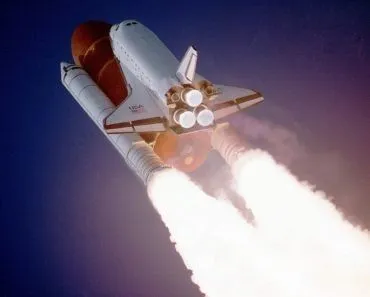
Specific impulse is a measure of efficiency for rocket engines. It is the change in momentum per unit of mass for rocket fuels. Simply put, specific impulse is a measure of how much push (thrust) accumulates as you burn the fuel.
Specific impulse (Isp) is a measure of how efficiently a rocket engine uses its propellant. It is the impulse (change in momentum) delivered per unit of propellant consumed, and it is usually expressed in seconds. The higher the specific impulse, the more thrust a rocket gets from each kilogram of fuel.
From the aforementioned definition, it’s quite evident that you are most likely to hear the term ‘specific impulse’ in conversations regarding rocket and jet engines, especially those that revolve around rocket launches.
Specific Impulse Definition (And Difference From ‘Thrust’)
People often confuse specific impulse with thrust, which are actually two very dissimilar entities.
You may already know that, in the context of rockets, thrust is a measure of power, as in, if you don’t supply enough thrust to the rocket, it won’t lift off the launch pad.

As a matter of fact, you need this thrust not just to lift off, but also to achieve orbit (otherwise, what’s the point!). In a bid to ensure that you can make it into orbit (or wherever it is you are headed) using the minimum amount of fuel, you’d prefer an engine with a high specific impulse. This is because it will help you get more thrust from a given amount of fuel.
You see, the speed of a rocket depends on thrust (which roughly depends on the amount of propellant ejected out the back of a rocket, and the speed at which it’s thrown out); the faster the propellant is ejected from the bottom of the rocket, the faster it can go and the more weight it can carry with itself. Therefore, the specific impulse of a rocket is simply a rough measurement of how fast the propellant is thrown out the back of the rocket (Source).
The higher the value of the specific impulse of your rocket, the more oomph you get from the fuel rushing out the back of the rocket. That’s why a rocket with a high specific impulse wouldn’t have to carry as much fuel as a rocket with a low specific impulse.

In a nutshell, therefore, thrust is a measure of how hard engines can push, whereas specific impulse determines how much thrust you can get from a given amount of fuel.
Specific Impulse Equation
Technically, specific impulse (denoted by Isp) equals the total impulse (or change in momentum) delivered per unit of propellant consumed. This relation tells us that specific impulse is inversely proportional to specific fuel consumption (i.e., the fuel efficiency of an engine design with respect to thrust output), which leads us to this simple equation:
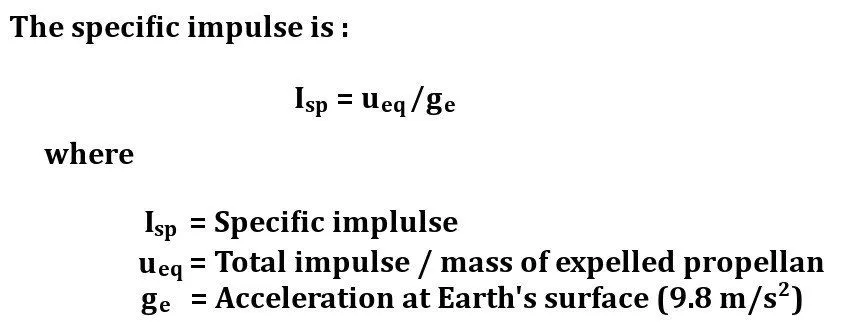
Thus, if you know the exhaust velocity of a rocket engine, you can easily calculate its specific impulse, as the latter turns out to be a ratio of the exhaust velocity (Ve) and the gravitational attraction of the Earth (g).
Specific Impulse Units
While reading up on specific impulse from various sources, you’d likely come across a few of its units, which are different from one another, and might (potentially) confuse you a bit. Although specific impulse is most commonly expressed in seconds (s), it’s not uncommon to see it measured in m/s too; in some places, you could even see it expressed in N·s/kg.
However, specific impulse is most commonly expressed in ‘seconds’, as in the graph given below.
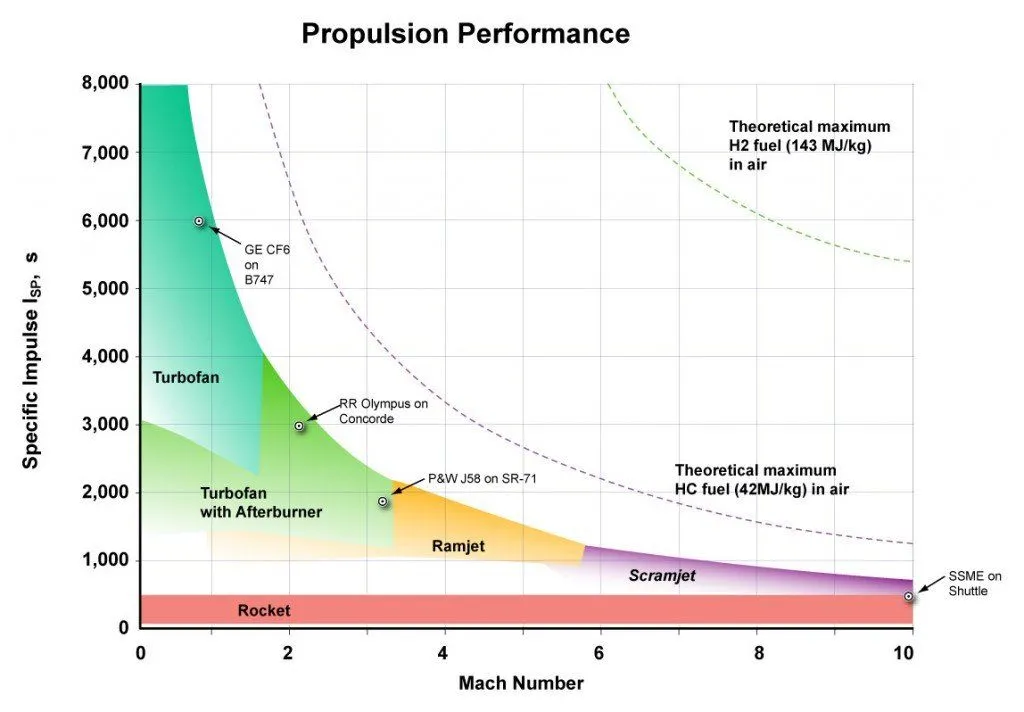
For instance, if a rocket has a specific impulse of say, 1000 seconds, then it means that the rocket can generate thrust for 1000 seconds, given a quantity of propellant whose weight equals the rocket engine’s thrust. Note that most manufacturers quote the specific impulse of their rocket engines in ‘seconds’.
Here’s a simple fact that will help you distinguish and understand different units of specific impulse: if weight (pound or Newton) is used as the unit of propellant in the rocket, the specific impulse is measured in seconds; when mass (kilogram or slug) is used instead, then it’s measured in meters/second.
For a feel of the numbers: solid rocket boosters sit around 250 seconds, kerosene/LOX engines like SpaceX’s Merlin manage about 300-310 seconds at sea level, hydrogen/LOX engines like NASA’s RS-25 reach roughly 450 seconds in vacuum, and modern ion thrusters (used on deep-space probes) clock in at 3,000 seconds and up.
What Is Impulse, And How Does It Differ From Specific Impulse?
Before we go any further, let’s untangle a knot that trips up a lot of people: plain impulse and specific impulse are not the same thing, even though they share half a name.
In ordinary physics, impulse (often written as J) is simply a force applied over a stretch of time. If a force F acts for a time interval Δt, the impulse it delivers is just the two multiplied together: J = F × Δt. The beauty of the idea is what that product is equal to. By the impulse-momentum theorem, the impulse you hand to an object equals the change in its momentum (where momentum is mass times velocity). So a small push held for a long time and a hard shove given in a flash can deliver exactly the same impulse, and exactly the same change in motion.
Because impulse is force times time, its unit is the newton-second (N·s). And since it also equals a change in momentum, you can write the very same quantity as kilogram-meters per second (kg·m/s). The two units are interchangeable. Imagine kicking a stationary football: a boot delivering 200 newtons of force for 0.05 seconds hands the ball an impulse of 10 N·s, which is what sends it flying.
Specific impulse is a different beast. As we saw above, it is not a force-times-time at all, but a measure of efficiency: how much thrust a rocket engine wrings out of each unit of propellant. That is why one is measured in newton-seconds and the other (most often) in seconds. They are cousins in the family of momentum, but they answer two very different questions, one about a single push, the other about how thrifty an engine is with its fuel.
What Is Total Impulse?
There is a third member of this family worth knowing, and it shows up constantly in rocketry: total impulse.
Total impulse is the grand total of all the push an engine delivers over its entire burn. If the thrust F were perfectly constant, total impulse would just be thrust multiplied by burn time, I = F × Δt. In the real world thrust rises and falls, so total impulse is really the area under the thrust-versus-time curve across the whole firing. Like ordinary impulse, it carries the unit of the newton-second (N·s).
So how does it sit alongside specific impulse? Think of it this way. Specific impulse tells you how good an engine is per kilogram of propellant; total impulse tells you how much work it does in total. A tiny ion thruster has a sky-high specific impulse but a feeble total impulse, since it sips propellant and produces only a whisper of thrust for years on end. A solid rocket booster is the mirror image: a modest specific impulse but an enormous total impulse, because it dumps a colossal amount of thrust in a couple of minutes. The two numbers are linked through the propellant burned, but they describe quite different things, which is exactly why people search for the difference so often.
How Do You Calculate Specific Impulse? (A Worked Example)
The equation above looks tidy, but it is easiest to trust once you have pushed real numbers through it. According to NASA, you can compute specific impulse straight from an engine’s thrust and the rate at which it burns propellant: Isp = F ÷ (ṁ × g0), where F is thrust, ṁ (pronounced “m-dot”) is the mass flow rate (how many kilograms of propellant the engine consumes each second), and g0 is the standard gravitational acceleration, 9.81 m/s² (32.2 ft/s²).

Let’s say an engine produces 1,000,000 N of thrust while burning 250 kg of propellant every second. Plug it in: Isp = 1,000,000 ÷ (250 × 9.81) = 1,000,000 ÷ 2,452.5 ≈ 408 seconds. That single number places the engine between a kerosene-oxygen first stage (around 300 seconds) and a hydrogen-oxygen upper stage (around 450 seconds) in efficiency.
The other common route starts from exhaust velocity. Since Isp = Ve ÷ g0, the conversion is one short step in either direction. An exhaust velocity of 4,400 m/s gives a specific impulse of 4,400 ÷ 9.81 ≈ 449 seconds, which is right where hydrogen-oxygen engines like the RS-25 live. Run it backwards and a 452-second engine is throwing its exhaust out at about 4,434 m/s.
And here is the answer to a question many readers ask: why does specific impulse come out in seconds at all? Watch the units cancel. Dividing a velocity (m/s) by an acceleration (m/s²) leaves you with plain seconds. The number is not literally a stopwatch reading of how long anything lasts; it falls out of the math, and it has the handy side effect of being the same whether you work in metric or imperial units, which is exactly why engineers the world over quote engines in seconds.
References (click to expand)
- What is specific impulse?.
- http://web.archive.org/web/20191220091900/http://spl.mit.edu:80/about-electric-propulsion
- 14.1 Thrust and Specific Impulse for Rockets.
- Lecture 2 Notes: Fundamentals and Definitions.
- Specific Impulse - NASA Glenn Research Center, Beginner's Guide to Aeronautics
- Impulse - College Physics (OpenStax / SUNY).
- Model Rocket Engine Designation (Total Impulse) - NASA Glenn Research Center.