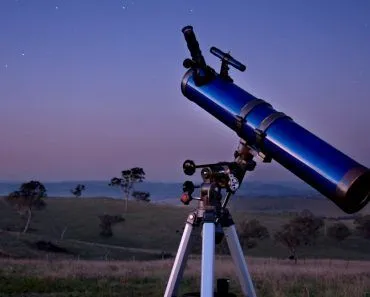
Binoculars cleverly use the concept of optics to enable us to view distant objects with ease. Their design is based on the principles of light refraction.
As a kid, I always wanted to own a super-cool pair of binoculars that the S.H.I.E.L.D. agents used in Marvel movies. Imagine being able to look through walls and see every technical detail of your surroundings.
Binoculars may not be superhero-level tools, but they cleverly use the science of optics to zoom you inside an anthill or out to the middle of the Milky Way. In this article, we will learn how exactly this cool gadget works, so that the next time you come across a pair, you’ll know what’s really happening!
Binoculars are essentially a pair of telescopes mounted on a single frame. The first telescope is generally credited to Dutch lensmaker Hans Lippershey, who applied for a patent in 1608. Two centuries later, in 1825, J.P. Lemiere designed the first practical handheld binoculars in the form of opera glasses. Fast forward to 1854, when Italian inventor Ignazio Porro patented the prism erecting system that laid the foundation for the modern prism binoculars we use today, commercialized by Carl Zeiss in 1894.
Optics Behind The Binoculars
Binoculars work on the concept of light refraction, and the “magic” element is how lenses/prisms effectively implement this property of light.
Refraction
When light passes through different media, it bends outwards or inwards, depending on the density of the medium through which it’s traveling. This is called the refraction of light. If light travels to a denser medium, it bends inwards, whereas if it travels to a rarer medium, it bends outward.
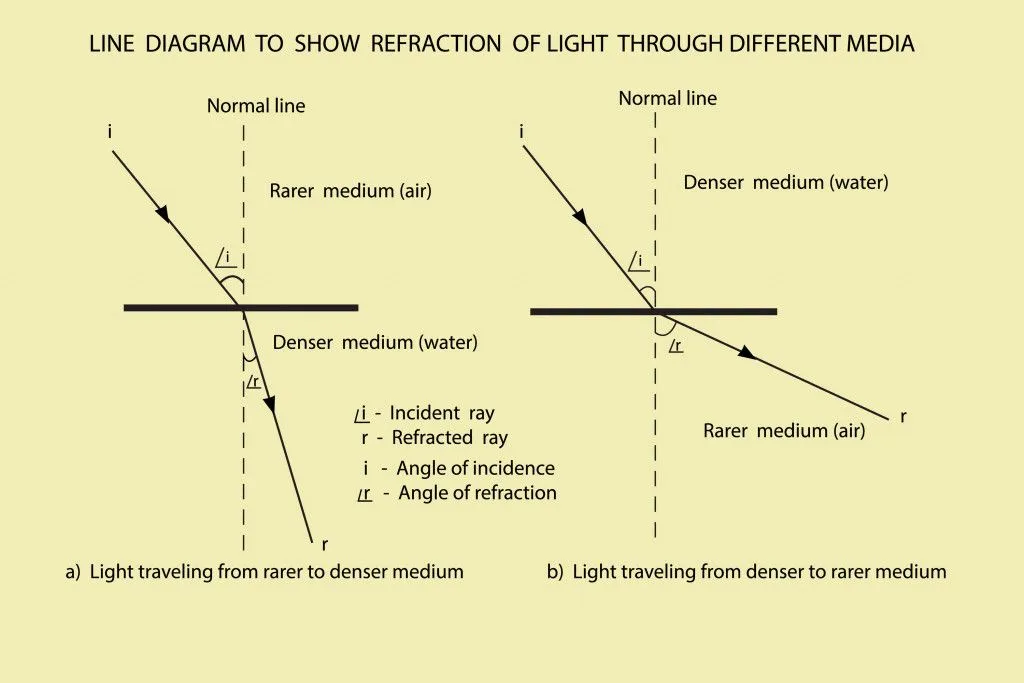
The glass in the objective lens of the binoculars receives the incident light, and when light passes through them it bends or refracts to form an image. Therefore, the amount of light can be controlled by altering the objective lens. The glass in the eyepiece further receives light through the objective lens and processes its image into the final image perceived by the observer.
Lenses And Magnification
The word lens comes from the Latin word for lentil, in reference to its shape. Therefore, a lens is a piece of curved glass through which light can be transmitted or refracted.
Primarily, there are two types of lenses: convex and concave.
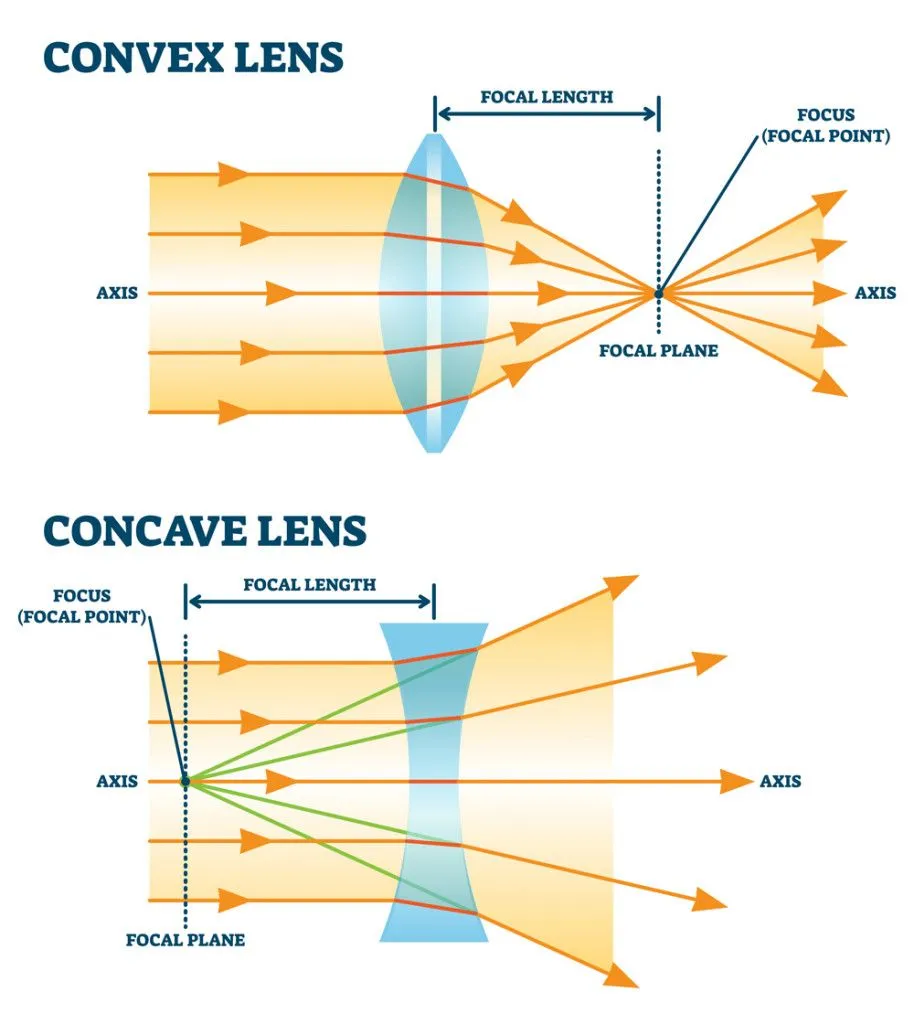
The convex lens is thicker in the middle and thinner towards the sides. This construction helps light refract inwards and allows for focusing distant rays into a smaller region, forming a small image of the distant object. It is used as the objective lens of the binoculars.
The concave lens, on the other hand, is thinner in the middle and thicker towards the side, so it spreads light rays outward (it diverges them). Concave eyepieces were used in the original Galilean opera glasses and are still found in some toy binoculars, but modern prism binoculars use a convex eyepiece. This eyepiece acts like a magnifying glass, enlarging the small real image formed by the objective lens so we can clearly see the distant object.
Prisms And Their Arrangement
The whole construction of binoculars is now coming together, but there’s a catch. It just so happens that when light from a very faraway object passes through the convex objective lens, it produces an upside-down image, resulting from the crossing over of light. The eyepiece also cannot resolve this problem, so the final upside-down image won’t be of any use. This is where prisms come to the rescue!
A prism is a three-dimensional piece of glass that can fold and flip a beam of light using total internal reflection. Each Porro prism reflects the light path through 180⁰ off two 45⁰ surfaces, inverting the image along one axis as it does so. A second prism rotated 90⁰ relative to the first flips the image along the other axis, so together the two prisms turn the upside-down, left-right-reversed image from the objective into a fully upright, correctly oriented one.
A set of two prisms in each tube is used to obtain the desired image in a pair of binoculars. There are two types of arrangements for the prisms, namely Porro prisms and Roof prisms.
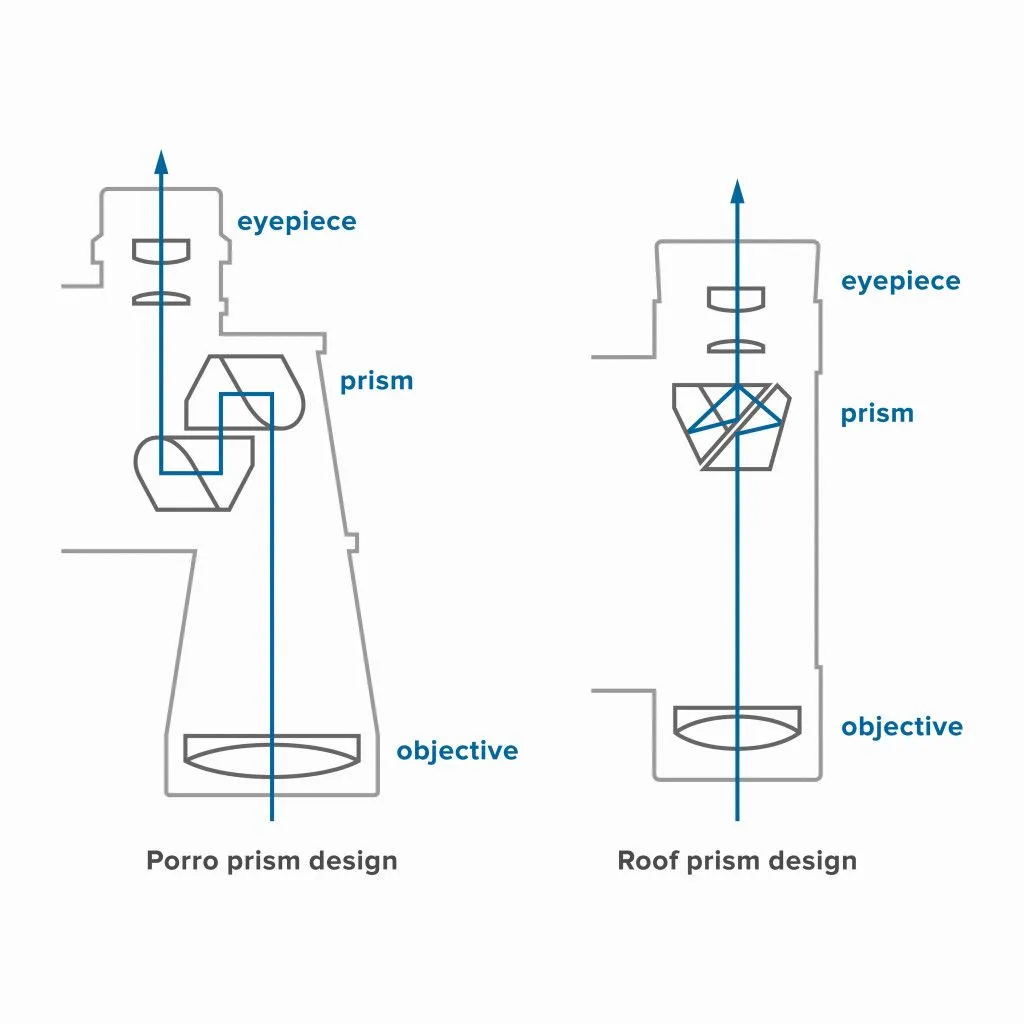
In Porro prisms, the two prisms are arranged side by side at 90⁰. This results in a bulkier structure to the binoculars.
In Roof prisms, the two prisms are arranged in a straight line along the direction of light propagation, which results in more compact binoculars.
How Do Binoculars Work?
Putting all the above inferences together, we conclude that when rays of light passing through the objective lens form an inverted image of the distant object, the arrangement of the prisms rotates it by 180⁰ and the eyepiece, in turn, produces a magnified image of the initial image, enabling the observer to easily view that object with clarity. This happens for both the left and right tubes of the binoculars.
What Does The Ray Diagram Of Binoculars Look Like?
If you have ever tried to sketch what actually happens inside a pair of binoculars, the labeled diagram below ties the whole story together. Light from a distant object enters the large objective lens, which bends those rays to a focus and forms a small, upside-down real image inside the tube. That flipped image then travels into the pair of Porro prisms, which bounce it back and forth using total internal reflection and turn it the right way up. Finally, the eyepiece works like a magnifying glass, spreading that corrected image across a wide angle so your eye sees an enlarged, upright view.

Two clever tricks hide inside that folded path. First, doubling the light back on itself lets engineers fit a long-focal-length objective into a short, hand-friendly tube, and it is that long focal length that delivers the punchy magnification. Second, the prisms space the two objective lenses wider apart than your eyes (roughly 125 mm apart, compared with the typical 68 mm gap between human pupils), and that extra separation exaggerates the stereo effect, giving you a stronger sense of depth than your eyes manage on their own.
What Do The Numbers On Binoculars Mean?
Pick up almost any pair of binoculars and you will spot a label like 8x42 or 7x50 stamped on the body. Those two numbers are simply the magnification multiplied by the diameter of the objective lens in millimeters. So an 8x42 pair magnifies the view eight times (an object 800 m away looks as though it sits just 100 m from you) through front lenses that are 42 mm across, while a 7x50 gives seven-times magnification through chunky 50 mm objectives. In effect, binoculars are a pair of small telescopes working side by side.
The second number matters more than people expect, because the objective lens is what gathers light. A lens collects light across its whole area, so its light-gathering power grows with the square of the diameter: a 50 mm objective pulls in far more light than a 30 mm one, which is why a bigger second number means a brighter image in dim conditions.
Those two figures together also set the exit pupil, the small disc of light you can see hovering in each eyepiece when you hold the binoculars at arm's length. Its diameter equals the objective diameter divided by the magnification, so an 8x42 produces a 5.25 mm exit pupil while a 7x50 produces roughly 7.1 mm. That value is worth checking, because your own pupil narrows to about 2 mm in bright daylight and opens to around 7 mm in the dark, so a wide exit pupil only pays off at night, when your eye can actually use all that light. Higher magnification also comes with one built-in catch: the field of view shrinks, which is why an 8x42 shows you a wider slice of the scene than a 10x42 does.
Different Types Of Binoculars
With advancements in science and technology, devices are becoming better each day. Binoculars have broadened their horizon of versatile use and are now classified into some specialty categories listed below:
Mini Binoculars
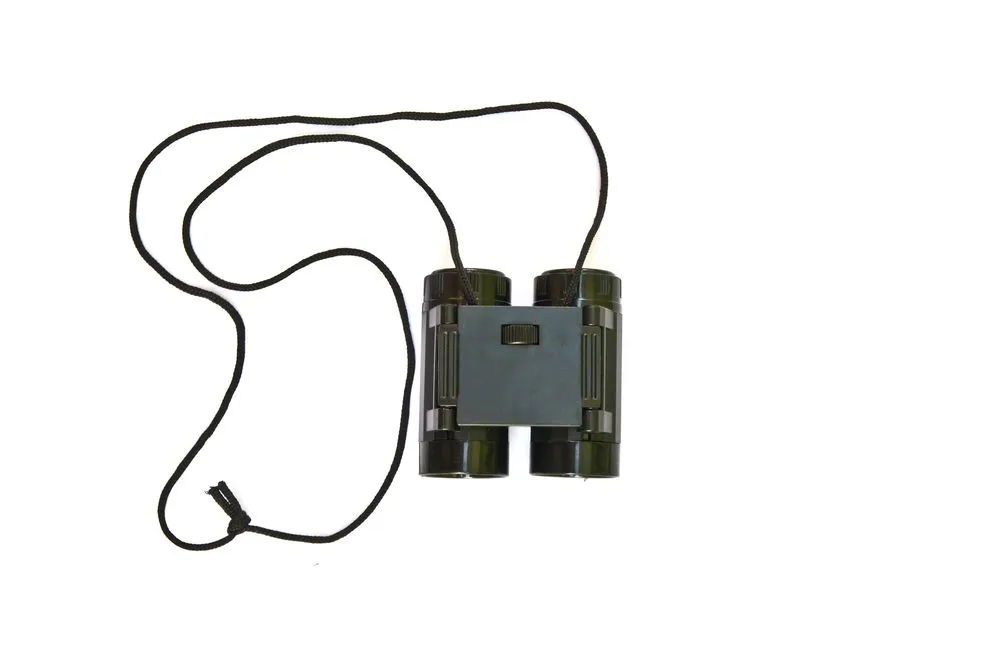
These are portable and can be stuffed into your backpack quite easily. They may be not as powerful as the full-sized ones, but still serve the purpose of magnification quite well.
Zoom Binoculars
These types of binoculars specialize in changing the magnification of the lenses according to your requirements and are able to zoom in on objects.

Wide-Angle Binoculars
As the name suggests, these binoculars have a wider field of view than normal binoculars, enabling you to cover a better range to spot objects in open spaces. These are ideal for wildlife and game spotting.

High-powered Binoculars
These are used as an alternative to telescopes by astronomers. They are ideal for long-distance viewing, due to their high level of magnification.

Night-vision Binoculars
These are probably the coolest type of binoculars, as they can enable you to see distant objects in the dark. Used especially by the military or special forces, these binoculars make use of photo-sensitive lenses and photo-cathodes. Thermal imaging may also be available in these binoculars.

A Final Word
Whether a secret agent, a celebrated soldier, or a wildlife enthusiast, when on a mission or adventure, binoculars are as essential tool. The ability to see what you want beyond the physical limitations of the human eye is quite fascinating.
Let’s just hope that someday, we can have a device that fits into our eye lens and automatically turns it into a binocular. That ability may not be far away, as technology is evolving fast!
References (click to expand)
- How do binoculars work? - Explain that Stuff
- What Do Numbers on Binoculars Mean? - A Detailed Guide [Upd. 2022] - theoptics.org
- How to Use Binoculars (the right way) - Deschutes Land Trust. The Deschutes Land Trust
- Binoculars - New World Encyclopedia. newworldencyclopedia.org
- Lab 8: Binoculars - OPTI 202L Geometrical and Instrumental Optics. The University of Arizona
- Telescopes: Magnification and Exit Pupil - ASTR 3130 Lecture Notes. University of Virginia