A lighthouse is visible for miles thanks to the Fresnel lens, which gathers scattered rays into one intense beam. But how far it reaches depends mostly on height: because the Earth curves away, a taller light reaches farther over the horizon. Powerful lights are commonly seen 20 to 30 miles (32 to 48 kilometers) out to sea.
Lighthouses have been an object of adoration and fascination for many poets and storytellers for hundreds of years. This should come as no surprise, as these tall, forlorn structures of the sea have been guiding ships and sailors for generations, not only in peaceful waters, but also in the most difficult and challenging situations.
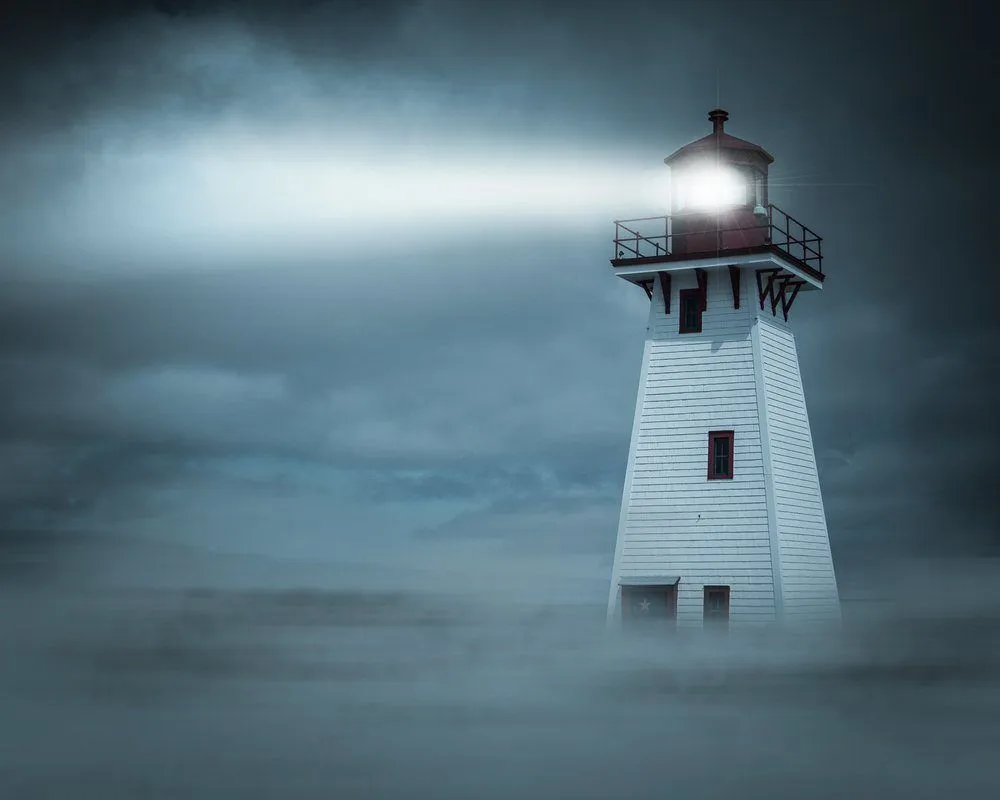
A strong beam emitted by a lighthouse is an astounding navigational aid to many ships and boats at sea. Have you ever wondered what allows the light emitted by a lighthouse to be seen by sailors who are many miles away? Is that a magic light or is there some kind of science acting behind it?
What Is A Lighthouse?
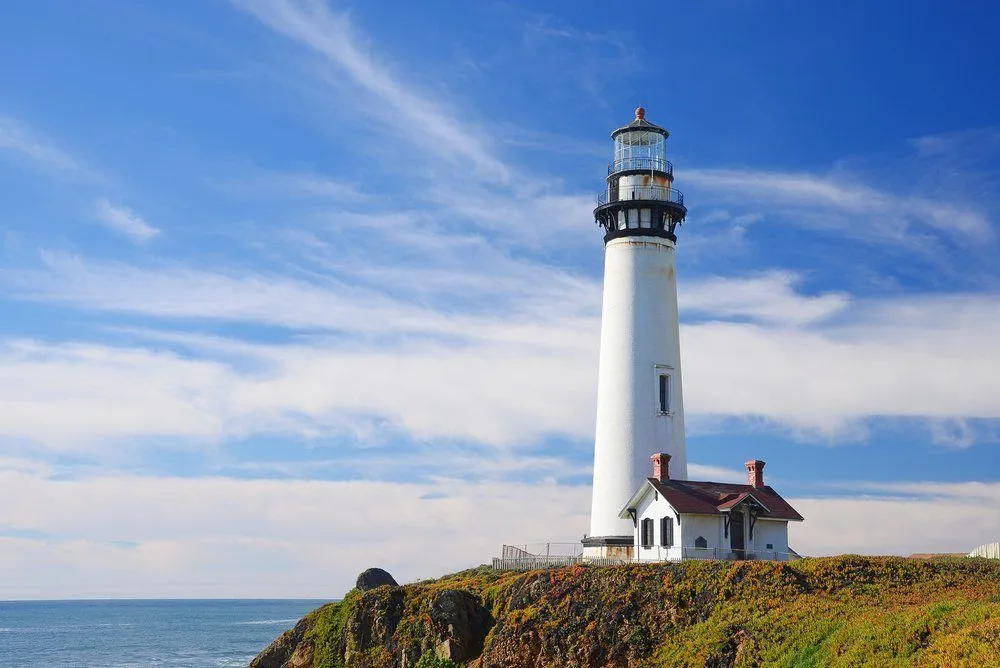
A lighthouse is a tall building (usually a tower-like structure) that contains a set of lamps and lenses that emit strong beams of light to aid navigation at sea. This light is visible over long distances and helps to guide ships toward safe harbor or away from dangerous rocks.
To support the main function of a lighthouse, which is producing a light beam, a lighthouse used to contain heavy and cumbersome systems that ensured that the light glowed both day and night. In addition to this, a lighthouse will often have a boathouse, a fog signal building, living quarters for the keeper of the system, and an oil house.
Construction Of A Lighthouse
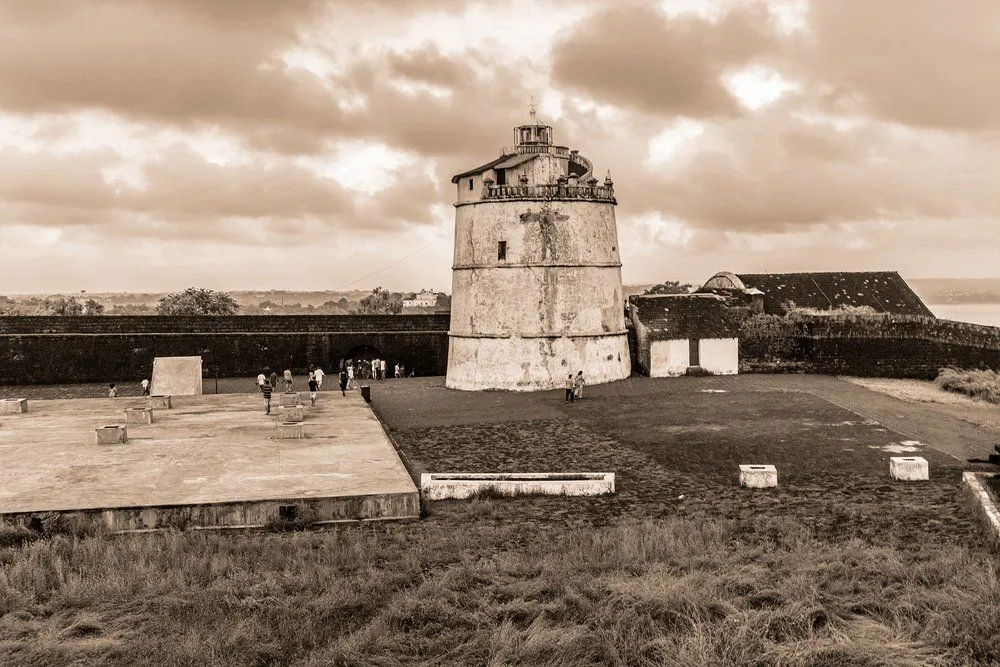
It is said that no two lighthouses are the same. In the past, lighthouses were built using the materials that were available locally and easily, such as wood, cast iron, brick, stone, concrete and various other substances. The site construction of a lighthouse can also vary significantly. Some are constructed onshore overlooking the water, while others are built offshore on small patches of rocks. The heights can also vary quite a bit. For example, if you are building a lighthouse on a cliff that is quite tall, you don’t need to make it too tall, as the height of the cliff already boosts the height of the lighthouse.
Design Of The Light System
This brings us to our first question: what makes the light glow so brightly?
The function of a lighthouse all comes down to the intensity of the light. A French physicist and engineer, Augustin Fresnel, had deduced that light was actually a kind of energy that travels in the form of waves (which was not commonly known at the time). Given that light traveled in waves, it was possible to make them converge on a single point or deflect from a certain point in different directions. He used this principle to make lenses and reflectors that were capable of capturing and then concentrating light to a specific point, making it quite powerful.
Fresnel also made lenses that had high aperture and low focal length. The lenses he made were also far smaller than the conventional lenses present at that time (in some cases, as thin as a sheet of glass). Finally, and what makes them so special, is that a Fresnel lens could capture more light from a light source and thus increase the intensity of the lamp.
The first lighthouse system that Fresnel made consisted of highly polished prisms and an array of such lenses in a concentric arrangement. The light rays contained within this system from the source were combined together (using the lenses) and thus the combined intensity was much greater than the light source itself.
The light beam emitted by such an ingenious system is visible over 20 miles (32 kilometers) away!
Following the advent of more automatic technologies, the presence of lighthouse keepers and other resources became less desirable, as automatic lamp changers emerged, eliminating the need for such traditional measures. Fortunately, the great design presented by Fresnel is still applied in lighthouses around the world and guides innumerable people at sea to this day.
How Far Away Can A Lighthouse Be Seen?
So how far away can you actually see a lighthouse? A bright beam helps, but the honest answer is that two completely different limits are at work, and the shorter one wins.
The first is the geographic (or geometric) range, and it has nothing to do with how powerful the lamp is. Because the Earth is curved, every light eventually dips below the horizon as you sail away from it. The higher the light sits, the farther over that curve it can reach. A rough rule of thumb for the distance to the horizon, in nautical miles, is 1.17 times the square root of the height in feet (or roughly 3.86 times the square root of the height in meters, giving kilometers). For a light perched 30 meters (about 100 feet) above the water seen by an observer standing 5 meters (about 15 feet) up on a ship’s deck, the two horizons add up to a geographic range of around 16 nautical miles (about 30 kilometers).
The second limit is the luminous range: the farthest the light can be seen given its intensity and the clarity of the air on a given night, ignoring the curve of the Earth. To compare lighthouses fairly, charts list a standardized version called the nominal range, measured for a clear night with a meteorological visibility of 10 nautical miles. In thick haze or fog the luminous range shrinks dramatically; on a crystal-clear night it can stretch well beyond the horizon.
In practice, whichever range is shorter sets what a sailor sees. If a powerful light’s luminous range exceeds its geographic range, the beam is still cut off at the horizon. That is why height matters so much, and why you can often spot the loom of a light, a soft glow scattered upward by water vapor in the air, well before the lamp itself climbs into view over the horizon.
Why Is A Lighthouse Beam A Classic Example Of A Ray Of Light?
If you have ever sat through a geometry lesson, you may have met this exact question: a beam of light from a lighthouse is an example of a ray. It turns out that the humble lighthouse is the textbook picture of one of the most basic ideas in both math and physics.

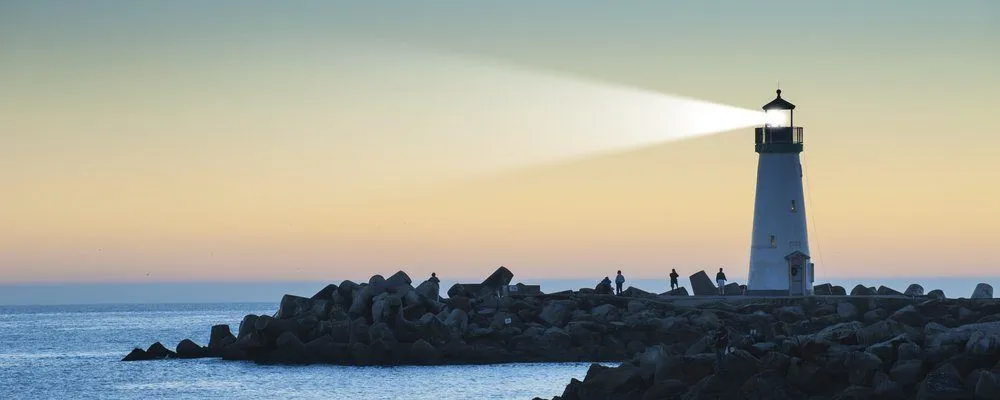
In geometry, a ray is the part of a line that starts at a single fixed point, called the initial point, and then carries on indefinitely in just one direction. That is exactly what a lighthouse beam looks like: it begins at the lamp and streams out across the sea one way, with an obvious starting point but no visible end. A full line would run away endlessly in both directions, and a line segment would have a point at each end, so neither of those describes the beam nearly as well.
The physics is just as tidy. In a uniform medium such as clear air, light travels in straight lines, a property known as the rectilinear propagation of light. A beam is simply a bundle of these straight rays traveling side by side, and each ray keeps going straight until it reaches a boundary between two different materials, where it can bend, scatter or be absorbed. That predictability is what lets a lighthouse aim its light so cleanly at the horizon.
It also sharpens the point from the previous section. Because the rays travel dead straight and cannot bend to hug the curve of the sea, a distant beam eventually passes clean over the top of a ship as the water bulges up in between. The light does not run out, it simply overshoots. That straight-line stubbornness is exactly why the curve of the Earth and the horizon, rather than the brightness of the lamp, so often decide how far a lighthouse can be seen.
How Does A Lighthouse Send A Message To Ships At A Distance?
Spotting a light is only half the job. On a coastline dotted with harbors, buoys and rival lighthouses, a sailor also needs to know which light they are looking at, and a steady glow is not much help there. Seen from far out at night, a plain fixed lamp is easy to confuse with a star, a passing ship or a window on shore, and a light that could mean anything effectively means nothing.

The fix was to give every lighthouse its own signature, known as its character. Rather than shining steadily, most modern lights blink to a set rhythm, and the exact pattern is unique to that station. The time the full pattern takes to repeat is called the period. A few of the standard characters are:
- Flashing (Fl): short bursts of light separated by longer spells of darkness.
- Occulting (Oc): the reverse, a steady light briefly blacked out at regular intervals.
- Isophase (Iso): equal amounts of light and darkness.
- Group flashing, such as Fl(3): flashes delivered in fixed groups, for example three at a time, before the sequence repeats.
Color is part of the code too, as white, red and green lights can mark safe channels or warn of dangerous ground. A navigator with a stopwatch can time the rhythm, match it against the symbol printed on a nautical chart or the entry in an official Light List, and work out precisely which lighthouse is on the horizon, which in turn helps fix the ship's own position.
Two famous towers show the idea in action. North Carolina's black-and-white striped Cape Hatteras Lighthouse, the tallest brick lighthouse in the United States, flashes white once every 7.5 seconds and is rated to be seen about 24 nautical miles (44 kilometers) away. France's Île Vierge lighthouse, the tallest traditional stone lighthouse in the world at 82.5 meters (271 feet), gives a single white flash every 5 seconds with a range of around 27 nautical miles (50 kilometers). And when fog smothers the beam altogether, many stations fall back on a fog signal, a distinctive horn or bell, so the message still reaches the ship even when the light cannot.
References (click to expand)
- Lighthouse - Wikipedia. Wikipedia
- How is the light of a lighthouse magnified so that it can be .... The Library of Congress
- How do Fresnel lenses work? - Explain that Stuff. explainthatstuff.com
- How Lighthouses Work - Adventure | HowStuffWorks. HowStuffWorks
- Lighthouse - Intensity, Visibility and Character of Lights. Encyclopaedia Britannica
- Ray (optics) - Wikipedia. Wikipedia
- Line (geometry) - Wikipedia. Wikipedia
- Light characteristic - Wikipedia. Wikipedia
- Cape Hatteras Lighthouse - Wikipedia. Wikipedia
- Île Vierge - Wikipedia. Wikipedia