Table of Contents (click to expand)
Fish see differently from us because their eyes are tuned for water rather than air. Their cornea hardly bends light underwater, so a dense, almost spherical lens does nearly all the focusing, projecting a sharp image onto the fovea (the area of sharp vision).
Have you ever opened your eyes underwater only to find that everything is blurry and out of focus? “Is this what sight is like for fish?” you wonder, “Or do they have specialized ways of seeing underwater?”
Well, not quite. To help us understand how a fish sees, let’s “look” at this subject through the “lens” of anatomy, evolution and optics.
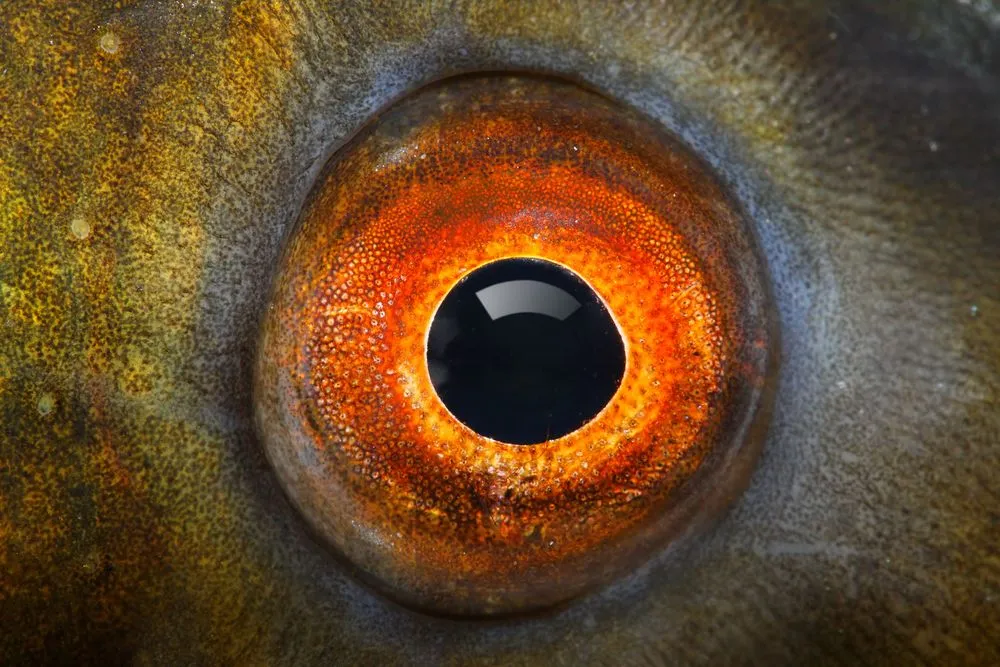
The Basic Structure Of An Eye
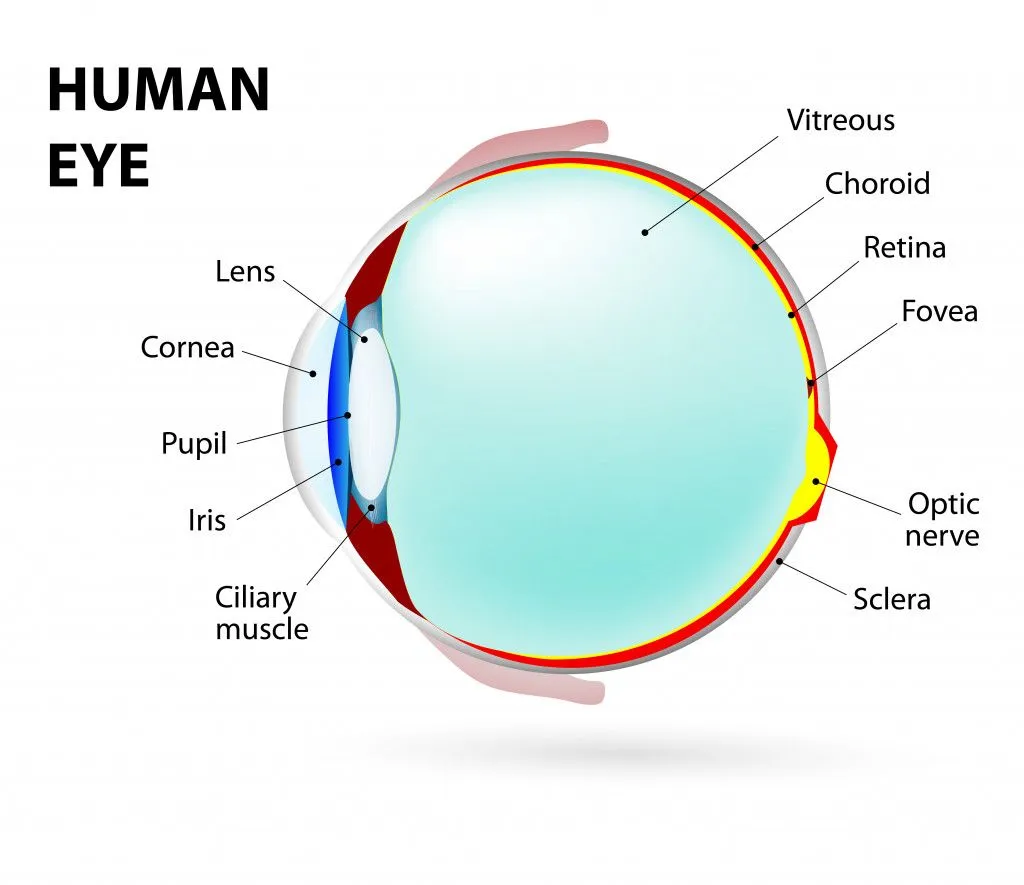
The eye has a very complex structure and function. The basic structure and function of the eye is more or less the same for all vertebrates. Despite its complexity, classic modelling work by Nilsson and Pelger (1994) suggests a camera-style eye can evolve from a simple light-sensitive patch in fewer than 500,000 years of selection. For the sake of this article, we will only be looking into three basic components: the lens, the vitreous humor, and the fovea.
When light enters through the eye, it passes through a lens and the vitreous humor. The vitreous humor is a water-like liquid, while the lens helps focus light onto the fovea. The fovea is the part of the eye where sharp images are formed. In other words, it is the part that allows us to see clearly.
Light Underwater
Seeing underwater is very different from how we see on land. Firstly, water absorbs light far more than air does, so things get darker the deeper you go. For the sake of this thought experiment, we will only look at vision down to roughly 200 meters, the lower edge of the sunlit (euphotic) zone, although faint traces of light reach down to about 1,000 meters in very clear ocean water.
Second, water “absorbs” red light the most, followed by orange, yellow, green and then blue. This means that everything underwater will appear a bit more “blue”. Things will get even bluer the deeper you go.
However, that is not the only property of light underwater. Let’s look at the property that makes everything underwater a bit blurry.
Why Is Everything Blurry Underwater?
To understand this, we must look at two things: the physics of light and the anatomy of the eye. We talked about the structure of an eye in the first subsection. In this subsection, we will look at the physics of light. To be more specific, we will look at how light behaves when underwater.
Water has a higher refractive index than air (about 1.33 versus 1.00), so light travels more slowly through it and bends when it crosses the boundary between the two. Although we don’t notice this slowing directly, it has other effects.
A common term you might hear in optics is refraction. Refraction is the bending of light when it travels between media of two different densities. One example would be when light travels from air to water. This is why a pencil will look like it’s broken or bent when you put it in water.

When light travels from a less dense medium to a more dense medium, it converges. That means it comes together. When light is focused at a certain point in the eye, it creates a sharp image, which is done by the lens.
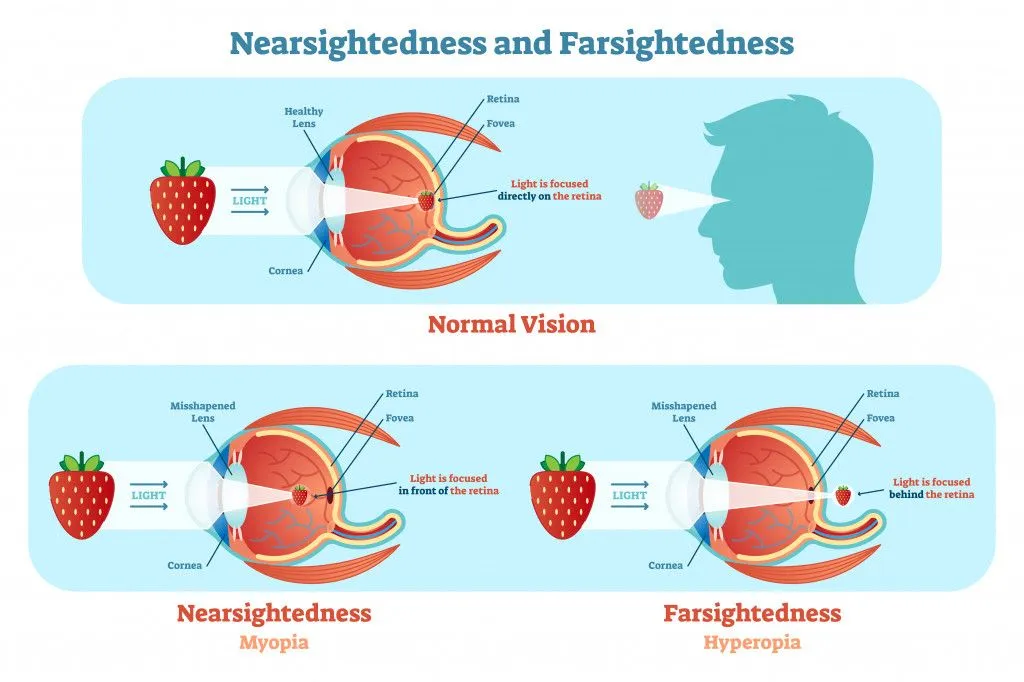
The way the lens in an eye works is by converging light. For an image to be clear, light must converge exactly at the fovea. If the light is not focused on the fovea, it creates a blurry image.
When underwater, the light passing through the eye must be refracted enough to focus on the fovea. If the light is not refracted enough, then everything looks blurry, just like in farsightedness. By looking at the diagram below for farsightedness, you will get a better idea of where the light gets focused when not refracted enough.
So, How Do Fish See Clearly?
When light travels from water into a fish’s eye, the cornea barely bends it at all. That is because the cornea sits between water (refractive index ~1.33) and the aqueous humor inside the eye (~1.336), so the two indices are almost identical and the cornea offers almost no focusing power. The lens, being noticeably denser and with a much higher refractive index than the surrounding fluid, refracts the light strongly and does nearly all the focusing. Because it is almost spherical, light also passes through a longer path inside the lens, which adds to that bending. If the lens were flatter, light would no longer converge on the fovea.
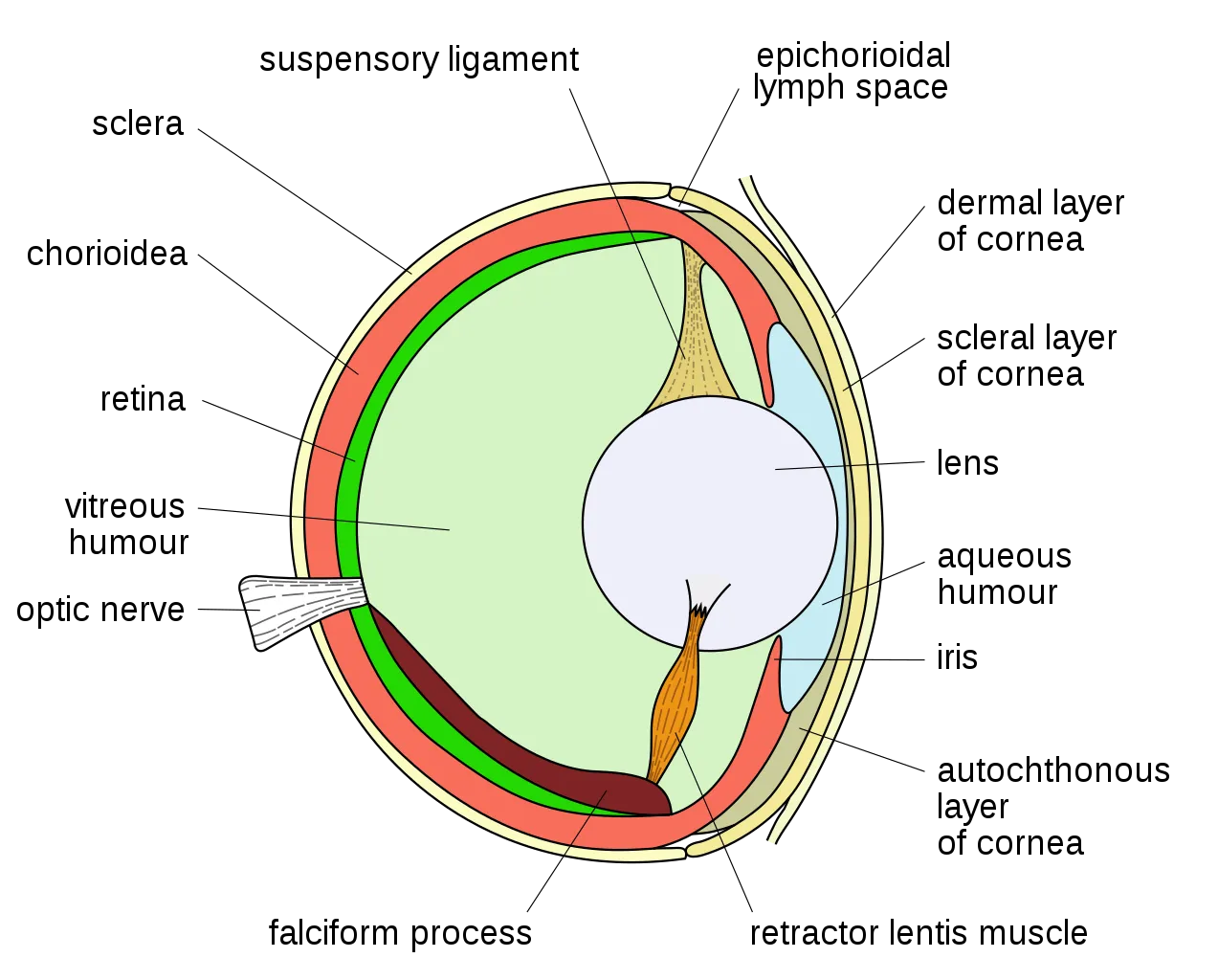
The other reason is that the angle at which the light passes through the lens is greater. This is because of the curved surface of the lens. According to Snell’s law of refraction, this makes the refraction higher. This causes the light to focus on the fovea, making images sharp underwater.
The spherical lens also warps images. From our perspective, the way a fish sees its surroundings will be a bit curved. This adaptation also gives them a wider field of view.
Conclusion
Humans and other land animals have flat lenses because they help us focus in the medium of air, while fish have a more rounded lens to help them focus in water.
You might be thinking that this is a cool adaptation for fish. That’s true, as sight in fish is very evolved and complex. However, in reality, it is the sight of terrestrial animals that has adapted more impressively. Vertebrate camera eyes first evolved in aquatic ancestors over 500 million years ago, so the lens-dominated fish eye is essentially the ancestral vertebrate design, and the cornea-dominant terrestrial eye is the later remodel.

When animals came onto land, their eyes adapted to have flatter lenses. This occurred as a way to adjust to the “extra” refraction. The flattening of the lens helped adjust for the change of density from water to air, but what about other animals that went back to water?
Some animals, like dolphins, were originally land animals that returned to marine environments 50 million years ago. When these animals started to move into the water again, they once again adapted to have spherical lenses. In addition, some species, like dolphins, started to have flatter front portions of the front part of the eye, which helped focus the light even more.
The round lenses of a fish had the added advantage of a wider range of vision. This helped them by allowing them to see more around them. This helped them look more closely for both food and foes! Land animals adapted to have flatter lenses so that everything would be less distorted, just like the images produced by a fisheye camera lens!
References (click to expand)
- Snell's Law -- The Law of Refraction - UBC Math. The University of British Columbia
- Anatomy of the Eye | Kellogg Eye Center | Michigan Medicine. umkelloggeye.org
- Dolin, L. S., & Levin, I. M. (2004, July 15). Underwater Optics. digital Encyclopedia of Applied Physics. Wiley-VCH Verlag GmbH & Co. KGaA.
- Light and Optics - Thin Lenses - Physics 299. The University of Louisville
- Wave Behaviors | Science Mission Directorate. The National Aeronautics and Space Administration
- MC Lucas. Biology of Fishes.pdf. agrifs.ir
- (2011) EVOLUTION OF THE EYE - JSTOR. JSTOR
- . (2009). Encyclopedia of Marine Mammals. []. Elsevier.
- Nilsson, D.-E., & Pelger, S. (1994). A pessimistic estimate of the time required for an eye to evolve. Proceedings of the Royal Society B.
- How far does light travel in the ocean? NOAA Ocean Service.
- Kröger, R. H. H. (1992). The optics of the spherical fish lens. Vision Research / PubMed.