3D movies exploit binocular stereoscopic vision. The film is shot or rendered as two slightly offset images, one for each eye, mimicking the roughly 6.5 cm gap between your eyes. Polarized or active-shutter glasses then route the correct image to each eye, and your brain fuses them into a single picture with depth. Movies originally shot in 2D can be converted in post-production using specialized depth-mapping software.
We’re in the Golden Age of summer blockbuster cinema right now, but realistically, this is just the beginning. Every new action-heavy, “genre” film (think superhero, fantasy, adventure films) seems to get the 3-D treatment these days – something that was extremely rare even a decade ago. The film that really set the bar in terms of 3-D was Avatar (2009), which went on to become the highest-grossing film worldwide. Since then, movies have continued to take advantage of this new technology, perhaps due to a combination of enhancing the movie-watching experience and increasing their earnings.
So, what exactly does watching a movie in 3-D involve? What is it about this fascinating technology that entices movie-going audiences around the world?
The Basics
3-D, as we know, stands for 3-dimensional. Anything that has length, width and height is considered to have 3 dimensions. When we talk about a 3-D film, however, we refer to one of those dimensions as “depth”. The more depth an object has on-screen, the more real it seems to us, thereby enhancing our viewing experience.

As human beings, we have incredible depth perception. Because our eyes are slightly set apart, each eye has a slightly different perspective of what we’re looking at. Therefore, our retinas (layer of our eyes upon which light is received) form two different 2-dimensional images, which are instantly pieced together by our brain to form a 3-dimensional picture of the world around us. This is known as stereopsis or stereoscopic vision.
![Stereopsis In Action. Credit: Keystone View Company (http://www.loc.gov/pictures/item/00651076/) [Public domain], via Wikimedia Commons](https://uploads.scienceabc.com/2016/02/A_typical_Irish_street_in_Cork_Ireland_LC-USZ62-123727.gif)
How Movies Accomplish This
Essentially, movies try to mimic the stereoscopic capabilities of human eyes. The cameras used for shooting 3-D films have 2 lenses placed adjacent to each other, closely resembling a pair of human eyes. Alternatively, movies shot using regular 2-D cameras can be converted to 3-D in post-production using special 2-D to 3-D conversion software. Visual effects would have to be created using computer-generated imagery (CGI) to accomplish the same effect (animated 3-D films are produced in a similar fashion).
This arrangement enables two sets of images to be captured, each with a slightly different perspective. In the cinema, both sets of images are projected simultaneously onto the screen. Now, all that needs to be done is for our eyes to merge those two images into one, 3-dimensional picture. This is where those 3-D glasses come in.
3-D Technology
Traditionally, each lens of the camera had a different color filter. The lens capturing images meant for the left eye would have a red filter and the lens doing the same for the right eye would have a blue/cyan filter. This produced two different-colored images that, upon being projected on the screen simultaneously, could be viewed as one stereoscopic image using red-cyan glasses (I’m sure this is the most common version that springs to mind at the mention of “3-D glasses”).
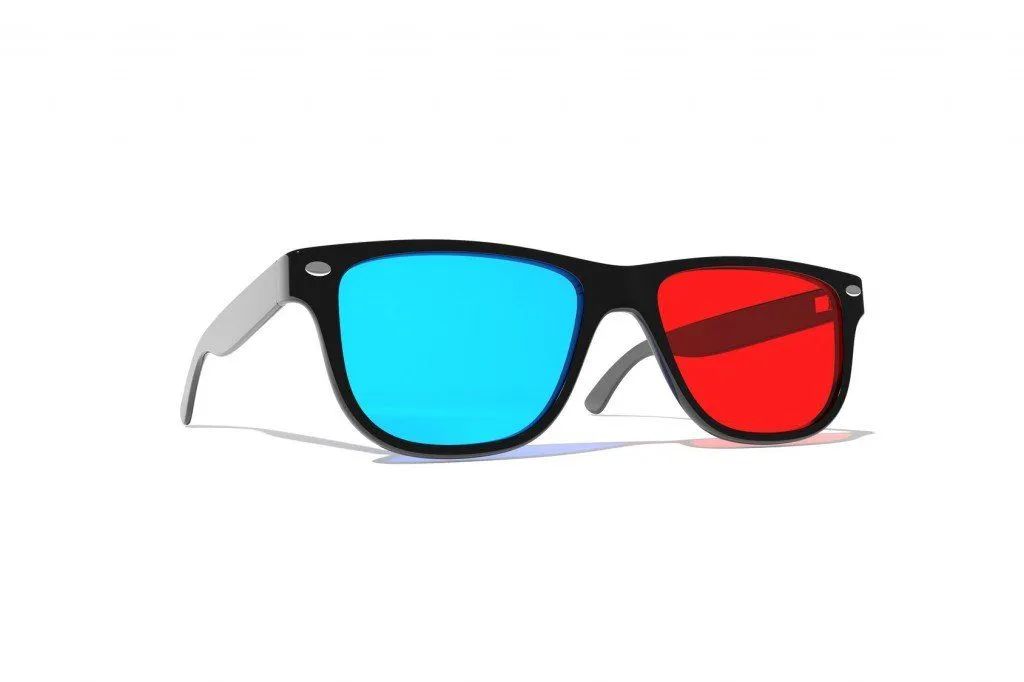
Due to their use of the same two opposing colors used as filter lenses to capture the images, each lens of the anaglyph 3-D glasses allows only the corresponding color image into the eye. Therefore, each eye is viewing a different perspective of the virtual object, similar to how a real object would be viewed. This stereoscopic 3-D effect is known as anaglyph 3-D.
![An example of an Anaglyph Image. By Kim Scarborough (Own work) [CC BY-SA 3.0 us (http://creativecommons.org/licenses/by-sa/3.0/us/deed.en)], via Wikimedia Commons](https://uploads.scienceabc.com/2016/02/Art_Institute_of_Chicago_Lion_Statue_anaglyph_stereo.webp)
It’s All About Polar Opposites
Instead of projecting red and blue light onto the screen, modern projection techniques use polarized light. Here, the two images are projected through oppositely polarized filters in the cinema. One is horizontally polarized and the other is vertically polarized. Some projectors even use clockwise and counterclockwise polarization for the same purpose.
![An illustration of how light is polarized. Credit: Dave3457 (talk) 21:42, 10 February 2010 (UTC) (Own work) [Public domain], via Wikimedia Commons](https://uploads.scienceabc.com/2016/02/724px-Circular_Polarizer_Creating_Clockwise_circularly_polarized_light.svg_.webp)

Who Invented 3-D Movies, And When?
The depth trick at the heart of every 3-D film is older than cinema itself. In 1838, the British scientist Charles Wheatstone built the first stereoscope, a device that used a pair of angled mirrors to feed each eye a slightly different drawing of the same object. He described it that year in the Philosophical Transactions of the Royal Society, in a paper titled Contributions to the Physiology of Vision, and showed that the brain fuses two flat, slightly offset images into a single solid-looking scene. A decade later, the Scottish physicist David Brewster replaced Wheatstone's bulky mirrors with prisms, producing a compact, lens-based stereoscope that became a Victorian living-room sensation. Long before any film camera existed, people were already using both eyes to conjure depth out of paper.

Moving pictures inherited the idea. The anaglyph print, the two-color images you decode with colored glasses, was invented by Louis Ducos du Hauron in 1895. The first feature commonly credited as a 3-D movie, The Power of Love, screened in Los Angeles in 1922 using a red-and-green anaglyph process. The real explosion came in the 1950s: Bwana Devil, written and directed by Arch Oboler, premiered on 26 November 1952 as the first feature-length 3-D film in color, shot with the Natural Vision system and projected through polarizing filters. It set off a brief 3-D craze, with titles like House of Wax following in 1953. That boom faded, and 3-D stayed a novelty until Avatar (2009) and digital projection pulled it back into the mainstream.
How RealD, IMAX And Dolby 3-D Differ
Walk up to a modern box office and you will see several "flavors" of 3-D on the menu, and they are not all the same technology under the hood. They all start from the same place, two slightly different images, one per eye, but they keep those images apart in different ways.

RealD 3-D is the most common format in cinemas worldwide. A single digital projector alternates the left- and right-eye frames very rapidly, while a push-pull liquid-crystal modulator called a Z-screen sits in front of the lens and stamps each frame with circular polarization, clockwise for one eye and counterclockwise for the other. Because the polarization is circular rather than linear, you can tilt your head without the 3-D effect breaking down. The lightweight glasses contain no electronics, just matched circular polarizers, and the image bounces off a special silver screen that preserves polarization.
IMAX 3-D traditionally relies on linear polarization (often using two separate projectors), which delivers a very bright image on a giant screen but is less forgiving if you tilt your head. Dolby 3-D takes a completely different route called spectral, or wavelength, multiplexing: instead of polarizing the light, it splits the red, green and blue parts of the spectrum into two slightly different sets of wavelengths, one set per eye, and the glasses carry narrow-band filters that admit only the correct bands. Finally, active-shutter systems (used by some cinemas and most older 3-D televisions) use battery-powered glasses with liquid-crystal lenses that alternately darken, blacking out the left eye while the right-eye frame is shown and vice versa, kept in step with the screen by an infrared or radio sync signal. Different mechanisms, same goal: deliver one image to each eye and let your brain do the rest.
3-D movies have both a fascinating history and some impressive science behind them. It’s exciting to see how the technology has changed and advanced through the ages and how it will improve even further in the future.
References (click to expand)
- 3D film - Wikipedia. Wikipedia
- Wired Explains: How 3-D Movie Projection Works. Wired
- How do 3D films work? | Explore | physics.org - www.physics.org:80
- 180 years of 3D. The Royal Society
- Stereoscopy. Encyclopaedia Britannica
- Bwana Devil - Wikipedia. Wikipedia
- Active shutter 3D system - Wikipedia. Wikipedia
- Dolby 3D - Wikipedia. Wikipedia