Table of Contents (click to expand)
Carbon fiber is made by spinning a polyacrylonitrile (PAN) precursor into thin fibers, stabilizing them in air at 200-300°C, and then carbonizing in an oxygen-free furnace at roughly 1,000-1,500°C to drive off the non-carbon atoms. What is left is an almost pure carbon filament, with graphite-like sheets aligned along its length, that is then surface-treated and sized.
Carbon fiber (sometimes called graphite fiber) is a solid material that is extremely lightweight for its strength. On a strength-to-weight basis it is incredibly tough: roughly five times stronger than steel and, in the higher-modulus grades, two to five times as stiff, at about a quarter of steel’s density. That combination of high strength, high stiffness and low weight is exactly why carbon fiber has become the material of choice in aerospace, Formula 1, wind turbine blades, high-end bikes and a growing list of consumer products. Now, let’s take a look at the classification and raw materials of carbon fiber.
Classification And Raw Materials
Carbon fibers are graded by their tensile modulus, a measure of stiffness (how much a fiber resists stretching for a given pulling force per unit cross-section). The traditional unit is psi (pounds of force per square inch); 1 million psi is roughly 6.9 GPa. Carbon fibers classed as low modulus have a tensile modulus below 34.8 million psi (240 GPa). Stepping up, the other grades are standard modulus, intermediate modulus, high modulus, and ultrahigh modulus. Ultrahigh-modulus carbon fibers reach 72.5-145 million psi (500-1,000 GPa). Steel, by comparison, has a tensile modulus of only about 29 million psi (200 GPa). So the stiffest grades of carbon fiber are roughly two-and-a-half to five times as stiff as steel along the fiber direction, and on a strength-to-weight basis they are about five times stronger.
The raw material used to make carbon fiber is called the precursor. Around 90% of the carbon fibers produced today are made from polyacrylonitrile (PAN). The remaining 10% is made from rayon or petroleum pitch (a thick by-product of petroleum refining). All of these are organic polymers, meaning long, chain-like molecules built from repeating units linked by carbon-carbon bonds. The PAN used for carbon fiber is typically a copolymer: roughly 93-95% acrylonitrile blended with a few percent of a comonomer such as methyl acrylate, methyl methacrylate or itaconic acid, which makes the fiber easier to spin and to stabilize. During the manufacturing process, various gases and liquids are also brought in. Some of them react with the fiber to produce a specific effect; others are there to keep certain reactions from happening. As with the precursors, the exact compositions of many of these process materials are considered trade secrets.
Manufacturing Process
The process of making carbon fiber is unusual in that it is part mechanical and part chemical. The precursor is first drawn into long strands and then heated to a very high temperature without allowing them to come in contact with oxygen. Without oxygen, the fiber cannot burn. Instead, the heat causes the atoms in the fiber to vibrate violently until most of the non-carbon atoms are driven out. This step is called carbonization, and it leaves a long, thin fiber that is almost entirely carbon, with its atoms locked into tightly bonded sheets running along the fiber. The fibers are then coated to protect them from damage during winding or weaving, and are wound onto cylinders called bobbins, ready to be turned into cloth, tape or composite parts.
The first process is known as the spinning process. Acrylonitrile, a small carbon-rich molecule, is mixed with a small amount of a comonomer such as methyl acrylate or methyl methacrylate, and is reacted with a catalyst in a conventional suspension or solution polymerization process to form polyacrylonitrile (PAN). The PAN is then spun into fibers using one of several different methods. In one common approach (wet spinning), the dissolved polymer is pumped through a spinneret with tiny holes into a chemical bath, where it coagulates and solidifies into thin filaments. The spinning step is important, because the way the polymer chains line up here sets the internal atomic structure of the finished fiber. The fibers are then washed and stretched to the desired diameter (typically around 5-10 micrometers, about a tenth of the width of a human hair).
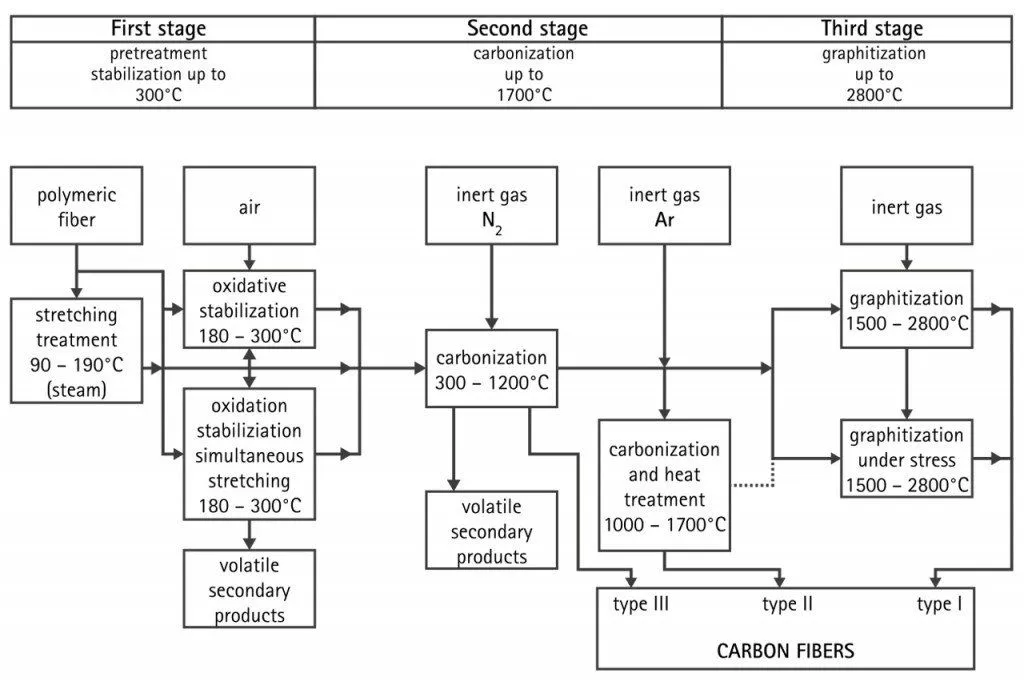
The subsequent step is the stabilizing of the fiber. The stabilizing process is done because the fibers need to be chemically altered to convert their linear atomic bonding to a more thermally stable ladder bonding. The stabilization process is done by heating the fiber in air at 200-300°C (about 390-570°F) for 30-120 minutes. This ensures that the fibers pick up oxygen molecules from the air and rearrange their atomic bonding pattern. Once the fibers are stabilized, we move into the carbonizing process, where they are heated to roughly 1,000-1,500°C (about 1,800-2,700°F) for several minutes in a furnace filled with an inert gas mixture (typically nitrogen or argon) that does not contain oxygen. This lack of oxygen prevents the fibers from burning at those high temperatures. The gas pressure inside the furnace is kept higher than the outside air pressure, and the points where the fibers enter and exit the furnace are sealed to prevent any oxygen from entering. The heat drives off the non-carbon atoms (mostly hydrogen, nitrogen and oxygen) as gases, leaving behind a fiber that is roughly 92-99% carbon. The remaining carbon atoms organize into stacks of graphene-like sheets oriented more or less parallel to the long axis of the fiber (a structure known as turbostratic graphite), which is what gives the finished fiber its stiffness along its length. In practice, two furnaces operating at two different temperatures are often used to control the heating rate through the carbonization phase. To make the ultra-high-modulus grades, the fibers are passed through a further graphitization step at about 2,000-3,000°C (3,600-5,400°F), which further aligns the graphene sheets and pushes stiffness up sharply.
After carbonization comes the surface treatment stage. Straight off the furnace, the fiber surface is too smooth and chemically inert to stick well to the epoxies and other resins used in composites. Adding oxygen atoms to the surface of the fiber gives it the chemical hooks it needs to bond properly. Oxidation can be achieved by passing the fibers through gases such as air, carbon dioxide or ozone, or through liquids such as sodium hypochlorite or nitric acid. More commonly today, the fibers are oxidized electrolytically, with the fibers acting as the positive electrode (anode) in a bath of electrically conductive solution. The treatment has to be carefully controlled to avoid tiny surface defects, such as pits, that could cause fiber failure under load. Once the fibers are treated, they go through the final step, called sizing. A thin polymer coating, typically an epoxy (or polyester, nylon or polyurethane chosen to match the resin it will be combined with), is applied to protect the fiber during handling and to act as a chemical bridge to the resin matrix. The sized fibers are then wound onto bobbins and shipped to manufacturers, who weave them into cloth, lay them up as unidirectional tape, or mold them into the carbon fiber composite parts that end up in aircraft, race cars, bicycles and countless other products.
References (click to expand)
- Fabrication and Properties of Carbon Fibers. Materials (Basel). PMC, National Library of Medicine.
- A comprehensive study on the effect of carbonization temperature on the physical and chemical properties of carbon fibers. Scientific Reports (Nature).
- Carbon fiber. Encyclopaedia Britannica.
- Materials Chemistry. MIT 3.082 course materials (Internet Archive).
- Advanced Carbon Fibers from Lignin. Iowa State University (Internet Archive).