Table of Contents (click to expand)
The different properties of graphite and diamond are due to the different arrangements of carbon atoms in their crystal structures. In diamond, the carbon atoms are arranged in a tetrahedral structure, while in graphite, the carbon atoms are arranged in 2D sheets. The different arrangements of carbon atoms result in different chemical and physical properties for the two allotropes.
Diamond and graphite are two allotropes of the same element (carbon) and the differences in their properties are a result of the way their crystal structures are arranged. Both diamond and graphite are made of pure carbon, yet they have dramatic differences in their properties. As allotropes of the same element, you might expect them to share many similarities, but that simply isn’t the case.
At first, this question might seem odd to many people. Diamond and graphite… doesn’t sound like a particularly sensible combination. Diamond and gold, or diamond and sapphire would make more sense, right? So, why is diamond pitted in the same category with graphite – the thing that we find inside our pencils?
Well, if you had paid attention to your Chemistry lessons in high school, you would know that there is, in fact, a very strong structural connection between the two.
What’s the connection between the two? And why are they so different from each other?
What Are Allotropes?
Allotropy (also referred to as ‘allotropism’) of an element is that element’s ability to exist in multiple forms in the same physical state with a different arrangement of its atoms. The different forms are called allotropes of the given chemical element.
Imagine that you have 36 balls that you can arrange in any number of patterns to obtain visually distinct geometrical shapes.
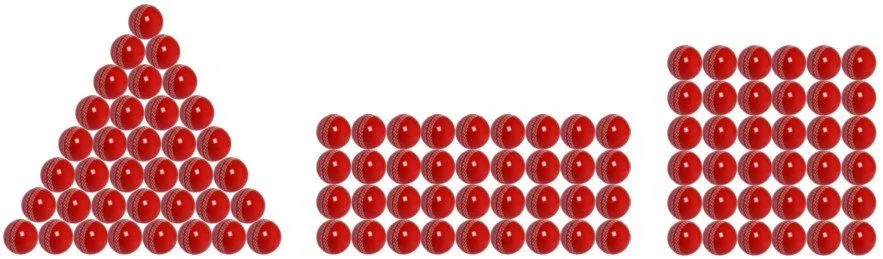
The constituent pieces of these shapes (balls) represent atoms, and the different shapes they assume (due to their varied arrangements) are the allotropes.
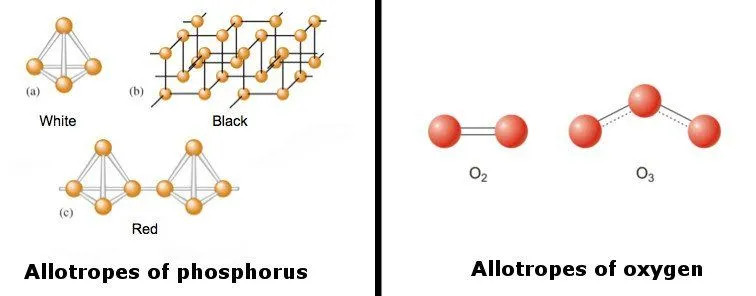
Allotropes of the same element have different bonding arrangements, which give rise to different chemical and physical properties for the substance. Furthermore, different allotropes can also differ in the occurrence of molecules in the number of atoms.
The following image features various allotropes of phosphorus and oxygen.
Allotropes Of Carbon
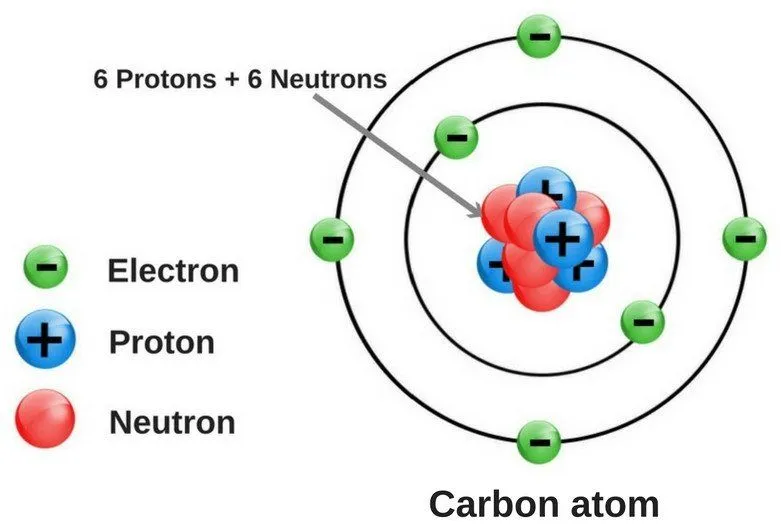
In the world of allotropes, carbon is nothing less than a rockstar. It has the ability to form many allotropes, thanks to its chemical structure. Its atomic number is 6, which means that it has 4 electrons in its valence shell.
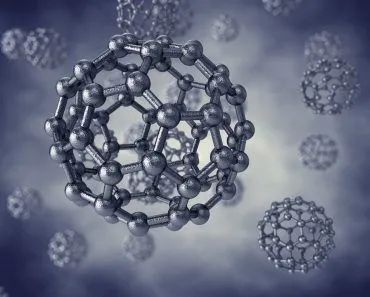
Scientists have identified numerous allotropes of carbon, including diamond, graphite, graphene, fullerenes (buckyballs), carbon nanotubes, lonsdaleite, carbon nanofoam and glassy carbon. New allotropes continue to be discovered. In 2019, for instance, researchers at Oxford and IBM Research in Zurich created and imaged cyclo[18]carbon, a ring of just 18 carbon atoms, for the first time.
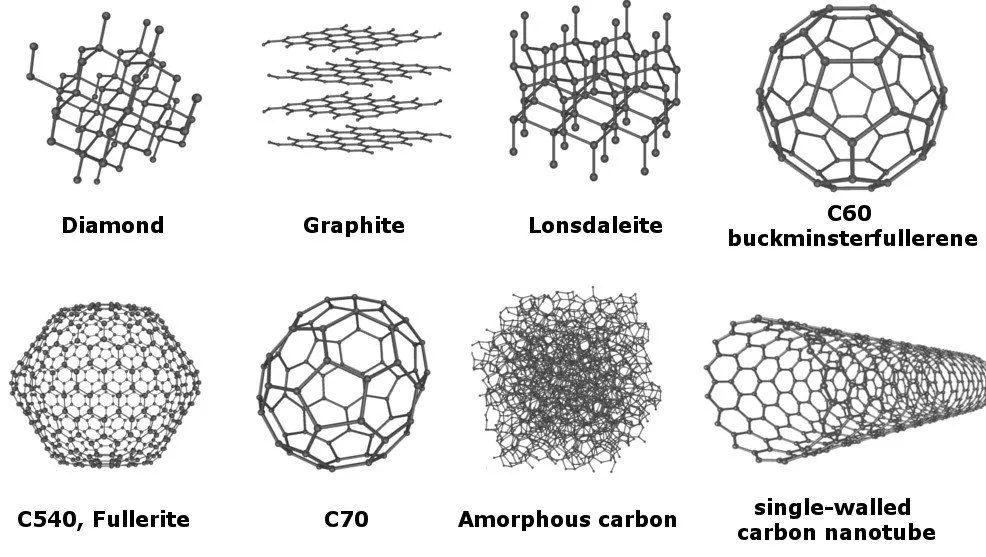
However, out of all the known allotropes, the most popular ones are diamond and graphite. These two allotropes, which visually appear incredibly different, are still made of nothing but carbon. Although their composition is the same, they exhibit different chemical and physical properties, thanks to the arrangement of carbon atoms within them.
Why Is Diamond Hard, But Graphite Is Soft, Despite Being Composed Of The Same Element (Carbon)?
It boils down to a single factor: geometry.
The arrangement of carbon atoms in diamond follows a tetrahedral fashion, with each carbon atom undergoing sp3 hybridization. This means that each carbon atom is attached to 4 other carbon atoms at bond angles of 109.5 degrees, forming strong covalent bonds.
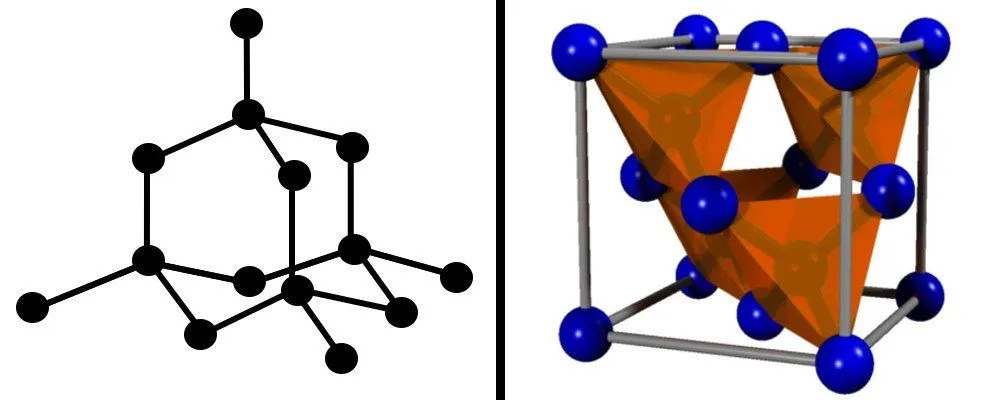
This crystal arrangement is energetically very favorable and imparts that characteristic strength, durability and rigidity to diamond. Diamond has a density of 3.51 g/cm3 and because all four valence electrons are used in bonding, diamond does not conduct electricity. To scratch or break it requires a high amount of force, which makes it one of the hardest naturally-occurring materials on the planet.
Graphite, on the other hand, has an entirely different geometric arrangement than diamond. Its carbon atoms undergo sp2 hybridization and are arranged in 2D sheets, where each carbon atom is bonded to three other carbon atoms at 120-degree angles to form hexagonal rings in an infinite array. Although the bonding of atoms within each individual layer is covalent and therefore quite strong, the bonding between layers is weak (Van der Waals forces). Because each carbon uses only three of its four valence electrons for bonding, the fourth electron is delocalized across the layer, which is why graphite can conduct electricity along its planes.
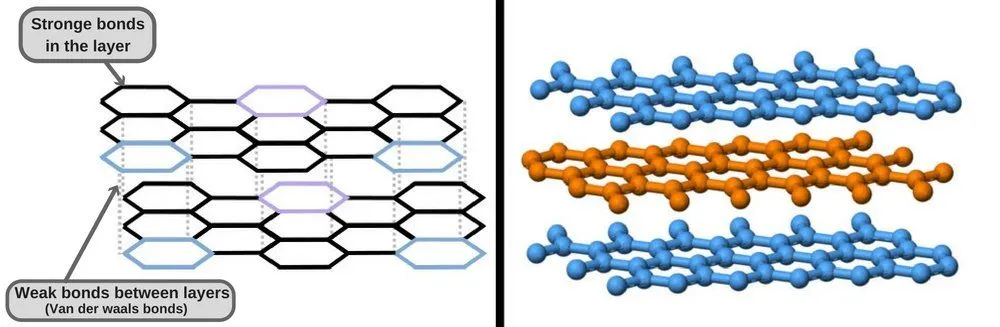
The result of this is that the layers slide over each other and can detach from each other very easily. These weak bonds between the multiple sheets of carbon atoms make the graphite used in pencils flake off on paper, allowing you to write. In addition to being soft and slippery, graphite also has a much lower density (2.26 g/cm3) than diamond (3.51 g/cm3), because of the relatively large amount of space between its layers.
The one thing about all of this that amazes me most is how a few tweaks in the chemical structure of identical substances make them so massively different in their appearance, toughness and chemical properties!
Diamond Vs Graphite: The Key Differences At A Glance
We have seen why the two behave so differently, but it helps to put their properties side by side. Remember, both are 100% pure carbon. Nothing else is added, removed or contaminating them. The only thing that changes is how the carbon atoms are wired together, and that single change cascades into almost every property you can measure.

- Bonding: Diamond uses sp3 hybridization (every atom bonded to four others); graphite uses sp2 (every atom bonded to three others in flat sheets).
- Structure: Diamond is a rigid 3D tetrahedral network; graphite is stacked 2D hexagonal sheets held together by weak forces.
- Hardness: Diamond scores a perfect 10 on the Mohs scale, the hardest natural material known. Graphite scores just 1 to 2, soft enough to leave a mark on paper.
- Density: Diamond is 3.51 g/cm3; graphite is only 2.26 g/cm3, because of the open spacing between its layers.
- Electricity: Diamond is an excellent insulator; graphite conducts electricity along its sheets.
- Appearance: Diamond is transparent and brilliant; graphite is opaque, grey-black and greasy.
One question that surprises people: if diamond is so much tougher, is it also the more stable form? Actually, no. At ordinary room temperature and pressure, graphite is the thermodynamically stable form of carbon, and diamond is technically metastable. Diamonds should, in theory, slowly turn into graphite. The reason they do not is a huge energy barrier that must be overcome to rearrange the bonds, so the conversion is so slow at normal conditions that it is effectively never. This is the kernel of truth behind the slogan "diamonds are forever." You can read more about that in our piece on whether diamonds are really forever.
Why Does Graphite Conduct Electricity But Diamond Does Not?
Here is a genuinely strange fact: a lump of soft pencil "lead" will carry an electric current, while a flawless diamond, the hardest thing on the planet, refuses to. Both are pure carbon, so what gives? Once again, the answer is in the bonding.

Each carbon atom has four outer (valence) electrons. In diamond, all four are locked into rigid covalent bonds with neighboring atoms (the sp3 arrangement). There are no spare, mobile electrons to carry a current, so diamond is one of the best electrical insulators we know of. (It is, however, a superb conductor of heat, which is a separate story.)
In graphite, each carbon atom is sp2 hybridized and forms only three in-plane bonds. That leaves a fourth electron in a p-orbital sticking out above and below each sheet. Across a whole layer, these leftover electrons merge into a shared, delocalized cloud that can drift freely along the plane. Apply a voltage, and those electrons flow, which is exactly what an electric current is. That is why graphite conducts well within its sheets but poorly from one sheet to the next, and why it is used for electrodes and motor brushes.
Where Does Graphene Fit In?
If you have heard graphene called a "wonder material," here is the punchline: graphene is simply a single, one-atom-thick layer of graphite. Peel graphite down to one sheet of that hexagonal carbon honeycomb, and you have graphene. Stack hundreds of graphene sheets back up and you are holding graphite again.

Graphene was first isolated in 2004 by Andre Geim and Konstantin Novoselov at the University of Manchester, who famously lifted it off a block of graphite using ordinary adhesive tape. The two shared the 2010 Nobel Prize in Physics for the work.
What makes it special is that, freed from its neighbors, that single sheet is extraordinary. In a 2008 nanoindentation study published in Science, researchers measured graphene's intrinsic tensile strength at about 130 gigapascals, making it the strongest material ever tested, far stronger than steel and tougher in this sense than diamond. So strictly within a single layer, graphite's carbon bonds are not weak at all. It is only the flimsy forces between the layers that make bulk graphite soft and slippery. Diamond, by contrast, has no easy planes to slide along, which is what makes it so uncompromisingly hard.
References (click to expand)
- Allotropy - Wikipedia. Wikipedia
- Allotropes of carbon - Wikipedia. Wikipedia
- Materials. The University of California, Santa Barbara
- Why is diamond harder than coal if they are both made up of carbon? - UCSB Science Line. The University of California, Santa Barbara
- How can graphite and diamond be so different if they are both .... Scientific American
- The Three Forms of Carbon. University of Michigan, Materials Science and Engineering
- Measurement of the elastic properties and intrinsic strength of monolayer graphene. Science (2008). PubMed / NCBI
- An sp-hybridized molecular carbon allotrope, cyclo[18]carbon. Science (2019). PubMed / NCBI
- Carbon - Wikipedia. Wikipedia