The lightest solid material on Earth is graphene aerogel, with a density of about 0.16 mg/cm³ (lighter than air). Created at Zhejiang University in 2013, it belongs to the broader family of aerogels: porous, near-weightless solids that are 95-99.8% air, made by replacing the liquid inside a gel with gas without collapsing the solid skeleton.
Have you ever dreamt of sleeping on fluffy white clouds, or diving into a pool of solid air? Aerogels do look a lot like that fantasy wool, although they behave very differently. They are among the lightest solid materials ever made (the current record-holder, a graphene aerogel, has a density of only 0.16 mg/cm³, lighter than air itself), and despite weighing next to nothing, they are surprisingly sturdy and remarkably resistant to a wide range of harsh conditions.
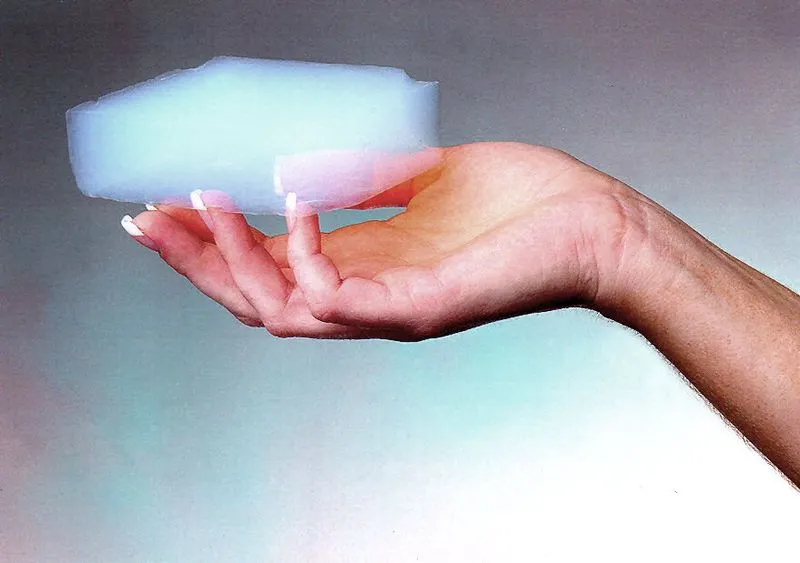
“Aerogel” is not a single substance like cotton or graphene, with one fixed chemical formula. Instead, it is a diverse class of solid, porous materials that share a particular geometrical structure (an extremely porous solid foam, with a highly branched skeleton running all the way through it). These nano-scale linkages, spanning only a few nanometers, are surprisingly strong and durable. And much to your surprise, these “mystically flamboyant” materials have been around for far longer than you might imagine. American chemistry professor Samuel Stephens Kistler first published his work on aerogels in Nature in 1931, after a long stretch of trial and error reportedly sparked by a bet over whether the liquid inside a jar of jelly could be replaced with gas without shrinking the jelly itself.
How To Make Aerogel?
Imagine preparing a bowl of sweet gelatin dessert. Making an aerogel is, oddly enough, quite similar. Gelatin powder is mixed into hot water and then cooled in the refrigerator. What you get is a gel. At this point, an aerogel and your regular edible jello are no different. If you then placed this wiggly gel in an oven and drove off all the moisture, the jelly would undoubtedly turn to dusty powder, because as the water leaves as steam, the surface tension at the receding liquid surface pulls the solid network inward and crushes it.
However, if you somehow managed to pull out all the liquid content of the gel, without damaging the solid structure and shape, what you would be left with is a low-density, extremely porous solid. This is precisely how aerogels are made.
So, how do you pull out the liquid without damaging the solid? Here’s a video demonstrating a DIY aerogel.
The Answer: Supercritical Drying
Supercritical drying is an intricate technique that pulls the liquid out of a gel without letting capillary action tear the solid skeleton apart. The trick relies on the fact that all pure substances (that do not decompose first) have a critical point: a specific pressure and temperature at which the distinction between liquid and gas disappears. Above that point, the substance becomes what is called a supercritical fluid.
To make a silica aerogel, the wet silica gel is placed inside a sealed pressure vessel along with a working fluid (most modern labs use liquid carbon dioxide, which goes supercritical at a gentle 31.1 °C, 88 °F, and 7.4 MPa). The vessel is fitted with a pressure gauge and a controlled heater. A certain amount of the liquid evaporates inside the container until its vapor pressure and the pressure in the vessel equalize. Heating the container then drives the pressure up further, because the vapor pressure of a liquid rises with temperature. As the critical point of the fluid is approached, the pressure squeezes the vapor molecules close enough together that the vapor becomes almost as dense as the liquid.
At the same time, the temperature inside the vessel becomes high enough that the kinetic energy of the molecules in the liquid overwhelms the attractive forces holding them together. Eventually, the critical point is reached, the meniscus between liquid and vapor dissolves, and the contents merge into a single supercritical phase. In this state, the surface tension inside the pores falls all the way to zero, and the capillary stress that would otherwise crush the gel collapses with it.
Aerogelification
The supercritical fluid now fills the entire vessel, including the pores of the gel itself. Because there is no longer any surface tension to fight, the fluid inside the pores can finally be vented away without yanking the solid framework inward. This is done by partially depressurizing the vessel (but never below the critical pressure). The temperature must also stay above the critical temperature throughout this step.
The objective is to remove enough fluid while it is still supercritical, so that when the vessel is finally depressurized below the critical point, there is too little substance left to re-condense as a liquid. Once enough has been vented, the vessel is slowly depressurized and cooled back to ambient conditions. The small amount of fluid still inside drifts back through the critical point and quietly turns to gas, never crossing a liquid-vapor boundary inside the pores. The capillary stress that would have crushed the structure never arises, and what is left behind is the aerogel.
Types Of Aerogel
Aerogels fall into three broad families: silica, carbon, and metal-oxide. Newer cousins like polymer and graphene aerogels (a carbon variant) belong to these same families but push the properties to extremes. In fact, the lightest solid material ever recorded, a graphene aerogel produced by Professor Gao Chao’s group at Zhejiang University in 2013, has a density of just 0.16 mg/cm³, lower than the density of air. Each family has found a wide range of applications in modern equipment, thanks to its unique structural and chemical properties.
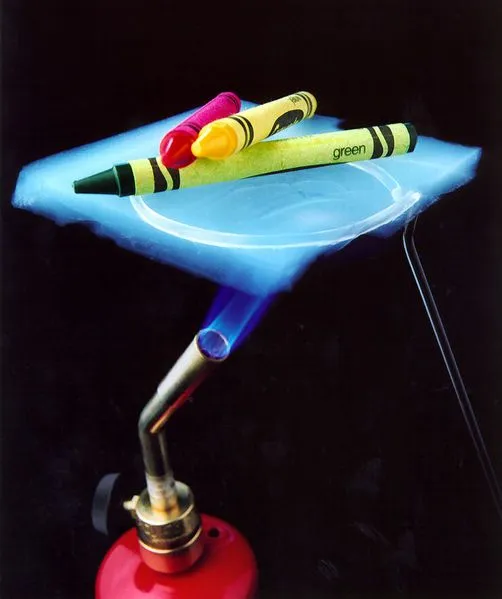
Silica should not be confused with silicon, the substance used in microchips and semiconductors. Silica is the glassy oxide of silicon (essentially the same stuff as quartz and ordinary window glass) and makes an excellent insulator. Silica aerogels are the most commonly discussed kind; if you hear someone talking about “aerogel,” there is a good chance they mean a silica one. The faint blue tinge of silica aerogel is not a pigment at all. It comes from Rayleigh scattering off the tangled nanometer-scale silica skeleton (the same effect that makes the daytime sky blue): shorter blue wavelengths scatter much more strongly off these tiny structural features than red and yellow do.
Quite unlike the sky-blue silica aerogels, carbon-based aerogels (including graphene aerogels) are inky black with a charcoal-like texture. Their drab appearance is more than offset by their high electrical conductivity. Millions of nanopores give them an enormous internal surface area for adsorption, making them strong candidates for fuel cells, desalination membranes, and supercapacitors. Graphene aerogels in particular can soak up around 900 times their own weight in oil, which makes them interesting for cleaning up marine oil spills.
Metal-oxide aerogels, as the name suggests, are made from metal oxides. They are essentially the inorganic cousins of silica aerogels. Each metal lends its own flavor: these aerogels work as catalysts for many chemical reactions, as scaffolds for explosive composites, and as precursors for other materials such as carbon nanotube catalysts. They also tend to be visibly colorful, and a few are even magnetic.
Applications Of Aerogel
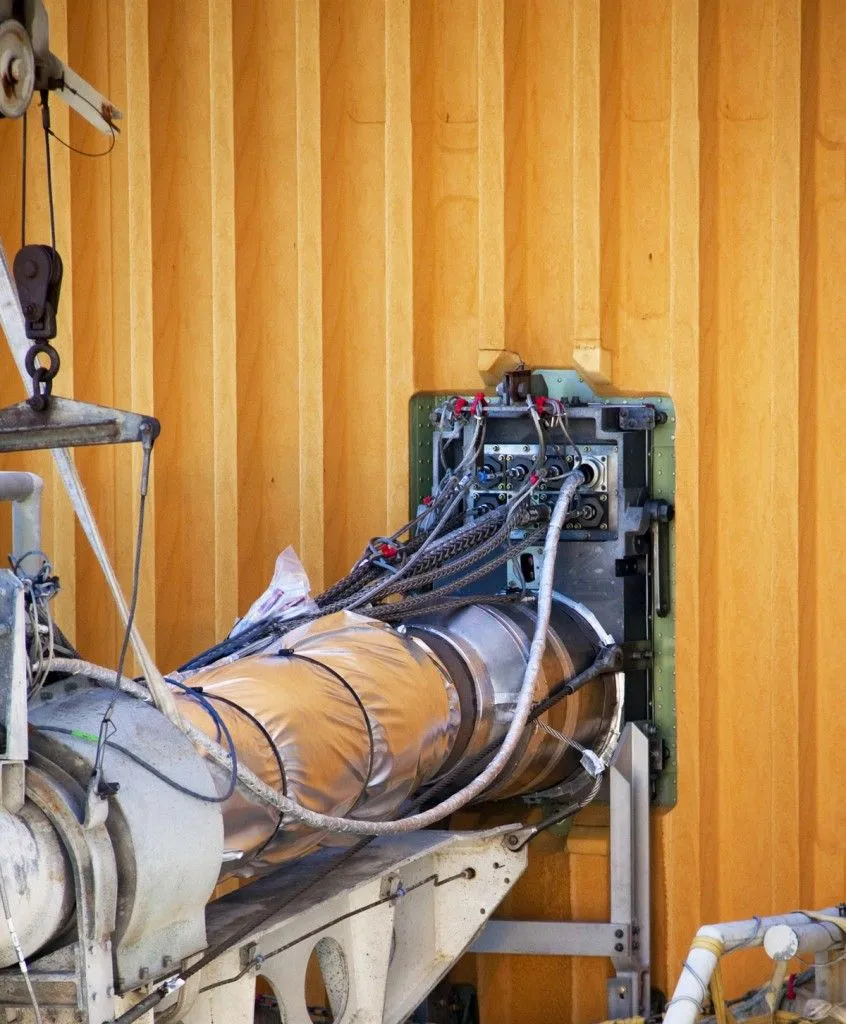
Owing to their extraordinarily low thermal conductivity (down to about 0.013 W/m·K for silica aerogels, several times better than fiberglass) and feather-light weight, aerogels are excellent candidates for insulating buildings, appliances, cryogenic storage tanks, automobiles, spacecraft, and solar collectors. NASA famously used silica aerogels as thermal insulation on the Mars rovers, and to capture comet dust at six times the speed of a rifle bullet on the Stardust mission.
Thanks to their high porosity and low density, aerogels are used in catalysis, gas sensors, fuel storage, ion exchangers, exhaust filters, pigment carriers, and as templates for growing other nanostructures. Being mildly translucent solids with a low refractive index, they also work as light guides in lightweight optics.
Because they damp sound waves so effectively, they are used to line soundproof rooms and to tune ultrasonic distance sensors. Their light weight and slight elasticity make them ideal energy absorbers in hypervelocity particle traps. And because they combine a high surface area with low dielectric constants and high dielectric strength, they are increasingly used as dielectric layers in integrated circuits and capacitors.
As you can see, this unique class of material can do a lot more than keep the moisture out of a shoe box!
Is Aerogel Edible?
Given that we started this whole story with a bowl of jelly, it is a fair question: if aerogel begins life as a gel, can you eat the finished product? The short answer is that you really should not, even though a piece of silica aerogel is unlikely to poison you.
Silica aerogel is made of amorphous silicon dioxide, the very same chemical family as the little “do not eat” desiccant sachets tucked into shoe boxes and pill bottles. That material is chemically inert and is not treated as acutely toxic. A published review of aerogel safety describes these solids as amorphous and inert, and notes that the toxicity people worry about is generally not expected from ordinary handling.
The catch is what aerogel does rather than what it is. It is an extraordinarily thirsty drying agent. Press a dry piece to your skin and it wicks the moisture straight out, which is why the same review warns that aerogels can cause temporary dryness and irritation of the skin, eyes and mucous membranes. In your mouth it would behave like the world’s most aggressive cracker, parching everything it touches, and its fine dust can irritate the airways if inhaled. Add the fact that aerogels are engineered for spacecraft and insulation rather than dinner, and the verdict is simple: fine to hold, not something to swallow.
What Is The Lightest Liquid, And The Lightest Gas?
Graphene aerogel takes the title of lightest solid, but the question people often really mean is broader: what is the lightest stuff of any kind? Once you leave solids behind, a single element sweeps the board.

The lightest liquid is liquid hydrogen. Chilled to about 20 K (−253 °C, −423 °F), hydrogen condenses into a clear liquid with a density of roughly 70.8 kg/m³ (0.071 g/cm³), which makes it about 14 times lighter than water. It is so feathery that rockets need enormous tanks to hold a useful amount, which is why the launch vehicles that carry it are dominated by those giant pale cylinders.
The lightest gas is hydrogen as well. With a relative atomic mass of just 1.008, it has the lowest density of any gas, only about 0.00008 g/cm³, roughly 14 times lighter than air. That is exactly why hydrogen (which is flammable, as the Hindenburg made infamous) and its inert cousin helium float a balloon, and why the answer to “is air the lightest thing on Earth?” is a firm no. Hydrogen is also the lightest element in the universe and, by far, the most abundant, so it holds the crown in every state it takes except one.
So the full scoreboard reads: hydrogen is the lightest gas, hydrogen is the lightest liquid, and a whisker-thin scaffold of carbon, graphene aerogel, is the lightest solid. Nature clearly has a favorite.
References (click to expand)
- Kistler, S. S. (1931). Coherent Expanded Aerogels and Jellies. Nature, 127, 741.
- Samuel Kistler, Inventor of Aerogel. Aerogel.org (history series).
- Aerogels: Thinner, Lighter, Stronger. NASA.
- Aerogel (Stardust Mission). NASA JPL.
- Aerographene (overview of the 2013 graphene aerogel density record, Zhejiang University).
- How is Aerogel Made?. Aerogel.org.
- What is Aerogel?. Aerogel.org.
- Compendium of the Safety Regulatory for Safe Applications of Aerogels. PMC, NCBI.
- What Happens When You Eat Silica Gel? McGill Office for Science and Society.
- Liquid Hydrogen Properties and Behaviors. H2tools, PNNL / U.S. DOE.
- Hydrogen: Element Information And Properties. Royal Society of Chemistry.