Table of Contents (click to expand)
No, a black hole cannot literally rotate at the speed of light, because general relativity forbids it (the dimensionless spin parameter a* cannot exceed 1, and accretion physics caps it at about 0.998). But it can come breathtakingly close: the event horizon of a near-extremal Kerr black hole can drag spacetime around it at almost light-speed. Astronomers have measured the supermassive black hole at the centre of galaxy NGC 1365 spinning at a* ≈ 0.84, near the practical upper limit.
One of the most interesting and enigmatic objects in the universe that has captivated the imagination of scientists, physicists and astro-enthusiasts alike are black holes! The phrase “what goes into a black hole stays in the black hole” accurately describes the irreversible nature of black hole physics, wherein even light cannot escape. The mysteries surrounding these extremely dense objects continue to pique the curiosity of humanity.
Introduction
Black holes aren’t just big balls of mass compressed into a small volume; they also rotate at incredibly fast speeds (at least the rotating ones do!). Fundamentally, there are different types of black holes, categorized on the basis of their spins and the charges they carry.
Schwarzschild Black Hole
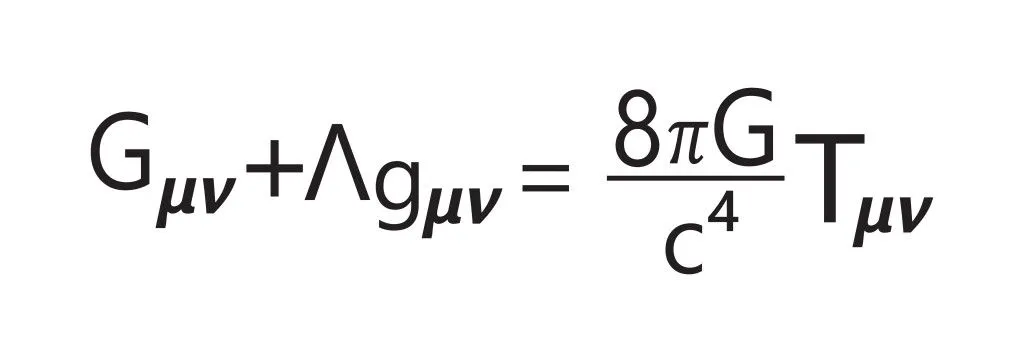
Named in honor of Karl Schwarzschild, who found the exact solution to Einstein’s field equations, this particular type of black hole is non-spinning and has no electric charge present. It is also called a static black hole and its description is given by Schwarzschild metrics in general relativity.
Kerr Black Hole
Kerr black holes are spinning black holes that are charge-less. They possess angular momentum, and like every planet, star and galaxy, they rotate about axes of symmetry. Of the four known solutions to the Einstein field equations, one of them is the Kerr metric. Another solution—the Kerr-Newman metric—describes a rotating Black hole that is also charged.
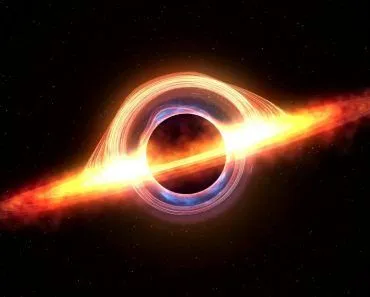
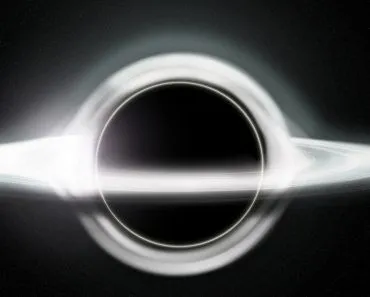
A Kerr black hole is quite commonly observed and was also depicted in the 2014 film Interstellar. The two fundamental properties that a Kerr black hole possesses are mass and angular momentum. A massive star collapses under its own gravity at the end of its life cycle, giving rise to a rotating black hole. The angular momentum of the progenitor star is conserved, leading to a black hole rotating at a significant fraction of the speed of light.
However, can this fraction of the speed of light reach the value of c (3 * 108) and break the laws of physics as we know them? Angular momentum is the measure of how mass is distributed from the rotational center of an object. The bigger and heavier the object is, the slower the spin must be to conserve angular momentum.
How Fast Do Black Holes Rotate?
In the case of a black hole, a huge amount of mass is compressed in an extraordinarily small amount of space, resulting in extreme density. Hence, for angular momentum conservation, the rotation of the object must speed up, making more revolutions per second. For a rotating rigid body, angular momentum L = Iω, where the moment of inertia I scales with the square of the radius. So if you compress the same mass to half its radius, the moment of inertia drops by a factor of four and the angular velocity must quadruple to keep L unchanged.
This is observed in neutron stars and some of the fastest-spinning objects in the Universe. When millisecond pulsars (fastest rotating neutron stars) are studied, it is noted that their rotation rates are relativistic, meaning that they do reach speeds close to the speed of light. If neutron stars, which aren’t actually the densest objects in the universe (black holes have that title) can approach such speeds, then isn’t there a tiny possibility that black hole mass could be compressed to such a point where an object moving at the speed of light couldn’t escape it?
What Role Does Angular Momentum Play Here?
The true astrophysical limits of the universe have not been discovered yet. For example, if the Sun were to be compressed into a black hole, its Schwarzschild radius would be only about 3 km (a diameter of roughly 6 km). The frame dragging around such a space would be enormous. Frame dragging can be studied for a black hole that is continuously accreting matter. The accretion disk of a black hole and the accretion flows around it exist in environments that are rich in matter.
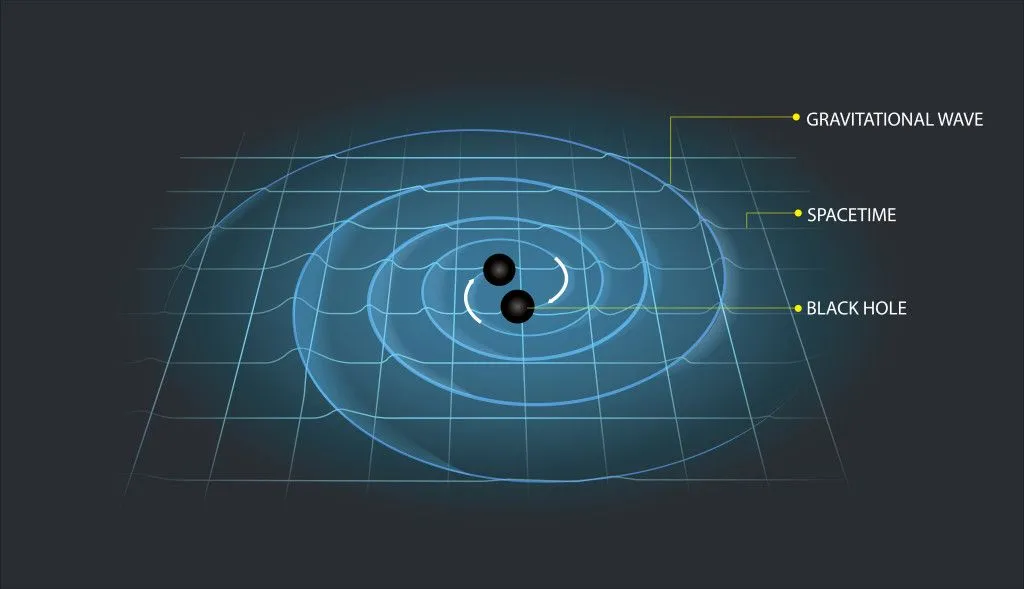
Ultimately, it all comes down to the conservation of angular momentum. A large amount of mass must be compressed down to very small volumes. Once this happens, for angular momentum to be conserved, the rotational speed must increase until it almost reaches the speed of light. At this point, the gravitational waves will move in and the energy will be radiated away. This brings the speed down to a theoretical maximum value. Someday, scientists hope to directly measure the rotational speed of a black hole.
Summing Up
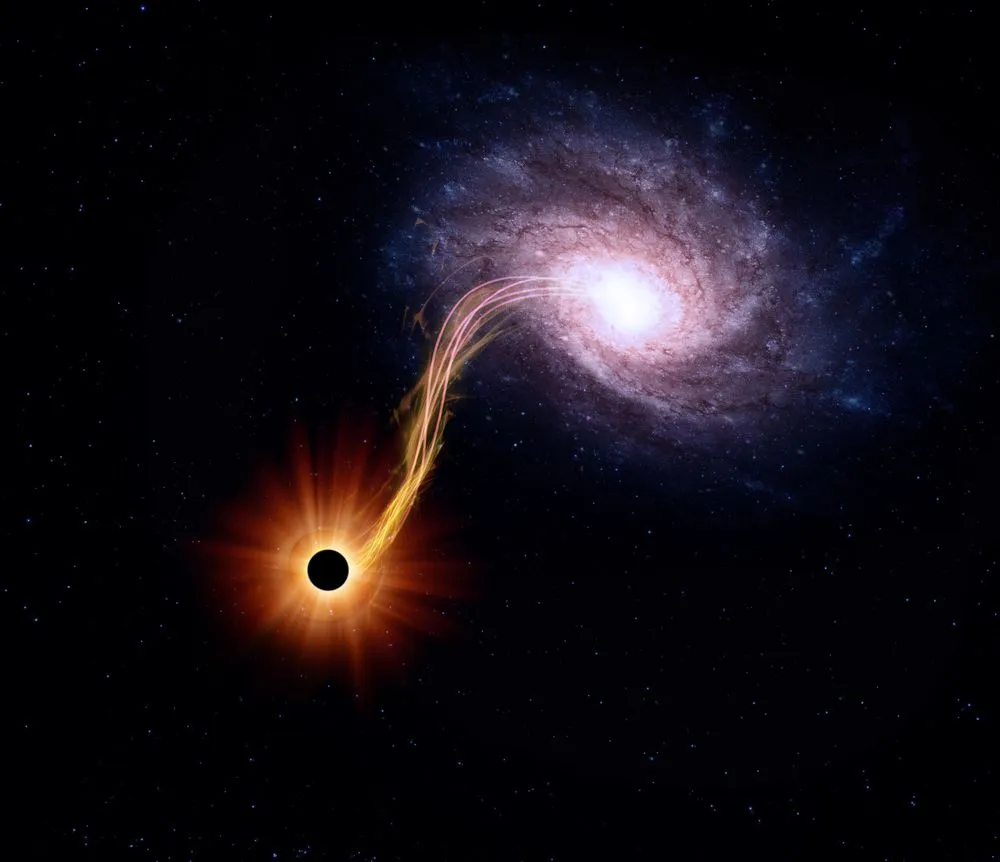
Astronomers have already detected a supermassive black hole with a dimensionless spin parameter of about a* ≈ 0.84, meaning its event horizon is being dragged around at close to the speed of light. The theoretical maximum spin for a Kerr black hole is a* = 1 (an extremal black hole), but real black holes are capped at around a* ≈ 0.998 by photon emission from the accretion disc (the so-called Thorne limit, 1974). Pushing past a* = 1 would expose a “naked singularity” and break the laws of physics as we know them. The black hole referenced here sits at the centre of galaxy NGC 1365.
As scientists continue to explore the mysteries of black holes, we move ever closer to unlocking the secrets of these captivating celestial objects, deepening our understanding of the universe’s most extreme phenomena.