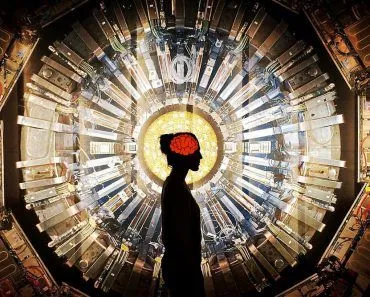
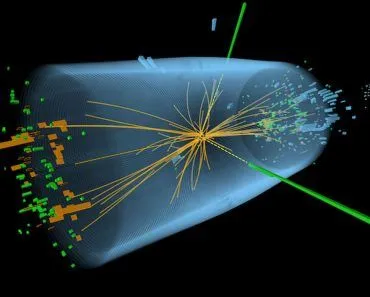
If you stuck your head inside an operating particle accelerator like the LHC, radiation from the proton beam would be the first thing to kill you. The beam can drill clean through tissue, the ring is chilled to about -271.3 °C (1.9 K), and the ultra-high vacuum would trigger ebullism (boiling body fluids and severe swelling, not a Hollywood-style explosion). In 1978, Soviet scientist Anatoli Bugorski survived exactly this at a 76 GeV Russian synchrotron, but he lost half his hearing and half his face to paralysis.
Machines known as ‘Particle Accelerators’ weren’t popular or well-known among the general masses until quite recently. Only scientists, lab rats and physics junkies knew what these machines did, but in the age of the Internet, everything has changed. Also, another reason for the sudden boom in the popularity of this field is the success of ‘The Large Hadron Collider’.
What Is The Large Hadron Collider?
The Large Hadron Collider (or the LHC) is the single largest machine ever built by humans. It also holds the honor of being the most powerful particle collider, as well as the largest and most complex experimental facility, on the planet. It was built by the European Organization for Nuclear Research (CERN) between 1998 and 2008, in collaboration with over 10,000 scientists and engineers from more than 100 countries. The ring itself is 27 kilometers (about 17 miles) in circumference and sits roughly 100 meters underground, straddling the France–Switzerland border near Geneva.
Since starting up in 2008, the LHC has delivered the discovery of the Higgs boson (announced in 2012) and is currently running at 13.6 TeV collision energy in its third operational run. So when we talk about sticking your head inside the world’s biggest particle accelerator, we are talking about a machine that runs colder than outer space and stores hundreds of megajoules of energy in a beam thinner than a human hair.
What Happens Inside A Particle Accelerator?
Basically, particle accelerators are powerful machines that push sub-atomic particles to enormous speeds. The walls of the beam pipe are wrapped in electromagnets that bend and focus the particles, a bit like the barrel of a rifle guiding a bullet, except the “bullets” here are protons or electrons travelling at about 99.9999991% the speed of light. A single 7 TeV proton from the LHC carries only about a microjoule of energy on its own (roughly what a mosquito in flight delivers), so one proton would not even sting. The real menace is the beam: each LHC ring stacks something like 1014 protons together, storing several hundred megajoules of energy.
Specialized accelerators can also be used as atom-smashers, or particle colliders, by colliding two beams of particles moving in opposite directions at close to light-speed. These collisions can be studied to learn about the building blocks of matter, and possibly even the early moments of the universe itself!
Can A Particle Accelerator Actually Explode?
This is the question the internet really wants answered, and the reassuring news is that a particle accelerator cannot detonate like a bomb. There is no fuel, no chain reaction and no critical mass hiding in the ring. As we saw, even the full 500-megajoule beam does not blast outward; it simply melts a narrow channel through whatever it hits and is normally steered safely into the graphite beam dump. So the mushroom-cloud version you might picture from a movie is off the table.

The real danger is far less cinematic, and it goes by a dull name: a magnet quench. The LHC bends its protons around the ring using superconducting electromagnets, which only work while they are chilled to that -271.3 °C and can carry current with zero resistance. A quench is the moment one of those magnets suddenly loses its superconductivity. All the magnetic energy stored in the coil then dumps into the wire as heat, the liquid helium around it flashes to gas (expanding to roughly 700 times its liquid volume), and that sudden pressure has to go somewhere.
That is exactly what went wrong on 19 September 2008, just nine days after the LHC first circulated a beam. During a high-current test in sector 3-4, a faulty electrical connection between two magnets melted, triggering a quench and rupturing the helium enclosure. Around six tonnes of supercooled helium escaped into the tunnel with enough force to tear multi-tonne magnets clean off their mountings and crack the concrete floor. In all, 53 magnets were damaged and had to be repaired or replaced, and the collider did not circulate beams again until 20 November 2009, more than a year later. Thanks to CERN's safety procedures, though, nobody was hurt.
And what about the fear that CERN might swallow the planet in a black hole? Before switch-on, an LHC Safety Assessment Group of physicists reviewed exactly these doomsday scenarios, and their verdict was that the collisions present no danger. Nature already runs this experiment for us: cosmic rays strike Earth's atmosphere at energies far higher than anything the LHC produces, and have done so for billions of years without spawning a planet-eating black hole or a lump of “strange matter”. Any microscopic black hole the collider could theoretically make would evaporate almost instantly through Hawking radiation. In short, the machine is far more likely to break itself than to break the world.
So… Would Your Head Stand A Chance?
Leaving the real experiments to the experts, let’s see how creative you can get with one particle accelerator and one human head, assuming you have both of them handy. There’s a lot going on inside such a complicated machine, and there is a lot of maintenance required to keep the environment inside the beam pipe stable and suitable for experiments. Four things in there would try very hard to kill you, more or less in this order: the radiation, the high-energy beam itself, the vacuum, and the cryogenic cold.
The Vacuum
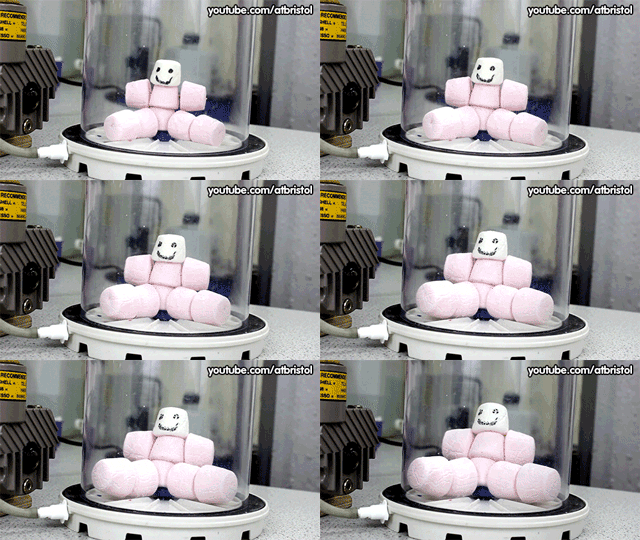
Since so much effort and energy is spent making the particles move so rapidly, scientists can’t afford useless collisions with stray air molecules. Inside the LHC the pressure is roughly 10-13 atmospheres, an ultra-high vacuum emptier than interplanetary space. Stick your head in and the saliva on your tongue, the tears in your eyes and the fluid lining your lungs would start boiling almost instantly, a condition NASA calls ebullism. Your face and head would swell up dramatically, but (despite what Hollywood likes to show) skin and tissue would hold things together: no popping balloon. You’d have maybe 10 to 15 seconds of useful consciousness before blacking out from oxygen starvation. Plenty of time, really, to rethink your life choices.
The Sub-Zero Temperature
The interior of the Large Hadron Collider is genuinely colder than outer space. To make its superconducting magnets carry current with zero resistance, the LHC is bathed in superfluid helium at a working temperature of -271.3 °C (1.9 K, or -456.3 °F), beating the 2.7 K background of deep space. That said, the beam pipe itself sits at roughly room temperature, and the cryogenic helium is sealed away inside the magnet cryostats, so your head would not actually flash-freeze on contact. The cold would still finish you off in time, but much more slowly than the real culprit.
High Energy Of The Particles
As you might guess, sub-atomic particle beams moving at near-light speeds carry a serious amount of energy. In accelerators like the LHC, the particles are moving so fast that if you stuck your head in their path, the beam would punch a microscopic hole clean through you. The two circulating LHC beams together store about 500 megajoules of energy, enough to melt roughly a tonne of copper. That is why, when physicists are done with a run, they steer the beam into a giant beam dump made of about eight meters of low-density graphite jacketed in concrete, which spreads the energy out and absorbs it without vaporizing.

Radiation
The feature of a particle accelerator most likely to actually kill you is the radiation from the beam, and we have real-world evidence for this. On 13 July 1978, a Soviet particle physicist named Anatoli Bugorski was checking malfunctioning equipment at the U-70 synchrotron at the Institute for High Energy Physics in Protvino, Russia, when he stuck his head straight into the path of a 76 GeV proton beam (a fraction of LHC energies, but still ferocious). Bugorski reportedly saw a flash “brighter than a thousand suns”, but felt no pain at the time.
Miraculously, he didn’t die. The left half of his face swelled up beyond recognition, and over the next several days the skin along the beam’s path blistered and peeled off, letting doctors trace exactly where the protons had travelled (in through the back of his skull, out through the left side of his nose). The dose his brain tissue absorbed has been estimated at 2,000 to 3,000 gray, hundreds of times the lethal whole-body limit. And yet, his intellectual capacity was largely spared. About 18 months later he was back at work, and he eventually completed his PhD. He did lose all hearing in his left ear, suffered tinnitus, and developed occasional partial seizures and rare grand-mal episodes, but he kept working at IHEP for decades.
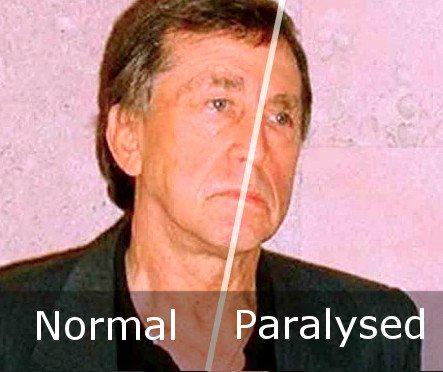
The most bizarre side effect of this ordeal actually came later. The left half of his face slowly became paralysed as the irradiated facial nerves died off over the two years following the accident. The right half of Bugorski’s face has aged normally, complete with wrinkles, but the paralysed left side never developed any expression lines, so it looks decades younger. One half of his face is frozen in time, almost literally. Bugorski, born in 1942, is still alive today and spent years as the experiment coordinator at the very accelerator that nearly killed him.
So…. sticking your head in a particle accelerator is now a miracle anti-aging treatment? Maybe… if you’re happy to swap your wrinkles for facial paralysis, hearing loss and a lifetime of seizures, not to mention all the other dangers of sticking your head where it really doesn’t belong.
References (click to expand)
- Anatoli Bugorski. Wikipedia
- The Large Hadron Collider. CERN
- Parking the LHC proton train. Symmetry Magazine
- Improving Survival After Tissue Vaporization (Ebullism). NASA NTRS
- Incident in sector 3-4 of the LHC. CERN Courier
- Large Hadron Collider. Wikipedia
- Review of the Safety of LHC Collisions. LHC Safety Assessment Group