No, you should never observe a solar eclipse with the naked eye. Even a few seconds of unprotected viewing during the partial phases can burn the retina (solar retinopathy) and leave permanent blind spots. The only safe ways to watch are with ISO 12312-2 certified eclipse glasses or by indirect projection.
Short answer: staring at a solar eclipse without proper precautions can absolutely damage your eyes, and ‘it could make you blind’ is not the overstatement it’s often made out to be. Doctors have documented cases of permanent blind spots after just a few seconds of unprotected viewing during the 2017 US eclipse.
Whenever there’s news of an imminent solar eclipse, stargazers get extremely excited and start counting down the days to when they will be able to see the Sun partially or totally obscured by the Moon. However, an unusual question that concerns many is whether the coveted event should be looked at with the naked eye. More specifically, can looking at a solar eclipse with unblocked eyes rob someone of their vision forever?
What Is A Solar Eclipse?
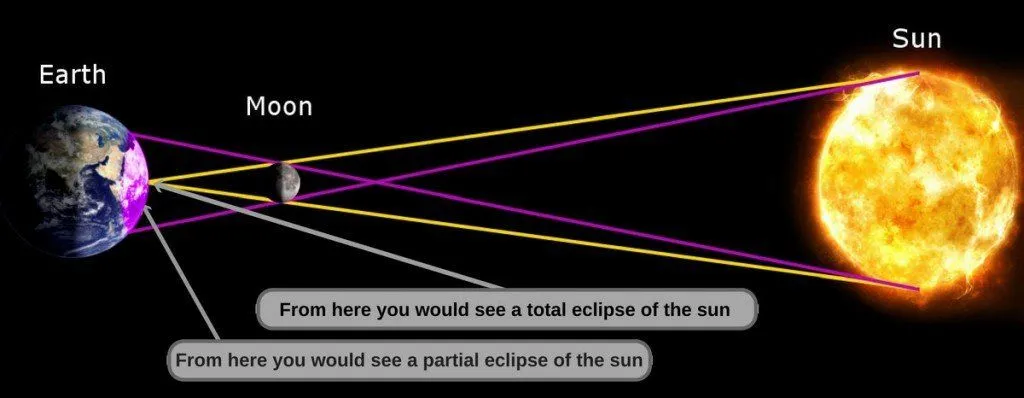
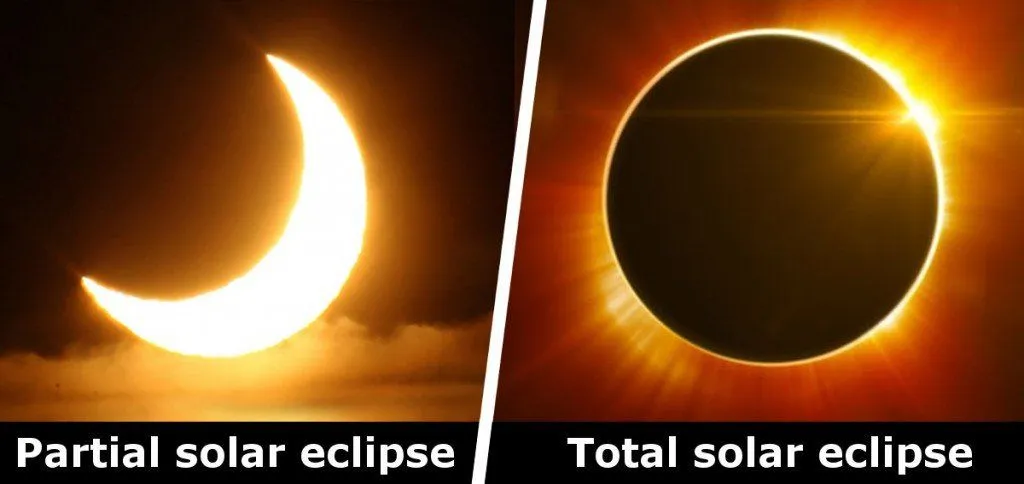
You must have learned about this at some point in high school – a solar eclipse occurs when the Moon passes between the Earth and the Sun and partially or completely blocks out our star. NASA recognizes four flavors: total (the Moon fully covers the Sun and reveals the corona), partial (only a slice of the Sun is hidden), annular (the Moon is too far from Earth to cover the Sun, leaving a bright “ring of fire” around its silhouette), and the rare hybrid, which appears total along part of its path and annular along the rest.
Observing A Solar Eclipse
Many stargazers and space enthusiasts look forward to this conjunction of three celestial bodies to observe such a visually amazing event. However, there’s also a certain degree of fright regarding how solar eclipses should ideally be observed, for we often hear that staring at the Sun during a solar eclipse with the naked eye can damage your eyes greatly, or in the worst-case scenario, blind you!
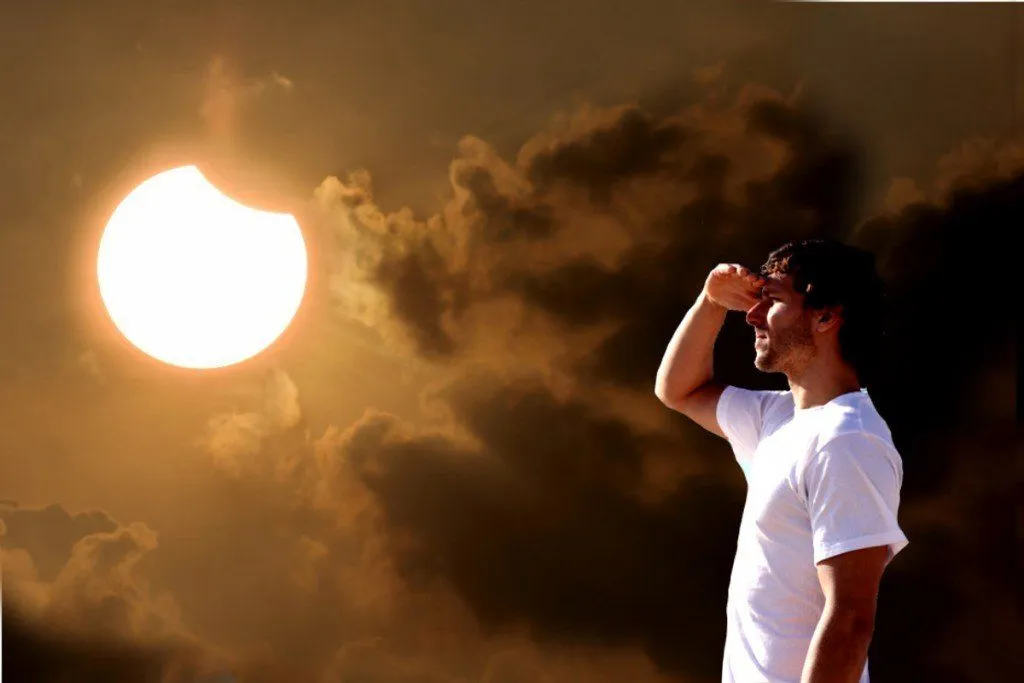
Well, it must be said that the fears of looking at the Sun without any protection to the eyes are not completely unfounded. Observing the sun with the naked eye during a solar eclipse can indeed have detrimental effects. In fact, staring at the Sun at any time is not good for one’s eyes. The reason is that gazing up at such an incredible source of light for too long can damage your retina.
Photic retinopathy (and its sun-specific cousin, solar retinopathy) is the term doctors use for damage to the retina from staring at a bright light source, whether that’s the Sun, an arc welder, or a laser. The retina, a light-sensitive screen on the back of the eyeball, gets ‘burned’ not from heat the way most people imagine, but mainly from a photochemical reaction in which intense light generates free radicals that wreck the photoreceptor cells at the fovea. It’s most commonly seen in people who stare at the Sun, watch a solar eclipse, or look directly at UV or other bright light sources.
Normal Days Versus A Solar Eclipse
Fortunately, we can’t stare at the Sun for too long on a normal day anyway. Its sheer brightness is just too much for human eyes to handle without some sort of filter covering them and dimming the incoming light. During a solar eclipse, though, it becomes alarmingly easy to gaze upward for minutes at a stretch. A big chunk of the Sun is ‘sheathed’ by the Moon, the disc looks comfortable to the eye, and the overall scene gets dimmer, which actually makes your pupils dilate. That bigger pupil now lets in even more of the still-blinding light from the exposed sliver of the Sun, while your usual blink reflex barely triggers.
The damage to the retina also happens to be painless, which is the cruel part. The retina has no pain receptors at all, so people can go on staring at the Sun with no clue that anything is wrong. The effects only show up afterwards, often hours or even days later: a dim or blurred patch in the center of vision, distorted shapes (metamorphopsia), reduced visual acuity and stubborn after-images.
Permanent blinding from a brief glance is rare, but ‘rare’ is not the same as ‘impossible’. Following the 2017 US eclipse, doctors imaged retinal lesions in a 26-year-old who had looked at the Sun for only a few seconds without proper glasses; six weeks on, her central blind spot was still there. Longer exposure can certainly cause great, irreversible damage and may even lead to complete loss of vision (Source). That is the real reason behind the warning that the Sun is more dangerous to look at during a solar eclipse. It is not because the Sun itself changes, but because the eclipse removes the cues that normally stop us from staring.
Is It Safe To Observe A Solar Eclipse Through My Sunglasses?
No, sunglasses don’t come anywhere close to offering enough protection. Even the darkest pair lets through thousands of times more sunlight than is safe. What you need are filters specifically engineered for direct solar viewing, certified to the ISO 12312-2 standard. Modern ‘eclipse glasses’ use a black polymer or aluminized polyester film (older filters used thin deposits of chromium, aluminum or silver) that cuts visible light by a factor of roughly 100,000 and blocks essentially all UV and infrared. NASA and the American Astronomical Society warn against the usual list of ‘hacks’: medical x-ray films, exposed color film, polarizing filters, photographic neutral-density filters, smoked glass, CDs, stacked sunglasses, etc. None of these are safe (Source). Looking at the Sun through binoculars, a camera or a telescope without a purpose-built solar filter fitted over the front objective is even worse; that combination can cause severe injury in an instant.
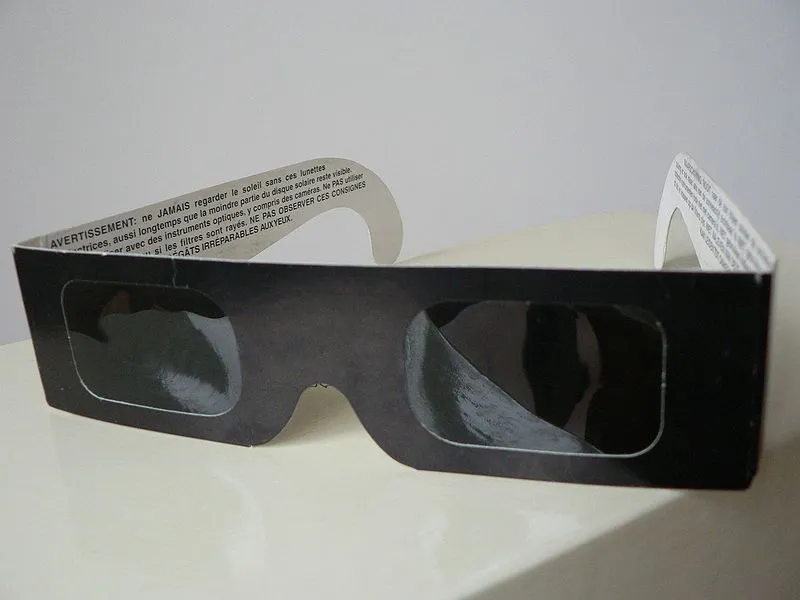
All in all, the rule is simple: assume you need certified eclipse glasses, and only take them off during the brief minutes of totality in a total solar eclipse, the short window when the Moon completely covers the Sun and the corona is visible. Annular and partial eclipses (and the partial phases of a total eclipse) never have a ‘safe’ moment; even a thin crescent of Sun is bright enough to cook your retina. The moment you see a sliver of the bright photosphere reappear after totality, the glasses go back on, before you gaze up at the brightest thing in our sky!
References (click to expand)
- Eclipse Viewing Safety. NASA Science
- Types of Solar Eclipses. NASA Science
- F. Espenak. Eye Safety During Solar Eclipses. NASA Goddard Space Flight Center
- Solar Retinopathy. EyeWiki, American Academy of Ophthalmology
- About the ISO 12312-2 Standard for Solar Viewers. American Astronomical Society
- OK, Look directly at a Total Solar Eclipse. Williams College
- Solar Eclipse Damage to Woman’s Eye Revealed in Striking Images. Live Science