If you need glasses, but don’t wear them, does your eyesight get worse?
Not necessarily. Corrective glasses help to compensate for a mismatch in corneal shape, which helps people see clearly and reduce eyestrain. However, this does not mean that one’s eyes are getting worse, per se, they’re just forcing the eyes to work harder.
From that first moment squinting at the blackboard from the back row, you knew the truth… your vision wasn’t perfect, and you’d probably have to start wearing glasses. In the brutal world of middle school, wearing glasses can be torture, particularly with the popular and timeless “Four Eyes” nickname still floating around.
This might lead you to avoid wearing your glasses, even if you really do need them to correct a vision deficiency or condition. This is seen in plenty of adults as well who want to keep up appearances and a youthful look. Failing vision is a natural part of aging, so ditching the glasses and straining one’s vision isn’t that unusual. The question is, if we should be wearing glasses, but choose not to, are we just making our vision worse?
What Does Having Bad Vision Really Mean?
When we talk about having “poor eyesight”, we aren’t describing a single condition. In fact, there are dozens of different problems that one could have with their eyes that might lead to vision impairment. As a child, blurry vision is usually due to refractive errors (being nearsighted or farsighted), astigmatism, or as a result of a lazy eye or crossed eyes.
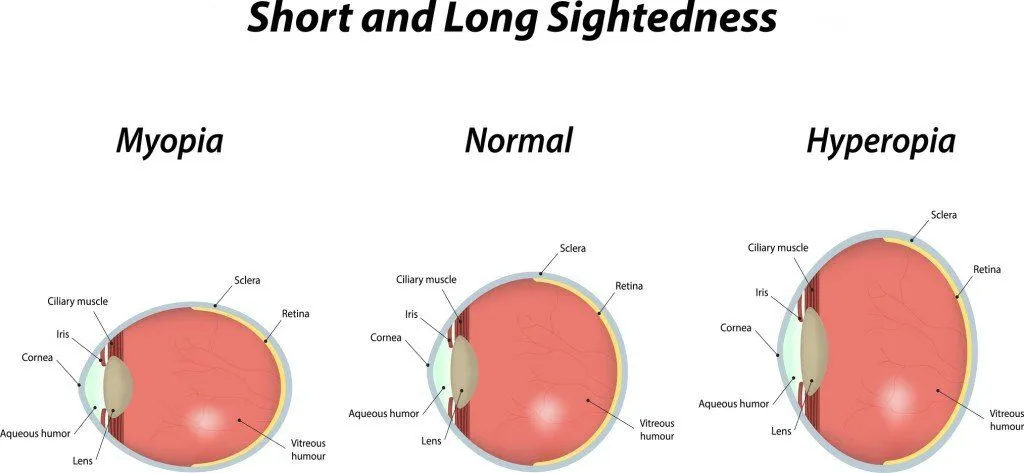
Myopia (nearsightedness) and hyperopia (farsightedness) are the most common forms of vision problems we see, but astigmatism is also quite common. These refractive errors arise from a mismatch between three things: the shape of the cornea, the length of the eyeball, and the focusing power of the lens. In particular, myopia is most often caused by an eyeball that is slightly too long, so light focuses just in front of the retina instead of right on it. When the light doesn’t land on the retina exactly, the image looks blurry.
These problems were once thought to be almost entirely genetic, but a growing pile of evidence shows that environment plays a big role too. The single strongest behavioural factor identified in recent meta-analyses is actually how much time children spend outdoors: kids who get more outdoor light exposure develop myopia far less often, regardless of how much they read or use screens. Excessive screen time and close-up work may contribute, but daylight outside appears to be the dominant protective factor (next-generation smartphone users who never go outside, we’re looking at you).
For these conditions, glasses help to compensate for that mismatch in corneal shape, allowing us to see clearly and reduce eyestrain. If we are constantly squinting to see clearly, we are much more likely to experience headaches and an inability to focus (due to eyestrain). However, this does not mean that our eyes are getting worse, per se, we are just forcing the eyes to work harder and inviting a number of unpleasant side effects.
Does Your Vision Get Worse If You Don’t Wear Glasses?
Short answer: Corrective glasses help to compensate for a mismatch in the corneal shape of the people who need them, which helps them see clearly and reduce eyestrain. If one has to squint constantly to see clearly, they are much more likely to experience headaches. However, this does not mean that one’s eyes are getting worse, per se, they’re just forcing the eyes to work harder and inviting a number of unpleasant side effects.
Effects Of Not Wearing Glasses
Some childhood vision problems are very different from ordinary blurriness. Amblyopia (lazy eye) is a developmental issue in the visual cortex of the brain: the brain learns to ignore input from the weaker eye, so even with correction that eye never sees as sharply as it could. Treatment combines corrective glasses with patching or blurring drops on the stronger eye, forcing the brain to use the weaker one while it is still plastic (usually before about age 10). Strabismus (crossed or misaligned eyes) is a separate condition involving the eye muscles, which can sometimes be helped by special lenses or surgery. In both cases, ignoring the condition during childhood can lock in permanent vision loss in the affected eye.
How Does Age Affect Eye Sight?
There are other types of vision problems too, including cataracts, glaucoma, and macular degeneration. The condition that affects almost everyone with age, though, is none of those: it is presbyopia. From around age 40, the lens of the eye gradually stiffens and loses its ability to focus on close objects, which is why nearly everyone reaches for reading glasses sooner or later. Age-related macular degeneration (AMD) is a separate disease that damages the macula (the small spot at the back of the retina responsible for sharp central vision) and is driven by a mix of genetics, smoking, and oxidative stress from free radicals. It is far from universal: AMD significantly affects roughly 1 in 10 Americans over 80, not everyone. Either way, neither presbyopia nor AMD is made worse simply by skipping your reading glasses.
Again, with this type of vision problem, not wearing glasses at this stage of life won’t directly cause vision to suffer or worsen at a faster rate. It will cause eyestrain, just as not wearing glasses for myopia and hyperopia will do. That eyestrain will lead to headaches, an inability to focus, double vision, and other symptoms, which makes it even more difficult to see, and weakens the muscles in the eye.
Most vision issues are anatomical and physiological in nature, and wearing glasses helps to correct our vision back to normal, thus preventing strain on our eyes. This is not the same as “fixing” these problems; rather, it is a means of alleviating the symptoms in an efficient way.
A few other great ways to protect your vision are to wear UV-blocking sunglasses, keep up with regular eye exams, manage conditions like diabetes and high blood pressure, and eat a varied diet. Vitamin A (which the body makes from beta-carotene in carrots) is essential for the retina, but unless you are actually deficient, eating extra carrots won’t sharpen your vision; that wartime myth was British RAF propaganda. Ophthalmologists typically recommend a diet rich in leafy greens, oily fish, and colourful vegetables (sources of lutein, zinc, omega-3s, and vitamins C and E), not carrots in particular.
Conditions like glaucoma and cataracts can be fixed by various procedures and medications, and for those who really don’t want to deal with poor vision any longer, procedures like laser eye surgery can be a nearly permanent solution.
However, if you’re at a fancy social gathering and don’t feel like pulling out your reading glasses to see the menu, a little bit of straining might give you a headache, but it won’t send you spiraling down the road to blindness!
References (click to expand)
- Refractive Errors | National Eye Institute. The National Eye Institute was established in 1968. It
- Will wearing glasses make my eyesight worse? - Harvard Health. Harvard University
- Safeguarding your sight - Harvard Health. Harvard University
- Blindness | Low Vision - MedlinePlus. MedlinePlus
- What Is Presbyopia? American Academy of Ophthalmology.
- Age-Related Macular Degeneration. National Eye Institute, NIH.
- Amblyopia. StatPearls / NCBI Bookshelf.
- 2024 meta-analysis: outdoor time and myopia onset in children. PubMed.