Table of Contents (click to expand)
When lava (around 1,170°C, or 2,140°F for Hawaiian lava) touches ice, the ice flash-evaporates directly into steam without passing through the liquid-water stage. The steam forms an insulating blanket that lets the lava glide over the ice instead of melting straight through it; pockets of steam trapped under the cooling crust blow strange bubbles that the experimenters who first studied this called “scrambled eggs from hell.”
When I say the word ‘volcano’, what’s the first thing that pops into your head?
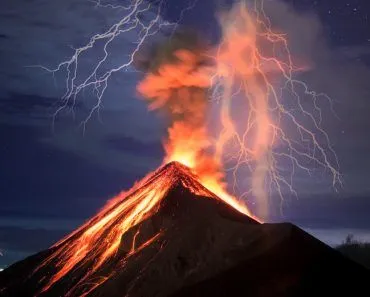
I can say, with a great deal of confidence, that you probably see a cone spewing orange and yellow molten material, a substance that is quite thick and flows rather ominously. It looks like the kind of river that would flow right past the gates of hell!
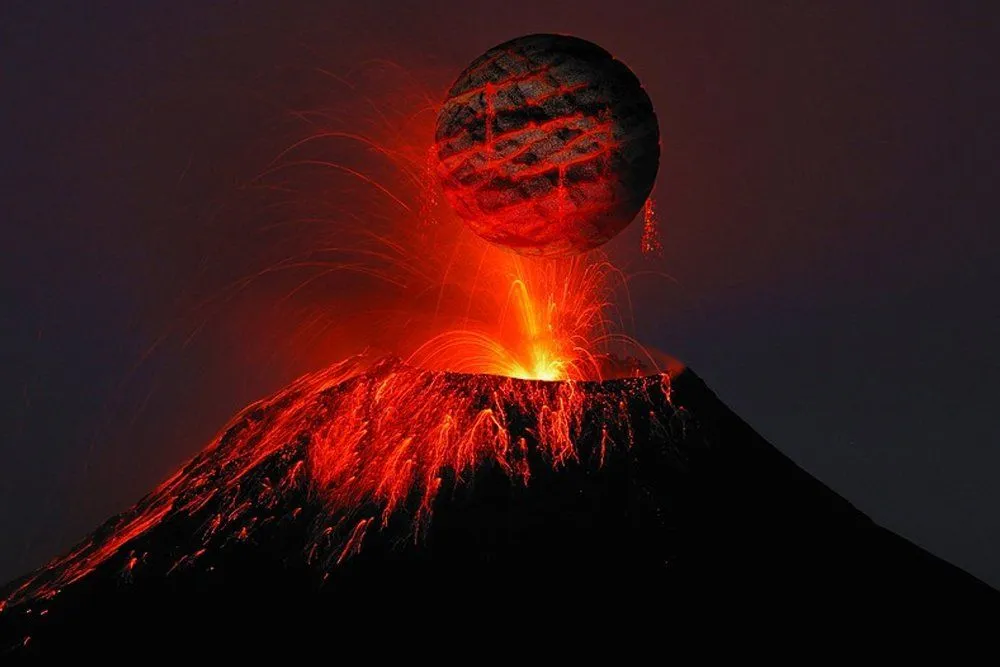
Lava is one of the hottest substances found on the Earth’s surface. The eruption temperature of Kilauea lava (Kīlauea is a currently active shield volcano in the Hawaiian Islands) is around 1170 degrees Celsius (2,140 degrees Fahrenheit) (Source).
When a volcano erupts, lava blasts out of it and flows down its slopes. The outer surface of the erupting lava cools down very swiftly (e.g., hundreds of degrees per second) when it’s first exposed to air!
Clearly, when red-hot lava comes in contact with air, it cools down incredibly fast, but have you ever thought about what would happen if the same red-hot lava came in contact with ice? Imagine that… an exceedingly hot object coming in contact with an extremely cold one!
What Most People Think Would Happen When Lava Meets Ice
Many people assume that there would be some type of explosion the moment lava came in contact with ice, thanks to the drastic temperature difference between the two objects. Some speculate that if lava is poured on ice, the former shall most likely ‘dig’ completely through the ice.
However, neither of those two speculated events is what will occur.
A team of researchers, including Bob Wysocki and Jeff Karson, both professors at Syracuse University (New York, United States), who published a paper concerning the dynamics involved in the eruption of a snow-covered volcano and how lava interacts with ice, conducted some real-life experiments with lava and ice. They melted over 300 kilograms (661 lbs) of lava and poured it over ice in their famous Lava Project.
What Actually Happens When Lava Meets Ice?
When lava meets ice, it neither explodes nor tunnels through; rather, it forms strange-looking bubbles. These bubbles are initially the same color as lava, but quickly turn black. One of the experimenters called these bubbles “scrambled eggs from hell”.
Here, take a look at it for yourself:
Why does that strange phenomenon occur? Why do those volcanic bubbles form?
The Science Involved In The Union Of Lava And Ice
The temperature of lava is so high that the moment it comes in contact with ice, it converts the latter directly into vapor, without turning it into water first. This steam essentially tries to escape through the lava. This is why it looks as though the lava is boiling (on ice), whereas it’s actually the steam trying to escape that ends up forming bubbles in lava, which are then simply referred to as volcanic bubbles.
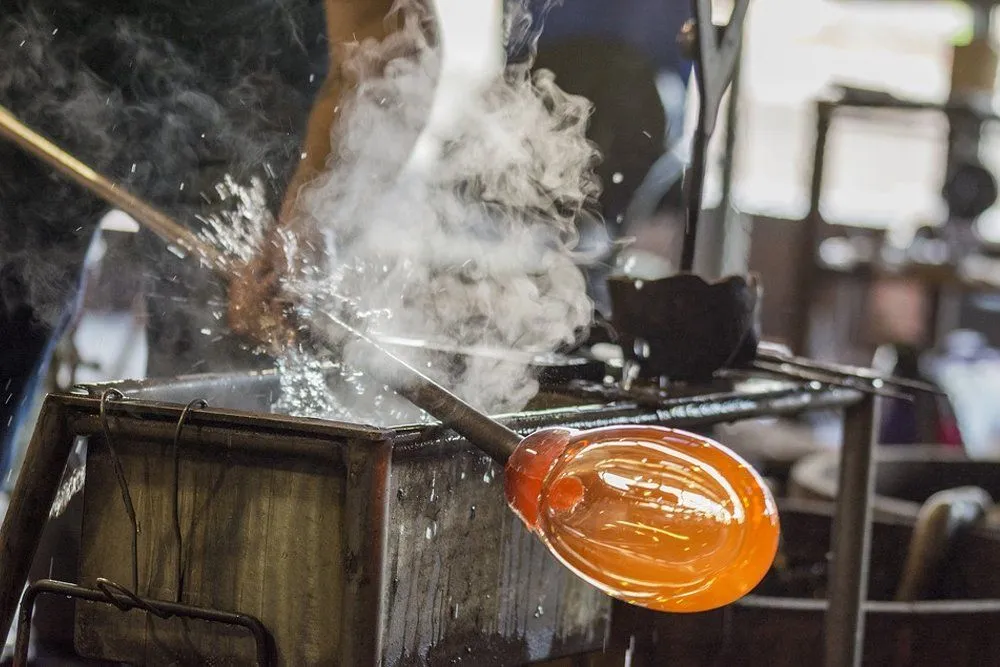
As the lava on the ice begins to cool, a thick black layer forms on the surface of the lava. This thick black layer traps the super-heated steam (which appears as bubbles) that forms underneath. It’s like a natural form of glassblowing. It is a glass-forming technique in which molten glass is inflated into a bubble with a blowpipe.
How Does Lava Flow On Ice?
This is another interesting aspect of pouring lava over ice. One would think that lava is so hot that it would dig right through the ice the moment it comes in contact with it. However, that doesn’t happen; lava can actually flow across the surface of ice!
This happens as a result of the formation of that super-heated steam we were discussing. This steam (which forms when red-hot lava vaporizes the ice with which it comes in contact) forms a blanket over the surface of the ice. This layer of steam actually minimizes the frictional force between the lava and ice, so the former has no problem flowing over it, hard as that may be to believe! If this sounds familiar, it should: it is the same idea behind the Leidenfrost effect, where a water droplet skates across a scorching frying pan on its own cushion of vapor instead of instantly boiling away.
This is not just laboratory curiosity, either. Iceland has provided several real-world demonstrations in recent years, most spectacularly during the 2023-2025 Sundhnúkur eruption series on the Reykjanes peninsula, where lava from fissures near Grindavík flowed across snow-covered ground on the same insulating cushion of steam Wysocki and Karson reproduced in the lab. Earlier examples in Iceland and Antarctica are how volcanologists know that even an ice sheet will not stop a vigorous lava flow.
What Happens When Lava Meets Water Instead Of Ice?
So lava glides over ice on a polite cushion of steam. You might assume liquid water behaves the same way, but it absolutely does not. Swap the ice for the ocean and the gentle bubbling turns into one of the most dangerous shows in nature.

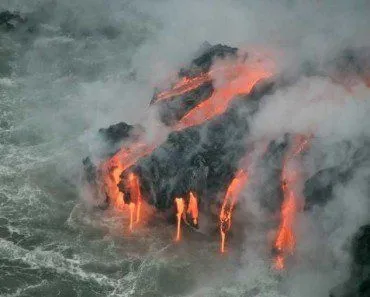
When lava reaches the sea (something geologists have watched again and again at Hawaii's Kilauea volcano), it can set off what scientists call a littoral explosion. USGS volcanologists Tari Mattox and Margaret Mangan, who studied these blasts at Kilauea, describe them as a kind of natural vapor explosion: the same physics that drives "fuel-coolant" accidents in industry, where a very hot liquid (here, the lava, around 1,150°C or 2,100°F) is suddenly mixed with a much cooler one (the seawater). In micro- to milliseconds the water flashes to steam and expands so violently that it tears the lava apart and flings the fragments outward.
It is not gentle. The USGS has recorded littoral lava fountains that reach higher than 100 meters (about 300 feet), and bench-collapse explosions that hurl molten spatter and blocks of rock through the air. These hazards are real: in April 1993 a lava bench at Kilauea collapsed and one person was killed, while twelve others needed treatment after being struck by flying debris, and in 1994 two visitors were severely scalded by a sudden wave of superheated water.
There is a chemical hazard too. As the lava boils the seawater dry, chloride from the sea salt joins with hydrogen to brew a stinging plume the USGS nicknames "laze" (lava haze), a mix of steam, hydrochloric acid gas, and tiny shards of volcanic glass. The acid droplets in laze can have a pH between 1.5 and 3.5, roughly as corrosive as battery acid. So the difference between ice and water is enormous: ice quietly sublimates and lets the lava skate past, while liquid water can answer the same lava with a genuine explosion. If you want to dig into why some eruptions blow up like this while others ooze quietly, we cover that in our piece on why some volcanoes explode and others don't.
Can Lava Be Frozen, And Does It Have A Freezing Point?
People often ask whether you can "freeze" lava the way you freeze water, and whether lava has a tidy freezing point. The honest answer is: lava does turn solid, but it does not have a single sharp freezing temperature the way water does at 0°C (32°F). Instead it stiffens gradually over a range of temperatures as different minerals crystallize out of the melt one after another.

The USGS learned the details the patient way, by drilling into the cooling crust of a Hawaiian lava lake at Alae and sampling the melt at different temperatures. They found that olivine crystals keep forming down to about 1070°C, and that the lava is not fully solid until it cools below roughly 980°C. Quench a sample at 1070°C and it is still about 65% glassy (not yet crystallized); only well below 980°C is the rock essentially all solid. In other words, "frozen" lava is really lava that has finished crystallizing into rock, not lava that hit one magic number.
How fast the cooling happens decides what you end up with. Cool lava slowly and its atoms have time to arrange themselves into mineral crystals, giving you ordinary igneous rock like basalt. Cool it almost instantly (drop it in water, or fling it through the air) and the atoms never get to organize at all, so it locks up as a smooth, glassy solid. That is exactly what obsidian is: lava quenched so quickly that crystals never grew, leaving a natural glass. So yes, lava can absolutely be frozen solid. It just freezes by crystallizing or glassing over a span of hundreds of degrees, rather than snapping solid at one crisp freezing point.
References (click to expand)
- How is lava formed? - Volcano World - Oregon State University. Oregon State University
- How hot is a Hawaiian volcano? | U.S. Geological Survey. The United States Geological Survey
- Edwards, B. R., Karson, J., Wysocki, R., Lev, E., Bindeman, I., & Kueppers, U. (2013). Insights on lava-ice/snow interactions from large-scale basaltic melt experiments. Geology. Geological Society of America.
- 2023-2025 Sundhnúkur eruptions, Reykjanes peninsula, Iceland. Wikipedia.
- Lava entering ocean. Hawaiian Volcano Observatory, U.S. Geological Survey.
- Viewing Lava Safely: Common Sense is Not Enough. USGS Fact Sheet 152-00. U.S. Geological Survey.
- Mattox, T. N., & Mangan, M. T. (1997). Littoral hydrovolcanic explosions: a case study of lava-seawater interaction at Kilauea Volcano. Journal of Volcanology and Geothermal Research.
- Peck, D. L., Wright, T. L., & Moore, J. G. (1966). Crystallization of tholeiitic basalt in Alae Lava Lake, Hawaii. Bulletin Volcanologique. U.S. Geological Survey.