Table of Contents (click to expand)
The Mandela Effect is when a large group of unrelated people share the same false memory, remembering an event or detail that never actually happened. It is named after Nelson Mandela, whom many people wrongly recall dying in prison in the 1980s, even though he died in 2013. Internet folklore blames parallel universes, but psychologists explain it through ordinary false memory.
Nelson Mandela, the legendary anti-apartheid political leader, and former president of South Africa, died in 2013. However, that’s not what many people remember. There are actually those who swear by the fact that they saw news of Mandela’s death in the 1980s. Some even remember seeing clips of his funeral and a moving speech by his widowed wife. All of this was before 2013, which is when he actually died. This falsity is remembered by a group of people, unknown to each other, who number in the thousands!
This is exactly how the term ‘Mandela Effect’ came to be. The phrase was coined around 2009 by Fiona Broome, a self-described paranormal researcher, after she realized that she and many strangers at a conference shared the same vivid (and wrong) memory of Mandela’s death in prison decades before it actually happened. Broome set up a website where people could compare such shared misrememberings, and the name stuck. So when a large number of people remember an event occurring, or something looking a particular way, even though all the evidence proves otherwise, it is called the Mandela Effect. There are a number of examples that have baffled people.
Mandela Effect Examples
As you can imagine, anything as mysterious as this will be like a trip to Disneyland for conspiracy theorists and paranormal believers. A quick Google search will reveal a number of such Mandela Effect examples. For instance, a very popular example, apart from the death of Nelson Mandela, is the case of the Berenstain bears. This is the name of a popular series of children’s books, named after the writers, the Berenstains. However, there are a large number of people who swear that they remember it being spelt as ‘Berenstein’, instead of ‘Berenstain’
Another such example is that of the 1937 Snow White movie. Many people remember the evil queen speaking to her talking mirror and saying, “Mirror mirror on the wall”… except she never did. If you check now, all video clips of the movie show her saying, “Magic mirror on the wall”. There is also the case of Pikachu’s tail. Arguably the most famous Pokémon, Pikachu is remembered by many people as having a black tip on his tail, but the end of the tail has always been solid yellow. Star Wars fans fall for it too: most people are sure Darth Vader growls, “Luke, I am your father,” yet the actual line in The Empire Strikes Back (1980) is “No, I am your father.”
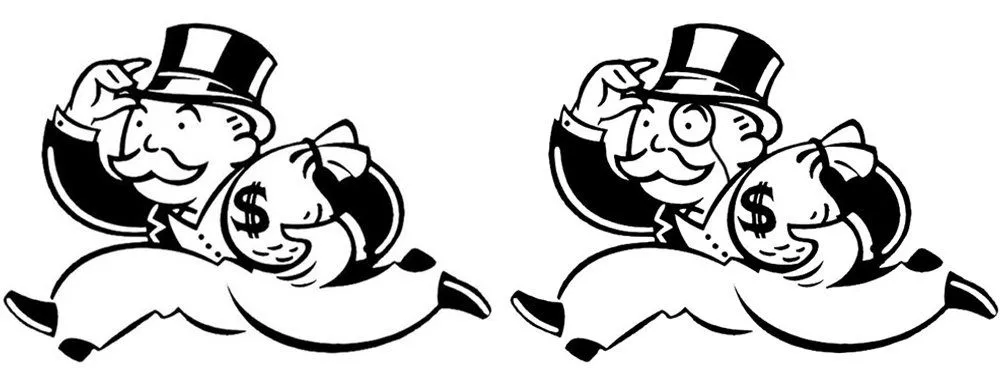
Even Rich Uncle Pennybags is drawn into this. Those who don’t know him by that name will probably remember him as the Monopoly Man. Many people remember him for his top hat, the tiny mustache, and the monocle he always wore. Here’s the kicker. He never wore one. The makers of Monopoly say the character was always drawn without a monocle. The same goes for the Fruit of the Loom clothing logo: a 2022 YouGov survey found that 55% of Americans pictured a cornucopia (a horn of plenty) behind the fruit, even though the logo has never included one. There are a number of other examples of such misremembered instances, including comedian Sinbad in a genie movie called Shazaam that was never made (people are likely thinking of Kazaam, the 1996 Shaquille O’Neal film), the Mona Lisa, Looney Tunes, and even Curious George, the cartoon monkey many recall having a tail he never had.
What Causes This?
Because so many people misremember the same details in the same way, it can feel like there has to be more to the story than a simple slip of memory. That instinct has spawned a number of theories that are catnip for conspiracy theorists and paranormal believers. The most popular of these folk explanations is the idea of multiple or parallel universes. According to this, there is a parallel universe in which, for instance, Mandela died in 1980 while incarcerated, or that the book was called The Berenstein Bears or the evil queen said ‘Mirror mirror’. Sometimes, a person may momentarily shift between these universes, and thus have the memory of something that happened in another universe, but not in this one.
It is worth being clear here: the idea of parallel universes does have a serious side in physics (the late Stephen Hawking explored multiverse models), but no version of that science predicts people sliding between universes and swapping memories, and there is no evidence any such thing happens. Even if other universes were confirmed someday, there would be no way to test the claim that anyone had traveled between them and brought a memory back. Another theory that can explain some of these occurrences is time travel. In the case of Mandela’s death, for instance, it is suggested that the person momentarily travelled into the future, saw the news about the death, and then came back to the “right time”. The time travel lasted for just a moment, leading the person to believe that the news genuinely occurred in the 1980s.
Scientific Proof
While the above reasons probably fit the bill, there is another explanation for the skeptics out there; psychologists often attribute this strange occurrence to false memory. Time and again, research has proven that our memory is not completely reliable and free of errors. In a series of experiments, Professor Elizabeth Loftus showed how easily, with the help of subtle cues, false memories can be generated in a person. For instance, she carried out an experiment wherein 24 individuals, ranging from 18-53 years in age, were provided with information about childhood experiences recounted by their relatives. Each individual was given a booklet that contained details of 3 actual childhood instances and brief, vague details about one false event: being lost in a shopping mall. The details about the fictitious incident were a combination of details provided by relatives related to a normal outing to a mall, combined with generic details of getting lost.
After reading the booklet, 29% of the people ‘remembered’ (partly or fully) getting lost in the mall; in the 2 follow-up interviews, 25% of people still maintained that they remembered the incident. In fact, the subjects even provided more details than those given in the booklet about the false incident. This proves how easy it is to induce false memories in a person and shows how our brain will automatically fill in the gaps of memories that we partly remember.

This possibility of creating false memories, along with other factors, such as the widespread reach of the Internet, suggestible cues, our exaggerated belief that our memory is foolproof, etc. can be used to explain the occurrences of the Mandela effect. For instance, if a person were seeing news about Nelson Mandela, followed by receiving the news of someone else’s death, it is possible that their brain mixed up the two events, thus leading them to believe that they saw the news of Mandela’s death. The Internet also plays a role here. If the person having such a notion were to find someone else with a similar notion, both of their beliefs in their false memories will be strengthened. Since the discovery of people who believed the premature news of Mandela’s death didn’t happen overnight, but rather over a period of time, it’s authenticity can be questioned.
Now, let’s consider the case of the Berenstain Bears and Snow White. “-stein” is a far more common ending for a surname than “-stain,” so the brain quietly autocorrects the unfamiliar spelling to the familiar one. That could explain why so many people remember the wrong version. The Snow White slip works much the same way. The classic Brothers Grimm fairy tale opens with “Mirror, mirror on the wall,” but in Disney’s 1937 film the Evil Queen actually says “Magic mirror on the wall.” Because the rhyming storybook phrasing came first and is repeated everywhere, people’s memories blur the book version into the movie version.
 In the image of the Monopoly man, if a person were to simply be presented with the image in which the man has the monocle and then asked if it were correct, with their attention being drawn to the monocle, chances are that they would agree. This is probably due to the similarity between the actual image and the one with the monocle. The same person, then exposed to the image without the monocle, would say that they definitely remember Uncle Pennybags having a monocle. This also elucidates the power of suggestion on the human brain. For instance, think of the question, “How big was the round table?” This question is already suggesting to the reader that the table is round. Alternatively, if the question were, “How big is the table?”, it leaves some leeway for the shape of the table.
Recent research has pushed this explanation further. In 2022, psychologists Deepasri Prasad and Wilma Bainbridge at the University of Chicago ran the first controlled study of what they called the visual Mandela Effect. They showed people well-known logos and characters, and found that for a handful of icons (including the Monopoly Man, the Fruit of the Loom logo, and Pikachu) viewers did not just make random mistakes. They made the same mistake, drawing Pikachu with a black-tipped tail or adding a monocle to the Monopoly Man. Eye-tracking ruled out the obvious culprits, like people simply not looking at the tail. In other words, these shared false memories appear to be a real, repeatable quirk of how human memory works, not proof that reality has been rewritten.
So while the internet folklore is the more entertaining story, the evidence points squarely at memory rather than the multiverse. There are still open questions about exactly why certain images and phrases trip us up so reliably, which is part of what makes the Mandela Effect such a revealing window into the workings of the human brain.
References (click to expand)
- False Memories and the “Mandela Effect” – Scientific Scribbles - blogs.unimelb.edu.au
- The Mandela Effect | The Psychology of Extraordinary Beliefs. The Ohio State University
- Creating False Memories - University of Washington. The University of Washington
- Why Is It Called the Mandela Effect? Encyclopaedia Britannica
- The Visual Mandela Effect as Evidence for Shared and Specific False Memories Across People. Psychological Science (PubMed)
- False Memories, explained. University of Chicago News