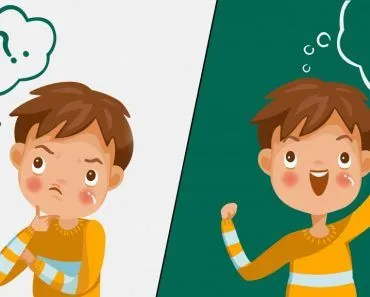
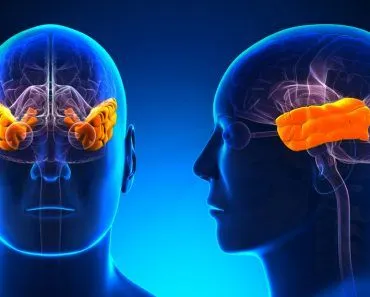
Amnesiacs typically do not forget their native language. Amnesia, especially anterograde amnesia, damages the hippocampus, which is the brain region that forms new episodic memories (specific events from your life). Language itself lives elsewhere: vocabulary and grammar are stored as semantic memory in the temporal cortex, and the motor sequences for actually speaking are procedural memories handled by Broca’s and Wernicke’s areas plus the cerebellum and basal ganglia. None of those circuits are usually destroyed by classic amnesia, so the language survives even when the autobiography does not.
50 First Dates is one of the most popular romantic comedies in recent decades. The film is a typical rom-com; it celebrates love, it is (moderately) funny and it is highly unrealistic. Still, it isn’t inaccurate. Barrymore’s portrayal of an amnesiac is surprisingly top notch, unlike protagonists in ridiculous drama or action films who are purged of their amnesia after a blow to the same spot on their head where an earlier blow caused it. This is convenient for the plot of fiction, but not real life.
Hume’s proposition is remarkable, but more importantly, courageous, for it was implicitly refuting Christianity’s eternal promise. However, his view became progressively more plausible as we became more knowledgeable about the brain’s intricate workings through neurology. One should not confuse amnesia with dementia, where the sense of self somehow erodes. Family members often claim that the patient is no longer his old self. Amnesia, an extensive loss of memory, strangely, spares his victims of this atrocity. Why? Honestly, we don’t know. The mysteries of memory, subjectivity and self-awareness continue to elude us.
Semantic and episodic memories
A discussion about amnesia would be incomplete without delineating the nature of memory. Neurologists divide memories into two classes, either procedural or declarative. Procedural memories, as the name suggests, are concerned with procedures. Their acquisition involves a combination of cognitive and motor skills. This would include riding a bike, driving a car or tying your shoelace. Declarative memories, on the other hand, are concerned with facts such as the sky is blue or Jurassic Park was released in 1993.
The cognitive and motor skills involved in procedural memories, with repeated access, become progressively unconscious and implicit. Declarative memories tend to operate on the surface , they demand conscious or explicit access. Furthermore, declarative memories come in two sub-classes: episodic and semantic.
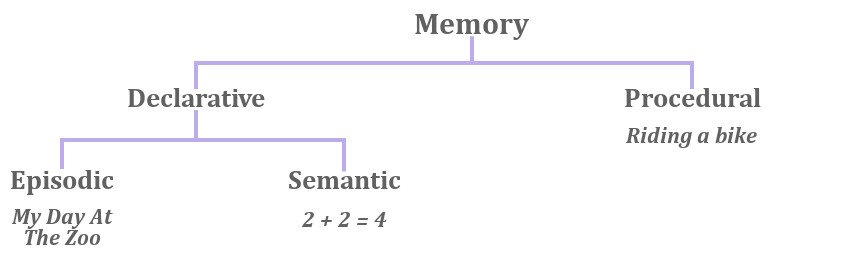
Episodic memories provide an account of our first-person experiences, the what-where-when of an event. These memories heavily rely on context and strengthen each time we relive them. They have a self-referential and autobiographical quality that is absent from other memories. Semantic memories are pure facts, without any source or contextual tags. While episodic memories would involve your experience learning math, semantic memory only involves the generic content you learned, such as 2+2=4.
Anterograde vs. retrograde amnesia: which memories vanish?
Fiction tends to treat memory loss as a single, dramatic blank. Neurologists are fussier, and they split amnesia by its direction in time. Anterograde amnesia is the inability to lay down new lasting memories after the injury; the patient is marooned in a perpetual present, greeting the same nurse as a stranger every single morning. Retrograde amnesia runs the other way, erasing memories formed before the event. Most retrograde cases follow a so-called Ribot gradient, in which the oldest, childhood memories are the most stubborn survivors while the most recent ones are the first to disappear.

The hinge for all of this is the hippocampus, a seahorse-shaped structure buried in the temporal lobe that is essential for consolidating new conscious memories. Damage it on both sides and you get dense anterograde amnesia, yet procedural and working memory carry on largely unharmed. This is exactly why Clive Wearing’s case is so harrowing: a viral brain infection handed him both the anterograde and the retrograde forms at once.
Notice, though, that language sits in neither basket. The anterograde form blocks tomorrow’s memories but leaves the grammar and vocabulary you consolidated decades ago untouched. The retrograde form, with its Ribot gradient, spares precisely the oldest and most over-rehearsed knowledge you own, and your native tongue is about as old and over-practiced as anything in your head. Whichever direction the erasure travels, your first language is sheltered from it.
Why does language persist?
Semantic memories store long-term knowledge of words and object meanings. Damage to parts that store semantic memories would cause you to tie your shoelaces without the conceptual knowledge of what a shoe actually is. However, these memories are unaffected by amnesia, which only foils episodic memories. The semantic nature of language is why an amnesiac might forget how much he adores apples, but not what an apple is.
A word is engulfed in an emotional sludge as it passes through the viscous filter of subjectivity. Essentially, language seems to be symbolic, with an arbitrary word-meaning methodology. In the absence of an emotional crust, lexical knowledge becomes semantic knowledge. This fundamental knowledge is represented within semantic memory. In fact, a great deal about semantic memory has been learned by studying the nuances of language processing.

Language courses. (Photo Credit: Maxx-Studio / Shutterstock)
Furthermore, language also seems to be procedural, to a certain extent. It seeps into the unconscious after recursive usage. Of course, semantic memory doesn’t exist entirely isolated from episodic memory. Our memories are so haphazardly entangled with the web of subjectivity that escaping it is impossible. Still, amnesiacs retain enough semantic or associative structures of language to use them unhindered.
Clive Wearing is known to be the most tragic case of amnesia, for he was tragically afflicted by both retrograde and anterograde amnesia. However, Wearing, despite his amnesia, could recall playing the piano and orchestrating, even though he had no recollection of ever receiving a musical education. Another way to put this is to say amnesiacs tend to preserve habits, rather than experiences or facts.
A loss of language is instead a symptom of aphasia, where the semantic memory is damaged. Consider Broca’s aphasia, where the patient understands a language but doesn’t know what to say – words callously betray him. Or, there is Wernicke’s aphasia, where the control of a language’s structures is intact, but the patient speaks meaningless hogwash. Still, the reach of language is so deep, and the urge to express is so primitive, so rooted within us, that without verbal language, patients can effectively communicate through non-verbal descriptions – by gesticulating and drawing.
So do amnesiacs forget how to read?
If the autobiography crumbles, surely reading goes down with it? Reassuringly, it doesn’t. Reading a familiar script is a perceptual and procedural skill, closer to muscle memory than to a recollection, and amnesia treats those skills gently. Patient H.M., who lost his hippocampus to surgery in 1953 and never formed another lasting memory, could still read perfectly well for the rest of his life.
The neatest proof came from a now-classic experiment by Neal Cohen and Larry Squire in 1980. They sat amnesic patients down to practice reading words printed in mirror image. The patients sped up at this peculiar skill at the very same rate as healthy volunteers and held onto the improvement for at least three months. The catch? They had no memory of ever sitting through the practice, and could barely recognize the specific words they had just laboriously decoded. The how survived intact while the what evaporated, a clean split between knowing how and knowing that.
Reading only collapses when the language machinery itself is wounded, a condition called alexia, which is a reading-specific cousin of aphasia. That stems from damage to the brain’s word and visual areas, not from the hippocampal damage behind classic amnesia. The same logic explains why amnesia won’t make you forget a language you already speak. So an amnesiac can usually read this very sentence without difficulty; he simply won’t remember having read it tomorrow.
The self
Amnesiacs tend to strongly retain childhood memories, which seem to be cemented by time. That being said, they are known to register new ones, albeit only semantic ones. Researchers claim that amnesia isn’t characterized by a loss of memories, but rather a failure to retrieve them. They aren’t forgotten, but merely inaccessible. Patients have repeatedly illustrated that they become progressively better at puzzles, despite having no memory of previously solving them. They mysteriously retain how memories, but forget what memories. No medical treatment to cure amnesia has been found yet; doctors only hope for the best by improving a patient’s memories.

Rene Descartes is one of the most revered Enlightenment thinkers. (Photo Credit: André Hatala / Wikimedia Commons)
The notion of memories also entails something that has been a perennial source of introspection and wonder. The essence of the self, our personal identity, has perplexed us since antiquity. The central question is what makes a vague memory of an 8-year-old you packing a school bag with his books the same person as you are at this moment, despite harboring completely different ideologies, appearance, milieu and even biological cells. Despite being biologically and metaphysically different, what makes these two different organisms across time the same being – what makes you you? What accounts for this connectedness?
Descartes believed that personal identity existed separately from our experience, in a Cartesian Ego, a soul. Hume, on the other hand, believed that identity was nothing eccentric, but merely a sum of experiences, a psychological continuity of memories. We are just our thoughts and our memories. Hume believed that it is the nature of memory that dupes us with an illusion of a persisting self, one existing separately from our experiences.
References (click to expand)
- Klein, S. B., & Nichols, S. (2012, July 1). Memory and the Sense of Personal Identity. Mind. Oxford University Press (OUP).
- Cognition and Brain Lab: Semantic Memory - internal.psychology.illinois.edu:80
- McRae, K., & Jones, M. (2013). Semantic Memory. Oxford Handbooks Online. Oxford University Press.
- Breakdowns: Amnesia, Agnosia, Aphasia Summary Prepared .... The University of Delaware
- Henry Molaison (Patient H.M.). Wikipedia.
- Patient H.M. Case Study In Psychology. Simply Psychology.
- Cohen, N. J., & Squire, L. R. (1980). Preserved learning and retention of pattern-analyzing skill in amnesia. Science. PubMed.
- Squire, L. R. (2009). The Legacy of Patient H.M. for Neuroscience. Neuron. PMC.
- Transient Global Amnesia. StatPearls. NCBI Bookshelf.