Table of Contents (click to expand)
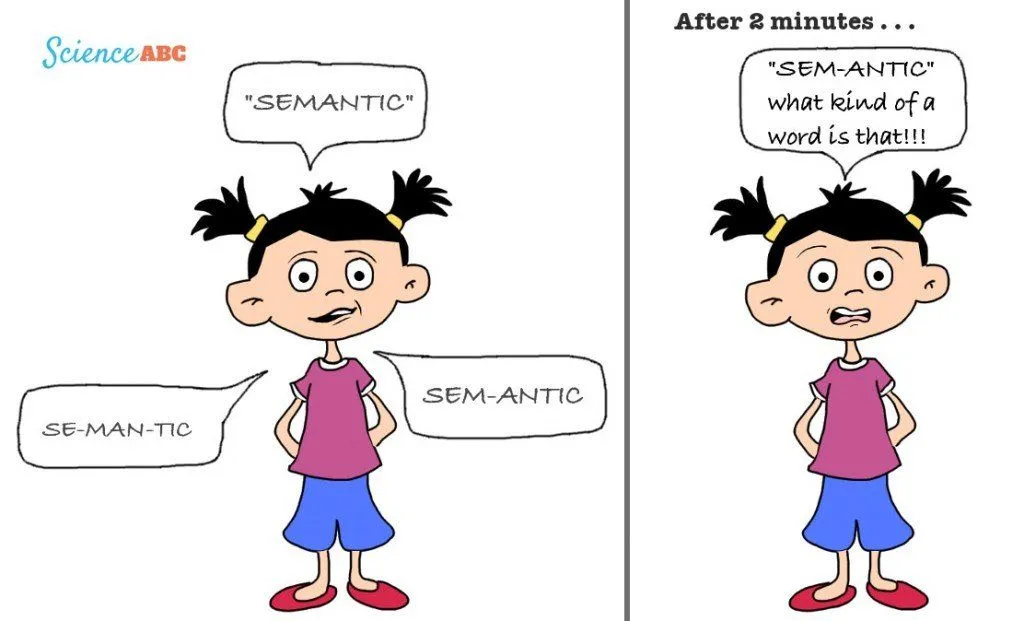
When a word is repeated multiple times, it can lose its meaning and just sound like gibberish. This is called semantic satiation and it happens because our brains translate words into ideas. When a word is repeated, the brain just focuses on the sound of the word and not the meaning, which is why it can start to sound like gibberish.
“‘Diction’. What a great word that is, right? ‘Diction’. I think the word is so slick that I like to say it over and over again.
This guy has great diction.
You should really work on your diction.
Diction is all about choosing the right words in the right places.
Diction. Hmm.. diction… d-i-c-t-i-o-n… diction… di– wait a minute, why does the word sound so weird now?”
Does this situation sound familiar? Has it ever happened to you that a perfectly normal word, when repeated over and over and over again, suddenly loses all its meaning and starts sounding weird? This includes both prolonged viewing of the word and its active repetition (oral or written).
If this has happened with you, then let me tell you this:
This phenomenon (namely when a word loses all its meaning when repeated multiple times), in fact, is quite common, and it also has a fancy name: semantic satiation.
What Is Semantic Satiation?
Semantic satiation is the name of a psychological phenomenon wherein the repetition of a word, whether it’s visual or oral, causes it to lose its meaning for the viewer/listener, and makes it seem like it’s just a meaningless sound. Historically, the term ‘semantic satiation’ has been used to refer to the subjective loss of meaning that comes as a result of prolonged exposure to a word.
The term 'semantic satiation' was coined by Leon Jakobovits James (now a psychology professor at the University of Hawaii) in his 1962 doctoral dissertation at McGill University. James framed it as a kind of mental fatigue, specifically the old behaviorist idea of reactive inhibition: each time a neural representation is activated in close succession, its responsiveness briefly drops, and after enough repetitions in a short window it stops "firing" the associated meaning at all. (The popular pop-science version that says "a brain cell needs more energy each time it fires" isn't quite right at the cellular level. What's really going on is short-term synaptic depression and the broader fatigue of the network that maps a word to its meaning.)
You can experience semantic satiation with practically every word, but some words lose meaning faster than others. Counter-intuitively, words with which you have stronger associations tend to satiate faster, because there is more semantic activity to deplete. So a high-frequency word like "Internet" or "book" can turn into brain mush more quickly than a rarer one like "ennui" or "semantic", whose associations weren't that vivid to begin with.
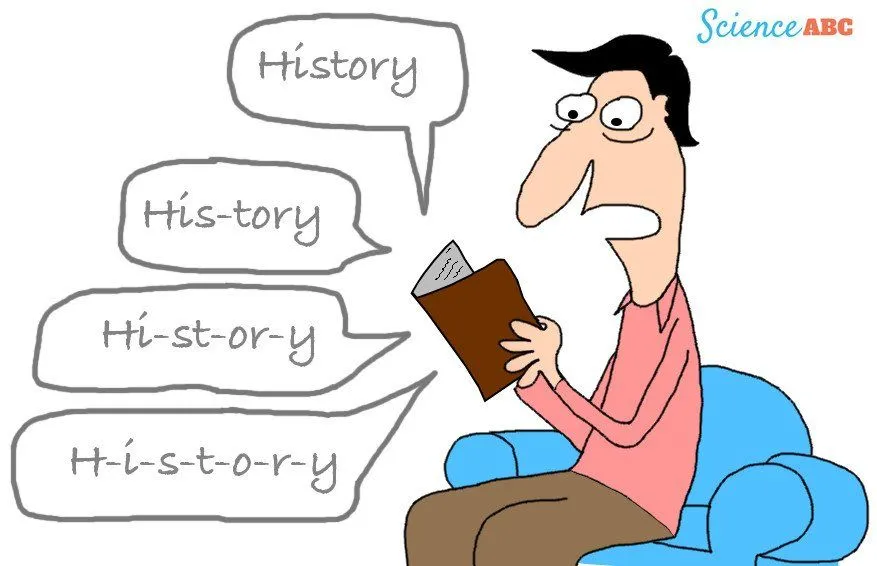
But why does really happen? What’s going on here?
Reason Behind Semantic Satiation
When you hear, read or speak a word, your brain isn’t really listening to its sound; rather, it’s translating those sounds into an idea. That idea is then put together with other words, to form a more complex idea. However, when you repeat a word multiple times, your brain ceases to recognize it as a word (which subsequently keeps it from translating it into an idea), and breaks it down into sounds. These sounds, of course, have nothing to do with the inherent meaning of the word. That’s why a purely normal word begins to sound like gibberish.
Think of it this way: our brains have an incredible ability to take words and understand an entire concept associated with them. For instance, when you think of the word “book”, you instantly conjure up the image of a book. You may have additional details like color, thickness, cover etc. in the background, but you instantly connect with the idea of a book the moment you look at the word or hear/speak it.
However, when you start repeating it actively, the brain refocuses on the actual word “book”. Then, it thinks about the word, its intonation, sound, the letters it comprises etc. These things obviously have nothing to do with the idea of a book, which is why the word seems meaningless the more times it’s repeated.
Interestingly, semantic satiation has even been proposed as a theoretical tool for reducing speech anxiety in people who stutter. The idea (laid out in a 1966 paper in the Journal of Speech and Hearing Disorders) is that deliberately repeating an emotionally loaded word until it satiates can dull the negative associations and feelings that get triggered when the word is spoken. It never really took off as a mainstream stuttering therapy (modern evidence-based approaches lean on fluency shaping, stuttering modification, and cognitive behavioral therapy), but it's a fun example of a quirky lab phenomenon finding a clinical hypothesis.
Did you ever imagine that something you considered a random 'thing' with words could end up being proposed as a clinical tool?
I doubt it. Doubt it. Doubt… doubt… d-o-u-b-t…
Why Does A Word Look Weird When You Stare At It?
So far we have been talking about words that sound weird when you say them too many times. But there is a close cousin to this effect that happens entirely with your eyes. Have you ever stared at a perfectly ordinary written word, say “the” or “book”, for a while, until it suddenly looks misspelled, foreign, or just plain wrong, even though you know full well it is spelled correctly? You are not losing your mind, and you are definitely not alone.

This visual version is actually older in the scientific record than semantic satiation itself. Way back in 1907, more than 50 years before Leon Jakobovits James coined “semantic satiation”, psychologists Elizabeth Severance and Margaret Floy Washburn (the latter being the first woman in the United States to earn a PhD in psychology) reported it in The American Journal of Psychology. They wrote that “if a printed word is looked at steadily for some little time, it will be found to take on a curiously strange and foreign aspect.” They noted that the word first looks like it belongs to another language, then dissolves into a mere collection of letters, and can eventually break down so far that the letters themselves look like meaningless marks on the paper.
Researchers often call this written-word version orthographic satiation, while the popular internet name for it is wordnesia. It is worth keeping the two effects apart: in semantic satiation the meaning drains away, whereas in orthographic satiation it is the visual form that starts to look wrong, even when you can still recall what the word means. A 2019 study in Frontiers in Psychology that used rarely seen Chinese characters argued that this satiation can arise at the level of how the brain stores the word form, not only at the level of meaning.
As for why it happens, the leading explanation is that staring forces conscious attention onto a process that is normally automatic. Reading is so over-practiced that you decode familiar words without thinking; deliberately scrutinizing one is like suddenly asking yourself whether you are breathing correctly. Charles A. Weaver III, a psychologist at Baylor University, has compared it to consciously monitoring any habitual action: the moment you watch the automatic machinery work, you get a “hiccup.” Cognitive neuroscientist Russell Epstein of the University of Pennsylvania has linked it to William James’s idea of the “fringe” of consciousness, the background hum that normally tags a familiar word with a feeling of correctness. When that signal misfires, the word that should feel right instead feels oddly wrong. If that sense of “I have never seen this before” about something familiar rings a bell, it is the same family of glitch behind déjà vu and its mirror image, jamais vu. The effect is completely harmless and fades within seconds of looking away.
References (click to expand)
- (2014) Semantic Satiation among Lexically Ambiguous Words. John Carroll University
- Semantic satiation inhealthy young and older adults - www.psych.wustl.edu
- Word Weirding - Language Log. Language Log
- Bruno Galmar, Jenn-Yeu Chen - Verbal Satiation Of Chinese Bisyllabic Words: A Semantic Locus And Its Time Course - CiteSeerX
- Kounios, J., Kotz, S. A., & Holcomb, P. J. (2000, December). On the locus of the semantic satiation effect: Evidence from event-related brain potentials. Memory & Cognition. Springer Science and Business Media LLC.
- Semantic Satiation and Word Association - Princeton University Library Catalog - catalog.princeton.edu
- Severance, E., & Washburn, M. F. (1907). The Loss of Associative Power in Words after Long Fixation. The American Journal of Psychology, 18(2), 182-186. JSTOR.
- Cao, K., Li, J., Wu, B., Zhang, H., & He, H. (2019). A Lexical Representational Mechanism Underlying Verbal Satiation. Frontiers in Psychology, 10, 2236. PMC, NIH.
- When Even the Simplest Word Looks Weird And Wrong You Have Wordnesia. Smithsonian Magazine.