Table of Contents (click to expand)
PU leather (short for polyurethane leather) is a synthetic, faux-leather material made by coating a fabric or split-leather backing with a layer of polyurethane, a flexible polymer. It looks and feels like genuine leather but is cheaper and less durable. When made entirely without animal hide, 100% PU leather is also vegan.
There are few things as comforting and cool as a leather jacket that has been well broken in, softened over the years to a smooth and stylish shine. However, such timeless quality doesn’t come cheap, and leather is definitely a finite resource, so an artificial option was developed. While this synthetic variety may be acceptable for certain faux-leather items, people with discerning taste or a bit of knowledge about PU leather usually opt for the genuine article, rather than a more affordable alternative. For those without much experience in the luxurious world of leather, knowing the difference between genuine leather and PU leather is important, as is being able to identify the small details that will betray a piece of fake leather right away!
What Is PU Leather?
PU leather is a type of artificial leather made by coating a backing material with a synthetic polymer, namely polyurethane (hence, PU leather), and is typically found in vehicles, furniture, clothing and accessories. The backing can be a low-quality split of animal hide, in which case the result is sometimes called bicast leather, or it can be a plain fabric with no animal skin at all. That second, fully synthetic form is the most common type of PU leather today, and because it contains no animal product, 100% PU leather is considered vegan. Split leather, when it is used, is a lower-quality grade of animal fiber, typically from a cow, that gets coated with a glossy finish to give it the appearance of genuine leather.
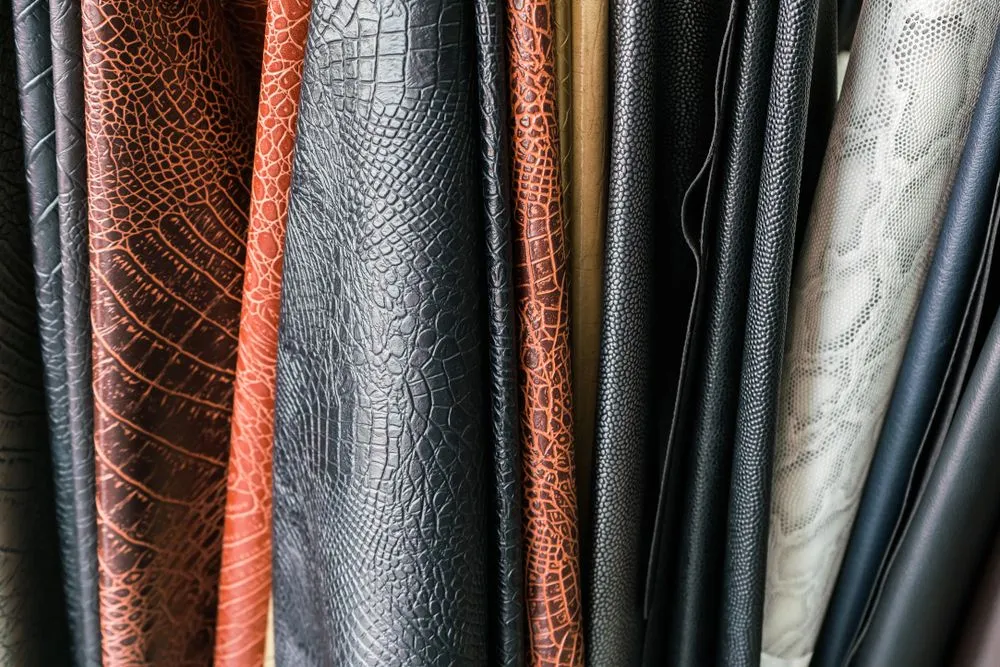
Since a raw, un-split cow hide is quite thick (around 45 millimeters, or about 1.8 inches), it must be split so that it can be manipulated into car or furniture upholstery, or into clothes, bags or shoes. In a tannery, the cow leather is fed into a splitting machine; the top layer is the grain layer (highest quality), while the lower layer is known as the split leather. This split leather is often used in the production of suede items, but if it is further coated in polyurethane to achieve more durability and gloss, it is referred to as bicast or split-coated PU leather.
There have been many different types of fake leather developed over the years, dating back to the 19th century. The materials to make these “knock-offs” have included pressed paper pulp, cork trees, collagen, plastic, and various organic and synthetic resins. The broad range of materials has also led to a laundry list of names, including split leather, bicast leather, pleather, vegan leather, faux leather and leatherette, among others.
Some of these varieties completely avoid the use of animal skin (i.e., vegan leather), while others are simply cheaper options that use lower-quality materials to achieve a similar appearance to genuine, top-grain leather. However, while genuine leather may last for generations, PU leather may start showing wear and damage within a few years.
If you’re shopping for a nice piece of leather furniture or clothing, you don’t want to be fooled by impostors; fortunately, there are a number of clear differences between real leather and PU leather.
PU Leather Vs Genuine Leather
To begin with, genuine leather is always made from real animal skin, specifically the top-grain layer closest to the surface, which gives it better breathability than faux leather. PU leather may or may not contain any animal skin at all; the bicast variety is built on a split-leather base, while fully synthetic PU leather is built on a plain fabric backing. Either way, the surface you actually touch is polyurethane, not natural hide.
The production process relies on a clever trick with “release paper.” The polyurethane is applied in liquid form onto a sheet of paper that carries a grain pattern, and a backing (a fabric layer, or a split-leather layer for bicast) is then glued onto the wet PU film.
Once it sets, the synthetic film is peeled off the patterned paper, and it now bears the embossed leather “grain” that people look for. Genuine leather, by contrast, does require a number of chemicals to be processed, so that the natural decomposition process is halted, but the end product is still a treated piece of animal skin, rather than a synthetic composite.
PU Leather Durability
In terms of durability, genuine leather gets better with age, often softening and developing small imperfections that give the item character. PU leather often looks “too perfect”, because it has been made with a patterned grain, rather than the unpredictable beauty of nature itself.
Speaking of nature, real leather can handle a fair amount of exposure to the elements without much risk of damage, but the same is not true for synthetic varieties. PU leather will begin to break down over time, both from exposure to the elements and from everyday use, typically showing cracks, peeling and signs of wear within three to five years. PU leather is also prone to rips and splits, which can reveal the padding of the couch or car seat below, and looks terrible when repaired.
When it comes to comfort, real leather is breathable, because it isn’t coated in a non-porous polymer, so it won’t “sweat” in changing temperatures. It is also more malleable, and can be stretched and bent without fear of damage, unlike PU leather, which is susceptible to punctures and tears. The deep and intoxicating aroma of real leather is also very difficult to mimic. When you first start using a PU leather item, the chemical smell will be unmistakable and quite pungent. While this may fade over time, the material will never have that authentic aroma of real leather.
Most of the comparisons between PU leather and genuine leather swing in the latter’s favor, except when it comes to cost and cleanliness. As those who own real leather know, it is very difficult, if not impossible, to clean leather effectively, whereas PU leather can be cleaned in a number of less intensive ways. Secondly, the cost of PU leather is often a fraction of genuine leather, so if you’re trying to shop for luxury on a budget, this synthetic option might be for you. Purchasing small PU leather items that you don’t mind replacing every few years is understandable, though experts would always recommend going for the genuine article for big-ticket items (e.g., jackets, furniture, vehicle interiors).
A Final Word
For those fashionistas and interior decorators who are opposed to the use of genuine leather for ethical reasons, or for people shopping for style on a budget, PU leather and other faux varieties are an ideal choice. However, if you want the classic look, smell, feel and durability of leather that could stay in your family for generations, there is just no substitute for the real thing!
References (click to expand)
- Durst, P. (1985, April). PU Transfer Coating of Fabrics for Leather-Like Fashion Products. Journal of Coated Fabrics. SAGE Publications.
- Artificial leather. Encyclopaedia Britannica.
- England) T. I. (. (2005). Chemical Testing of Textiles. Elsevier Science
- Sudha, T. B., Thanikaivelan, P., Aaron, K. P., Krishnaraj, K., & Chandrasekaran, B. (2009, June 24). Comfort, chemical, mechanical, and structural properties of natural and synthetic leathers used for apparel. Journal of Applied Polymer Science. Wiley.