Not all opera singers are fat. This is seems to be a popular myth that remains in the popular psyche of people because of continous influences in popular culture.
Recently a reader who made us an observation: that many opera singers in these videos were unmistakably obese or fatter than the average person. She said she liked opera and often watched performances of famous opera singers on video sites on the Internet, and many of them were overweight.
Is that true? Are most, if not all, opera singers obese? If so, what is the reason?
Not All Opera Singers Are Fat!
You should know this right at the start: Not all opera singers are fat!
This is a myth, or one might say a prevalent illusion among the general public.
It is also a stereotype, a vast generalization about opera singers, especially female opera singers. In reality, there is no nothing that says that opera singers necessarily have to be chubby.
In fact, many opera singers have an “average” body and are quite fit. It seems that the audience perceives opera as one of the few remaining entertainment areas where talent is more important than physical appearance, but interestingly, modern opera singers are increasingly subjected to stricter, fitter image standards.
If you look up Jose Carreras, Isabel Leonard, Lawrence Brownlee, and Joseph Kaiser on the Internet, you will see what I am talking about.
Why Do People Think Most Opera Singers Are Fat?
This is very subjective, and there may be many reasons why not everyone thinks opera singers are fat. One of the reasons for the image of a fat opera singer coming about was cartoons of Wagner’s heroine Brunhilde. Brunhilde who appears at the end of Richard Wagner’s Götterdammerung is caricatured as a large woman wearing a giant moo-moo and a horned hat.
This seems to have led to the popular expression, “It ain’t over till the fat lady sings”. The saying became popular in the media. Its first recorded was in an article published by Dallas Morning News, “Despite his obvious allegiance to the Red Raiders, Texas Tech sports information director Ralph Carpenter was the picture of professional objectivity when the Aggies rallied for a 72-72 tie late in the SWC tournament finals. “Hey, Ralph,” said Bill Morgan, “this… is going to be a tight one after all.” “Right,” said Ralph. “The opera ain’t over until the fat lady sings.””
There is no convincing scientific evidence that opera singers must be fat to project their voices across a concert hall. But there are several theories that float around.
Opera Singers May Have A Big Chest.
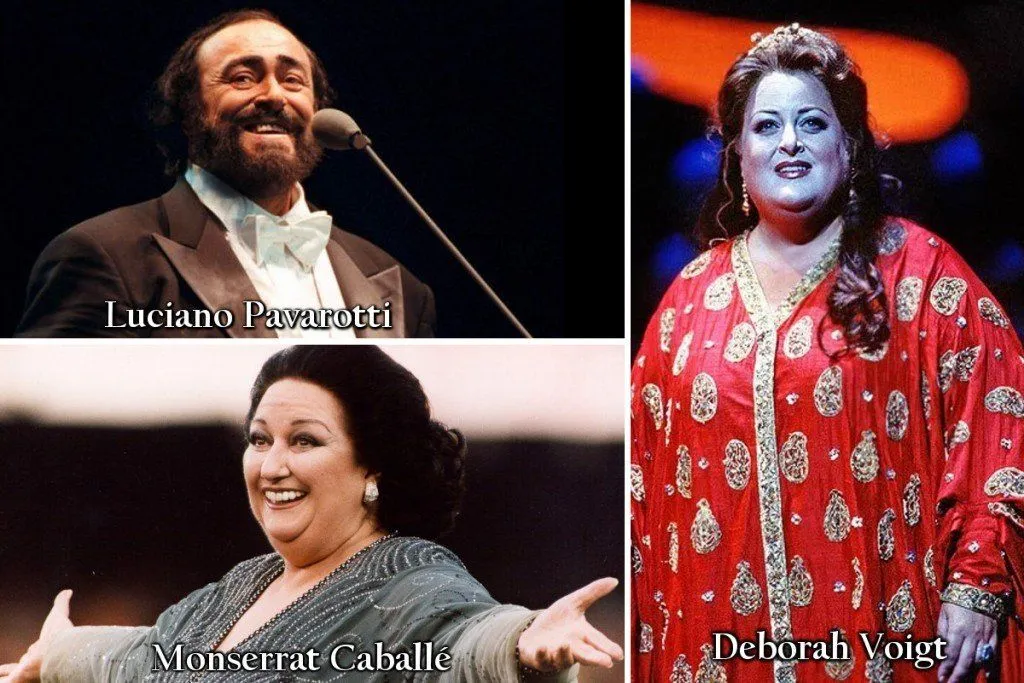
Many opera singers appear thicker than the average person because of their broad chests. A larger ribcage can house bigger lungs, and a few singers simply have a naturally roomy thorax. It is worth being precise here, though: what matters for breath is ribcage and lung volume, not body fat or breast tissue. Fat on the chest wall sits outside the ribs and does nothing to increase the amount of air your lungs can hold. Singers such as Luciano Pavarotti, Renee Fleming, and Beverly Sills are often pointed to as examples.
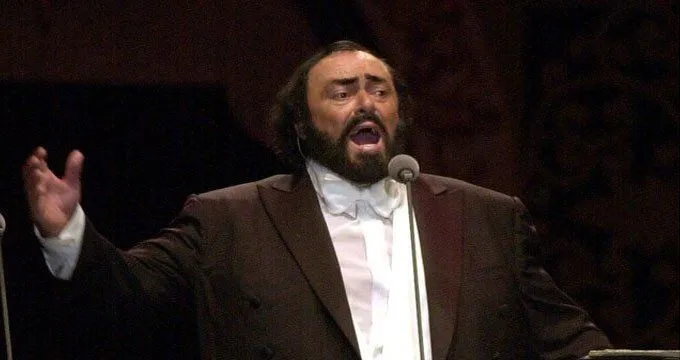
However, it goes without saying that you don’t have to have a large chest to be a good singer.
“Singing From The Diaphragm”
If you are a singer, you’ve most likely had many “experts” telling you to “sing from the diaphragm”, “be grounded, (sort of) literally”, “have low-breath” and so on.
While there’s no scientific research proving that being overweight makes your voice bigger/stronger, there are anecdotal pieces of evidence suggesting that there may be some advantages to it.

One hypothesis proposes that when you’re fat, you basically carry around a lot of weight. As such, you constantly have the ‘tugging down feeling, which may keep you ‘grounded’ and help you learn to sing. Music afficionadoes often say that a singer’s voice changes when they lose weight.
While there is no conclusive evidence supporting or denying the above claims, the reason for perceiving this change may be psychological. Reviews of opera singer Deborah Voigt after her weight loss stated that she has an “unfailingly lustrous tone, endless stamina and fine expressive restraint.”
Opera Is Hard!
Opera singers gain weight like anyone else in a stressful, travel-heavy job. Opera singing is not a breeze; it’s a high-anxiety job that requires singers to perform for hours at recordings, rehearsals, and live performances. They also have to travel… a lot!
With such a lifestyle, opera singers often neglect exercise and personal fitness. In addition, they sometimes do not get enough sleep, eat unhealthy foods, and drink alcohol, especially at parties, to celebrate their performances.
Opera Singers Are Fat Because They Can Be
However absurd this reason may sound, it is actually quite logical. Other performers, such as actors and dancers, need a fit physique, as it directly affects their performance.
In a study on perceptions of opera singers and their weight, a participant quotes that tenors can be overweight since they are the hardest voices to cast in productions.
The study notes that recent trends show a shift towards singers that are more fit. This makes sense as singing requires voice control and consistent breathing. This is improved through training and exercise.
Does Being Fat Actually Help You Sing?
This is the question most people are really asking, so let’s answer it plainly: there is no good evidence that body fat improves your voice. The idea that a heavier body somehow makes a richer, more powerful sound is folklore, not physiology.

If anything, the measurable effect of carrying extra weight runs the other way. In a study of 84 women grouped by body mass index, researchers found that higher BMI was linked to a lower maximum phonation time, the longest a person can hold a steady note on one breath. Women in the obese group sustained a vowel for about 9.3 seconds on average, compared with roughly 12.5 seconds for women in the normal-weight group. The likely reason is mechanical: adipose tissue around the ribs and abdomen makes it harder for the diaphragm and chest to move freely, which works against breath support rather than for it.
So why does the myth persist? Part of it is that talented heavy singers are highly visible, from Pavarotti to Adele, so people connect the size with the sound. But correlation is not cause. As one University of Miami review of body weight in classical singers puts it, the heavy singers we admire are not great because of their weight, they are great in spite of it, thanks to years of training. The same review notes that when a singer loses a lot of weight, the diaphragm can finally descend and flatten properly, which tends to help breath control, not hurt it.
How Do Opera Singers Project Without A Microphone?
Here is the part that genuinely surprises people. An opera singer can be heard clearly over a full orchestra of 80 or more players in a hall seating thousands, with no microphone at all. That is not done with brute size or lung power. It is done with a clever acoustic trick called the singer’s formant.

In the early 1970s, Swedish voice scientist Johan Sundberg studied recordings of star tenors and noticed a strong extra peak of energy in their voices at around 3,000 Hz, a peak that ordinary speakers don’t produce. This happens when a singer lowers the larynx and widens the throat, clustering several of the vocal tract’s natural resonances into one reinforced band of sound.
Why does that 3,000 Hz peak matter so much? Because of where an orchestra’s sound sits. An orchestra pours out most of its energy down around 500 Hz and tails off sharply at higher frequencies, leaving a relatively quiet gap near 3,000 Hz. The singer’s voice slots neatly into that gap, so it cuts through instead of being drowned out. It is less like shouting over the band and more like finding the one frequency the band has left open.
The takeaway is that operatic power is a matter of resonance and trained breath control, not body bulk. Singers spend years strengthening the diaphragm and the muscles that regulate the slow, steady release of air, which is why studies find trained singers with larger-than-average vital capacity. It is the same principle that makes your voice sound squeaky when you inhale helium, which shifts the vocal tract’s resonances rather than the rest of your body, or lets a beatboxer conjure drum kits from a single voice: the magic lives in how the vocal tract is shaped, not in how big the rest of the body is.
References (click to expand)
- (2012) "If There's No "Fat Lady," When Is the Opera Over? An .... University of Denver
- (2017) Body Weight Nutrition and the Classical Singer: A Review of the. The University of Miami
- Questions and Answers about Opera - web.augsburg.edu
- Rössner, S. (2014, September 11). ‘It ain't over till the fat lady sings’. Obesity Reviews. Wiley.
- Body mass index and acoustic voice parameters: is there a relationship? Brazilian Journal of Otorhinolaryngology. NCBI/PMC.
- The physiology of singing and implications for ‘Singing for Lung Health’. BMJ Open Respiratory Research. NCBI/PMC.
- The Singer's Formant. Timbre and Orchestration Resource.