Table of Contents (click to expand)
The likeliest explanation is linguistic: in Scotland and northern England, ‘pig’ (sometimes spelled ‘pygg’) was an everyday word for earthenware pots and jars from around 1450, so a coin jar was simply a ‘pig’. The popular story about an orange clay called ‘pygg’ is a debunked myth. The pig shape came later, helped along by old European and Asian traditions linking pigs to luck and wealth.
A few days ago, I went to a gift shop with a friend who wanted to buy a small coin bank for his 7-year-old nephew. Oddly enough, most of the money boxes that we came across in the store were shaped like pigs.
Interestingly, pigs are neither known for good etiquette nor a respectable diet. With so many other animals in the wild to choose from, humans could have opted for a better mascot for their whimsical money banks, right?
Perhaps a squirrel (a cute hoarder) would be a better choice. Even something like geese or chickens, which are supposedly known for laying ‘golden’ eggs in popular folklore, would make more sense. So why pigs? Why are these money boxes/coin banks so often in the form of piggy banks? Does it have anything to do with actual pigs?
The answer to this question isn’t straightforward, with different people giving different reasons for this porcine trend, but let’s look into some of these hypotheses.
The Practice Of Saving Money Is Old
People have been saving money since human ingenuity first contrived the concept of currencies. However, in ancient times, money was predominantly in the form of coins, rather than notes, which are more ubiquitous in today’s modern world. So, people back then needed something that could store their precious coins.
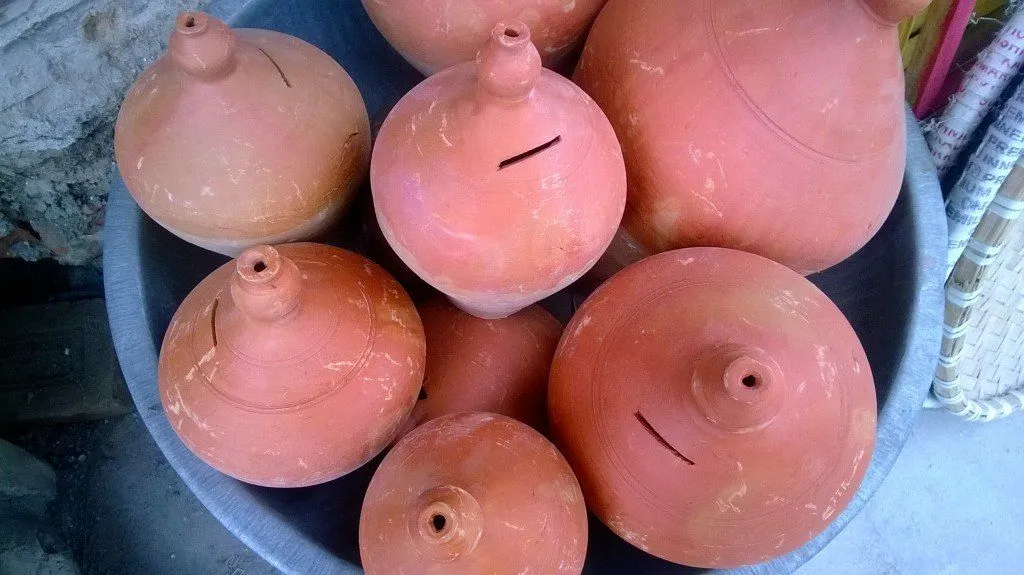
For the purposes of saving money, our predecessors designed containers with a small slit at their top, where coins could be dropped in, but could not be directly retrieved. Once the coin was dropped into this container, it remained there, lest someone broke the entire box to recoup all the money. This is similar to withdrawing all your money back from the bank, minus the shattering part!
Pygg Clay To Piggy Bank
As the purpose of these containers was temporary safe storage, they eventually had to be broken to retrieve the money, so a cheap material was needed for molding them.
The most widely repeated explanation goes like this. Charles Panati, in his 1989 book The Extraordinary Origins of Everyday Things, popularized the idea that an orange-colored clay called pygg was cheap and abundant, and so was used for everyday crockery, including these money boxes, in the Middle Ages. As the story goes, people naturally began calling money jars made of pygg clay… pygg jars. Over time, the clay was forgotten but the name stuck, ‘pygg’ drifted in pronunciation to ‘pig’, and potters eventually started casting the banks in the literal shape of a pig.
It is a tidy story. Unfortunately, it appears to be a myth. The tale can be traced to a 1965 book by Rudolph Brasch and was spread further by Panati in 1989, but neither writer cited a source, and word historians have not found one. British etymologist Michael Quinion calls the account “false in every particular,” pointing out that there is no record of any clay ever called ‘pygg’, orange or otherwise. The term ‘piggy bank’ itself is fairly young: the Oxford English Dictionary’s earliest citation dates only to 1913, far too recent to be a leftover from a medieval clay.
So if there was no pygg clay, where did the ‘pig’ come from? Here the real history is more interesting than the myth, and we will get to it next.

Other Theories On The Origins Of Piggy Banks
With the pygg-clay story set aside, the more credible explanations fall into two camps: one about the word and one about the shape. Many people also note that pigs carry genuine cultural significance, being regarded across several cultures as symbols of prosperity, wealth, or luck, which would have made them a natural mascot for a money box.
On the word itself, Michael Quinion, the reputed British etymologist, explains on his website World Wide Words that in Scotland and northern England, ‘pig’ (occasionally spelled ‘pygg’) was used from about 1450 as a general term for earthenware products: pots, pitchers, jars, and crockery of all kinds. By this account, a coin jar was called a ‘pig’ not because of its shape but because it belonged to this everyday class of earthenware. The animal sense, and the rounded pig shape, likely came along afterward.
Pirly Pigs
Another explanation is that Scots used to call coin banks ‘pirly pigs’, probably from the old Scottish word ‘pyrl’, which means to poke or thrust in, suggesting the action of inserting a coin.
Cèlèngan
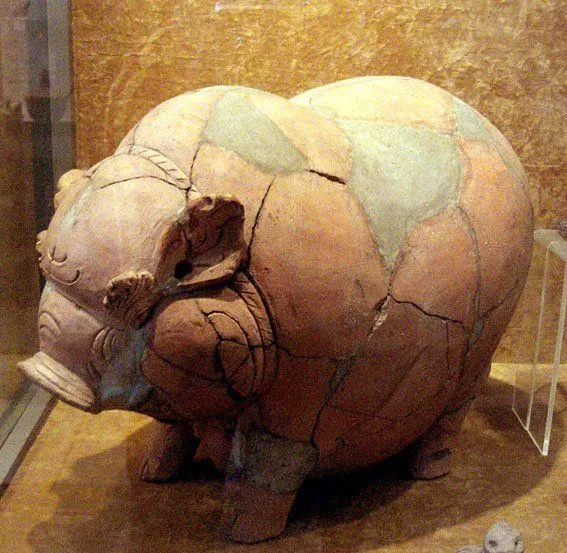
Some historians believe that piggy banks instead have their origins in Indonesia. The Indonesian and Javanese term cèlèngan is frequently used in reference to domestic places to store money. The word cèlèngan comes from cèlèng, meaning “wild boar,” so it literally describes “the likeness of a wild boar,” and it was used to refer to both savings and the money box itself. This is no minor footnote: some of the oldest known money pots in the world are the boar-shaped earthenware cèlèngan of Java, with examples traced as far back as the 12th century, and finely made Majapahit-era boar banks surviving from the 14th and 15th centuries.
Piggy Banks Came From China?
And yes, there is a final contender for the origin of piggy banks: China. Many historians reckon that during the Chinese Qing dynasty, the idea of pig-shaped money containers came into being, as pigs were a symbol of wealth and abundance under the Qing dynasty.
Germans Brought Piggy Banks To The US
Whatever the etymology is, piggy banks became popular in the US during the nineteenth century, when there was a great influx of Germans to the US. Money boxes in the shape of pigs had been used in Germany for centuries; in fact, one of the oldest known European piggy banks, dated to around the 13th century, was unearthed in the German region of Thuringia. Many claim that the shape is suggestive of the old Germanic tradition of regarding pigs as symbols of fertility and prosperity. In Germany, when someone gets lucky, ‘schwein gehabt’ is often said, which means “got pig”. Pig-shaped good luck candies are quite famous in Germany too!
To summarize, the true origins of the term ‘piggy bank’ is highly contentious and can’t be established with full certainty. However, the one thing that can be said with absolute conviction is that thanks to their immense popularity, the name and pig-shaped designs of money boxes are here to stay!