Scientists are not entirely sure what caused pouches to evolve on kangaroos, but they have noticed some evolutionary advantages to this part of the body. It requires less energy to develop, as opposed to a uterus. It also allows the female to forage for food while taking care of her young.
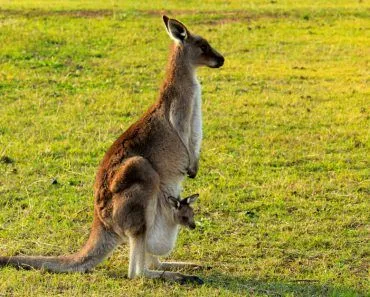
Kangaroos are amazing creatures. They have an amazing hopping ability thanks to their strong tail and legs, allowing them to push themselves 25 feet forward in a single leap! Another cool thing about kangaroos is the little pouch they have on their bellies. You can see how adorable it is when that little joey pops his head out as his mother carries him around!
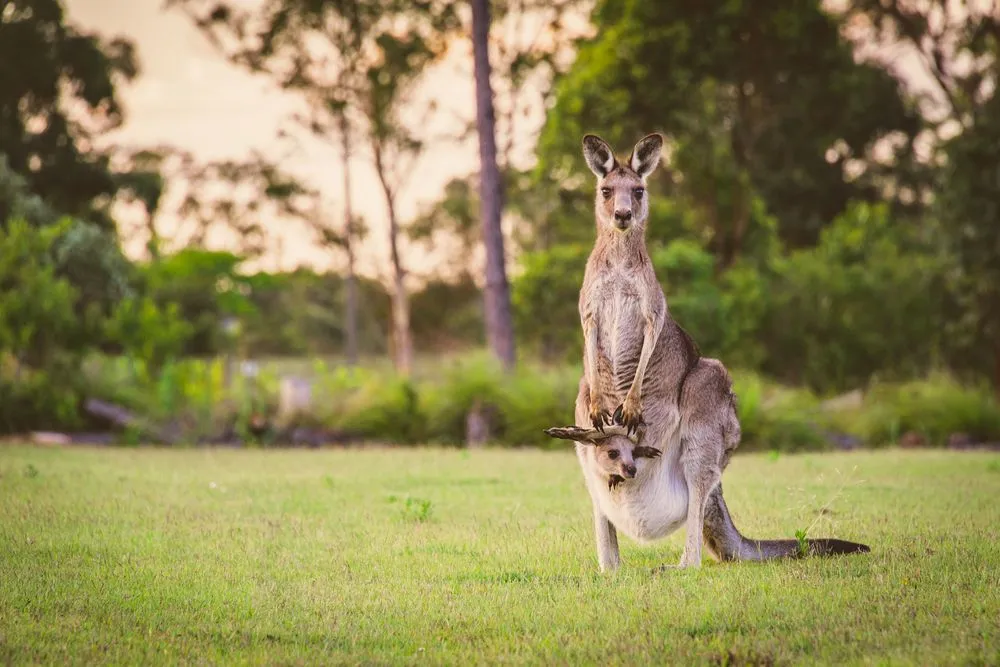
However, that’s quite an odd feature, don’t you think? You don’t often see pouches on the front of other animals. There are tusks, claws, fangs, wings and countless other features, but not many animals have pouches. In fact, you will only see pouches on marsupials.
Marsupials refer to animals like kangaroos, Tasmanian devils, wombats, opossums and many more. They are mammals like us, but are found almost exclusively in Australia, New Guinea and the Americas.
Their most distinctive feature, however, is the pouches in which they hold their young. These pouches are called the marsupium. They are not actually found on every marsupial. Some species, such as the antechinus and several shrew-opossums, have only a fold of skin around the teats, and among the egg-laying monotremes, only the female echidna develops a temporary pseudo-pouch during breeding (the platypus has no pouch at all). Even within marsupials that do have one, sizes vary widely: from kangaroos with a deep, well-defined pouch to species with little more than a flap covering the teat. But how exactly did this come about, and for what purpose?
The Evolution Of Marsupials
To understand marsupials, let’s take a broader look at mammals on the evolutionary scale. All mammals have fur on their bodies, and according to middle school science, all mammals have a placenta. However, when studying evolution in greater detail, you will find that is not exactly true.
A long time ago, mammals actually evolved from egg-laying animals. Some mammals still give birth by laying eggs. Eventually, evolution took a different path with mammals, who give birth to live young. Mammals that give birth to live young with the help of placenta are called eutherians. Quite a long time ago, the marsupials branched off from eutherian mammals.
The split between marsupials and other mammals is generally placed in the late Jurassic to early Cretaceous, with the marsupial crown group beginning to diversify around 130 million years ago. These early marsupials first migrated to South America. At this time, all the southern continents were a part of one giant landmass called Gondwanaland.
Gondwanaland is how the ancestors of kangaroos reached Australia. They just walked from South America, across what is today’s Antarctica, and into Australia. Soon after they crossed over to Australia, the continents began to drift apart. The marsupials in Australia and those in America continued to evolve on different paths.
A Marsupial Pouch
The pouch of a marsupial can differ from species to species, but they serve the same purpose, holding the young as they develop. However, it’s not just for fully developed young; it can also hold a still-developing youngling!
Marsupial reproduction is quite interesting. While in eutherian mammals the young develop inside the mother, and in most other creatures, they lay eggs and the young develop inside, the story of the marsupial is quite different.
Marsupials are conceived like most other animals, with the sperm and the egg fusing in the female reproductive system. After that, a barely developed embryo exits the vagina and climbs into the mother’s pouch. In fact, the child develops its brain and forearms faster than the rest of its body. This helps it crawl before it is fully formed.
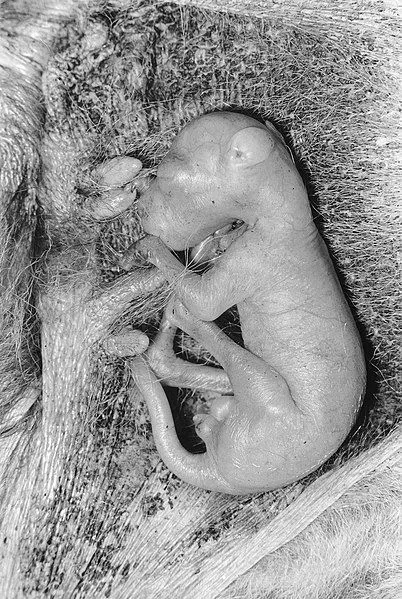
Once the half-formed embryo crawls into the pouch, it attaches its mouth to the nipple. It will continue to receive nutrition from the mother while it develops in the pouch.
The Usefulness Of Pouches
Scientists are not entirely sure what caused pouches to evolve on kangaroos, but they have noticed some evolutionary advantages.
Marsupials evolved when resources were extremely scarce, and taking care of offspring requires a lot of energy. Basically, in a situation where they don’t have the energy to take care of their young, it is easier to terminate the pregnancy. This may seem brutal, but it would give them an advantage in difficult times. The pouch also means that less energy will be spent on developing the uterus, which holds and nourishes the baby.
The pouch would also allow the mother to forage with greater ease. The mother would be more aware of her surroundings and could eat without having to worry about her baby. These pouches seem to be useful in many ways, but what’s interesting is the way they evolved differently in different marsupials.
Different Types Of Pouches
Some pouches are small, with only a thin flap to hold the baby as it develops, while others have a large enough pouch for a joey to jump into when it’s scared.
We all know that the opening of the pouch for a kangaroo faces upward. This seems logical, to ensure that the little joey doesn’t fall out while his mother hops around at 35 miles an hour!
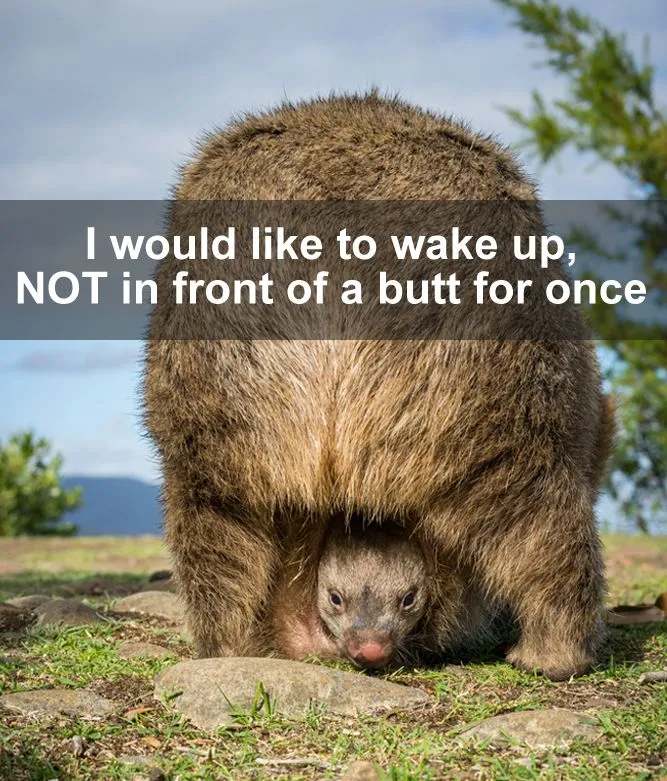
Wombats, on the other hand, have backwards-facing pouches.
Wombats are animals that dig holes in the ground. If they had forward-facing pouches, their children would be getting truckloads of dirt into their faces all the time. The backwards-facing pouch helps them avoid a mouthful of dirt. On the flip side, their pouch opens right in front of their mother’s butt!
Do Male Kangaroos Have Pouches?
Here's a question that trips up almost everyone: do male kangaroos have pouches too? The answer is no. Only female kangaroos have a pouch, and every healthy female has one. A male kangaroo, no matter how big and muscular, has a completely smooth belly.

It comes down to what the pouch is actually for. The marsupium exists to carry, warm and nurse a developing joey, and in kangaroos that job belongs entirely to the mother. Males play no part in raising the young, so there is simply nothing for a pouch to do. The structure is built in from the very start, too. When zookeepers peek inside a mother's pouch, they can often tell a female joey from a male one, because the tiny female is already growing the beginnings of her own pouch.
Is this true of every marsupial? Almost. The pouch is a female feature right across the group, with one quirky living exception: the male water opossum, or yapok, of Central and South America. Its pouch isn't for babies at all. It works as a watertight pocket that tucks away and protects the male's genitals while he swims and dives after fish.
What's Inside A Kangaroo's Pouch, And How Does It Work?
So what does the inside of a kangaroo's pouch actually look like? It's nothing like the cozy, furry pocket you might imagine. The inside is bare, hairless skin, warm and a little sweaty, with the mother's teats tucked at the bottom. A close look at the lining reveals plenty of large sweat glands, especially around the base of each teat, and these help keep the humidity just right for the tiny resident.

The pouch also isn't a loose, floppy bag. A ring of muscle around the opening lets the mother draw it tight, almost like a drawstring. She can clamp it nearly shut to keep a newborn snug and secure while she bounds across the plains, or relax it to let an older joey climb in and out.
You might assume such a sheltered nursery would be perfectly clean, but it isn't. Studies have found that the marsupial pouch is far from sterile; it is home to a whole community of bacteria, some of them potentially harmful. That is a real problem, because a newborn joey is so undeveloped that it hasn't yet built a working immune system of its own. Marsupials get around this in two clever ways. The pouch lining and the mother's milk are loaded with germ-fighting compounds, including lysozyme, dermcidin and a family of antimicrobial peptides called cathelicidins, which puncture bacteria and fungi before they can harm the joey. On top of that, the mother grooms the pouch herself, dipping her head inside to lick it clean, and on hot days she licks it to help cool the inside down.
Conclusion
Understanding what exactly led to kangaroos developing a pouch would be extremely difficult. This happened 130 million years ago, and it’s very hard to figure out exactly what their lives were like back then. Whatever the reason was, it is a fascinating feature that has allowed for the survival of some uniquely adorable animals.
References (click to expand)
- Sharman, G. B. (1970, February 27). Reproductive Physiology of Marsupials. Science. American Association for the Advancement of Science (AAAS).
- (1968) Origin and Early Evolution of Marsupials - jstor. JSTOR
- SMITH, K. K. (2001, July). Early development of the neural plate, neural crest and facial region of marsupials. Journal of Anatomy. Wiley.
- Sharp, J. A., Modepalli, V., Enjapoori, A. K., Abud, H. E., Lefevre, C., & Nicholas, K. R. (2022). Milk of Monotremes and Marsupials. Encyclopedia of Dairy Sciences. Elsevier.
- Vogelnest, L. (2015). Marsupialia (Marsupials). Fowler's Zoo and Wild Animal Medicine, Volume 8. Elsevier.
- (2012) The marsupial pouch: implications for reproductive success .... BioOne
- Koala facts - Queensland (Department of Environment. The Department of Environment and Science
- Nilsson, M. A., Churakov, G., Sommer, M., Tran, N. V., Zemann, A., Brosius, J., & Schmitz, J. (2010). Tracking marsupial evolution using archaic genomic retroposon insertions. PLoS biology, 8(7), e1000436.
- Kubota, K., Shimizu, T., Shibanai, S., Nagae, K., & Nagata, S. (1989). Histological properties and biological significance of pouch in red kangaroo, Macropus rufus. Anatomischer Anzeiger. PubMed.
- Cheng, Y., & Belov, K. (2017). Antimicrobial Protection of Marsupial Pouch Young. Frontiers in Microbiology. NCBI/PMC.
- Blackman, S. (2023). Why female kangaroos have pouches. Discover Wildlife (BBC Wildlife Magazine).
- Welcoming a New Joey to the Mob. Brevard Zoo.