Table of Contents (click to expand)
The word “mummy” comes from the Arabic mummiya, itself borrowed from Persian mum, meaning wax or bitumen used in embalming. Medieval European translators mistook the substance for the embalmed Egyptian corpses themselves, and the name stuck. The ancient Egyptians called their own preserved dead sah, meaning “noble one”.
Pop culture references around Egyptian mummies are a dime a dozen. Some shine as cherished cornerstones of media – the Brendan Fraser classic, The Mummy – while others are cheap shots like unimaginative jokes about mummies and mummies.
The dead one and the alive one have little in common. One is in a state of eternal sleep and the other barely gets any. One is covered in bandages from head to toe, while moms patch up offspring after they scrape their knee. Not to mention that one has had their brains removed, while the other is having their brains pureed by their offspring. The only thread that binds them is the 5 letter word… but how did that thread come to exist in the first place?
Origin Of The Word “Mummy”
The word ‘mummy’ (the Egyptian one) finds its origins in the Arabic word mummiya, meaning ‘tar’ or ‘bitumen’. Arabic borrowed it in turn from the Persian mūm, meaning ‘wax’, the very substance the Persians used to embalm and seal their own dead. Bitumen itself is a naturally occurring, heavy form of petroleum: a thick, sticky hydrocarbon found in seeps and lakes. Today, you’re most likely to meet it under another name, asphalt.
Bitumen is an important natural material. Along with its uses in construction and as an adhesive, it was also believed to have medicinal properties. Many physicians at the time, notably Arab physician Ibn Sina (Avicenna) and Muhammad ibn Zakariya al-Razi (Rhazes), wrote of the healing capabilities of bitumen, or mummiya, which could also mean a mixture of resins and oils. Both used the term in their treatises. Earlier texts by Roman physicians echoed the same.
When the Sasanian Persians, and then the Arabs, took Egypt from the Byzantine (Eastern Roman) Empire in the 7th century (the Persian conquest in 619 and the Arab conquest in 641), they encountered ancient Egypt’s pyramids and the bandaged corpses that lay within.
To the Arabs, these dead bodies looked like they were covered in thick brown-black bitumen, and they connected the appearance of bitumen, or mummiya, to the Egyptian corpses in their writing.
Worth pausing on: the ancient Egyptians never used the word ‘mummy’ at all. They called a properly embalmed body sah, meaning ‘noble one’ or ‘dignified one’, while an ordinary, unmummified corpse was just khat. ‘Mummy’ is an outsider’s label, pinned on after the fact by visitors who didn’t quite understand what they were looking at.
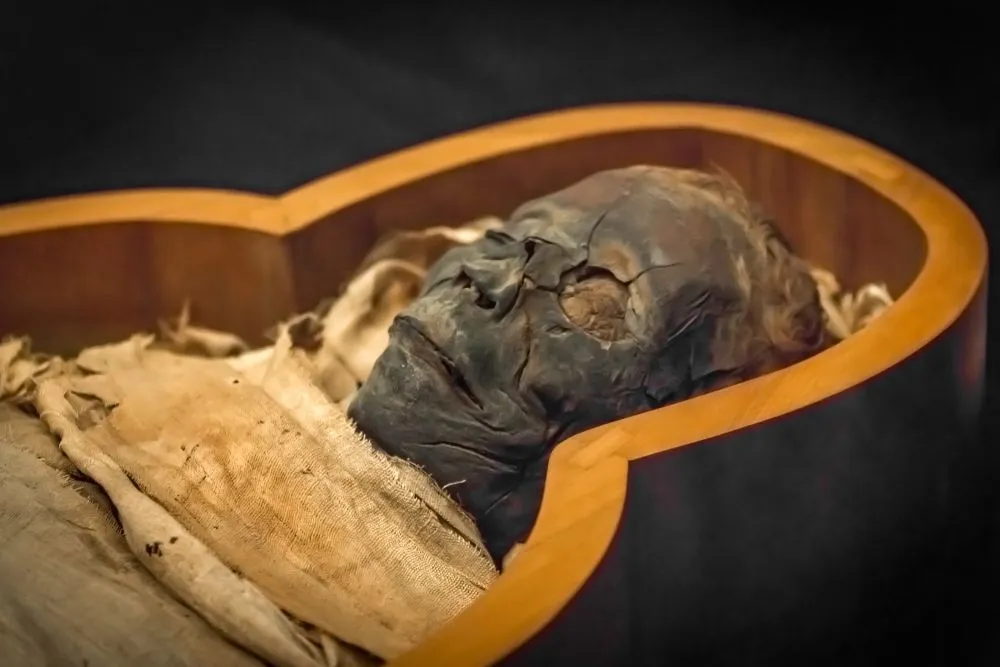
Those medicinal books written in the 8th century by the Arabs and Persians all perpetuate this misunderstanding. When Europeans began translating these texts into Latin, and then later into English (and other European languages), the misunderstanding deepened.
In the 12th century, Gerard of Cremona, a translator of scientific works from Arabic to Latin, while translating al-Razi’s Liber ad Almansorem into Latin, confused the term bitumen for the embalmed corpses of Egypt, and one of the main sources of the confusion was born. He defined the word as, “the substance found in the land where bodies are buried with aloes, by which the liquid of the dead, mixed with the aloes, is transformed and is similar to marine pitch.”
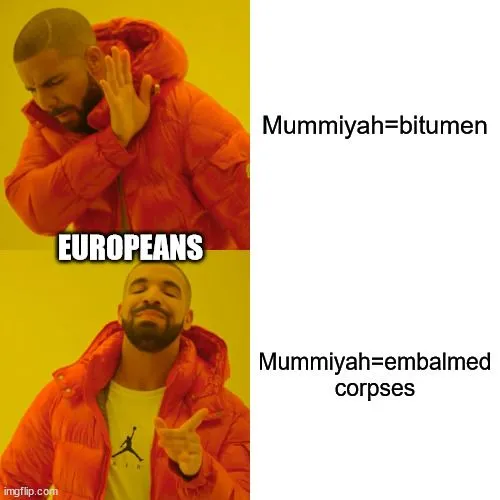
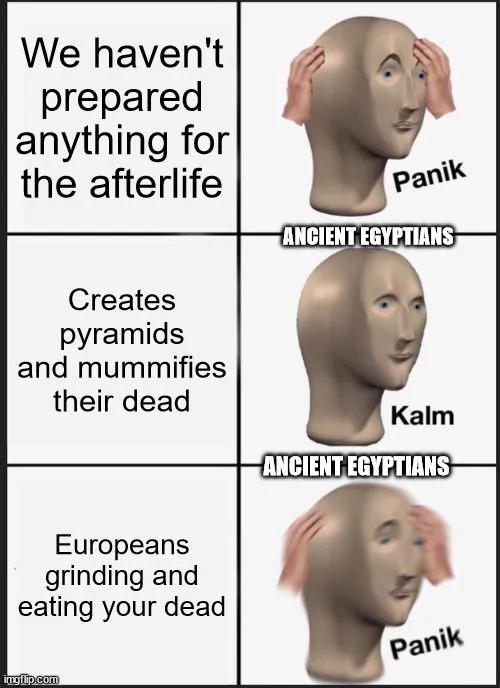
Mummies actually launched a health fad in Europe. Starting around the 12th century and peaking during the 15th and 16th centuries, Egyptian mummies were in high demand for their supposed healing properties. Europeans ground, powdered and pasted up old mummified corpses, then sold the product (“mummia” or “mummy powder”) on the open market as a cure for almost anything: bruises, bleeding, epilepsy, plague, you name it.
When the supply of authentic Egyptian mummies decreased, crafty criminal merchants began making their own stock. They would dig up dead bodies, mummify them, coat them with bitumen, let them dry and then powder them.
The mummy powder even made it into oil paints, giving us a distinct ‘mummy brown’ pigment that was prized for its rich, transparent shadows. Pre-Raphaelite painters were still squeezing it out of tubes in the 19th century, and the British color-maker C. Roberson only stopped selling it in 1964, when (according to the firm’s managing director) they simply ran out of mummies.
It is important to note that Egyptians didn’t always use bitumen. Some of the earliest dated mummies did not use bitumen to preserve mummies; they are instead coated in different mixtures of resins. According to some archeological findings, bitumen became a part of the mummification process only after 1000 BC, much later than what was initially assumed by the Arabs and Europeans.
Homonyms
English (and many other languages) is littered with words that have the same sound, but mean different things and have different origins.
Take these words for instance: bail (to clear water) and bail (release of a prisoner), beat (to hit) and beat (tired), capital (punishment of death) and capital (the chief city of a country), and so on. These are called homonyms.
Mummy and mummy is the same. The word for mother comes from old English. Much of Europe and Asia also have words for mother that start with ‘ma’: mama, mom, mum, maa, mommy, and mummy. According to one theory, all these words find root from the Proto-Indo-European language. Some linguists have also suggested that mother has a similar word in most languages due to the sounds babies find easiest to produce when they first learn to talk.
Mummies Today
Gone are the days of eating powdered mummies for health benefits. By the turn of the 20th century, medicine had moved away from mystery powders and alchemical formulations, but the word and the object had formed a link. So, when British archeologist Howard Carter and his team discovered the entrance to the tomb of Tutankhamen in 1922, the word took on a new cultural meaning.
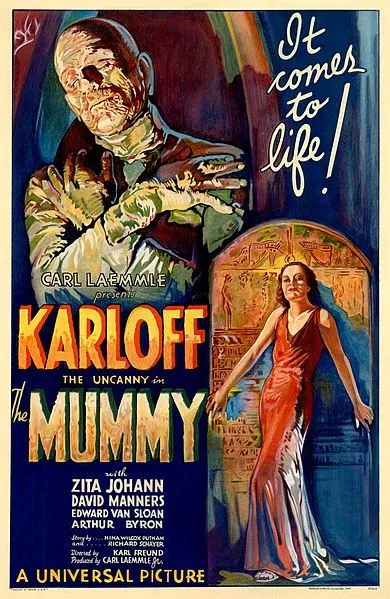
The tomb and the myth around it caught the attention of the public in Europe and the USA. Hollywood made the 1932 film The Mummy, starring old Hollywood legends Boris Karloff and Zita Johann. Most museums have also had an Egypt exhibition at some point.
Mummies are a fascinating part of the human past, and a horrifying part of Hollywood’s allure, but thankfully, they aren’t being put in bottles for us to eat!
References (click to expand)
- Clark, K. A., Ikram, S., & Evershed, R. P. (2016, October 28). The significance of petroleum bitumen in ancient Egyptian mummies. Philosophical Transactions of the Royal Society A: Mathematical, Physical and Engineering Sciences. The Royal Society.
- Connan, J., Evershed, R. P., Biek, L., & Eglinton, G. (1999). Use and Trade of Bitumen in Antiquity and Prehistory: Molecular Archaeology Reveals Secrets of Past Civilizations. Philosophical Transactions: Biological Sciences, 354(1379), 33–50. JSTOR.
- Harrell, J. A., & Lewan, M. D. (2002, May). Sources of mummy bitumen in ancient Egypt and Palestine. Archaeometry. Wiley.
- Mummy (n.) — etymology, from Medieval Latin mumia, Arabic mumiyah, Persian mum (‘wax’). Online Etymology Dictionary.
- Mummy. Encyclopaedia Britannica.
- Bitumen. Encyclopaedia Britannica.