Table of Contents (click to expand)
When you step off a moving train, your feet are stopped by the platform, but inertia keeps your upper body moving forward at the train's speed, so you pitch forward. In the train's decelerating reference frame, this shows up as a fictitious force (a pseudo-force) pushing you in the direction of the train's motion.
In the modern world, our lives often move very fast and we try to get things done as quickly as we can. For example, to get to the far edges of town, we sometimes use the subway or the bus.
To save as much time as possible, we tend to get off the train or bus as soon as the doors open. Most of the time, the train or bus is still moving at a very slow speed when the doors open, but we don’t wait for them to completely stop. We just get off as soon as we can, even if it’s still running.
We’ve all done it and have all then lost our balance while getting off, but believe it or not, there is some very interesting science behind this!
It is so interesting, in fact, that it almost seems… fictitious.
What Is Inertia?
It all starts with our very old friend, inertia.
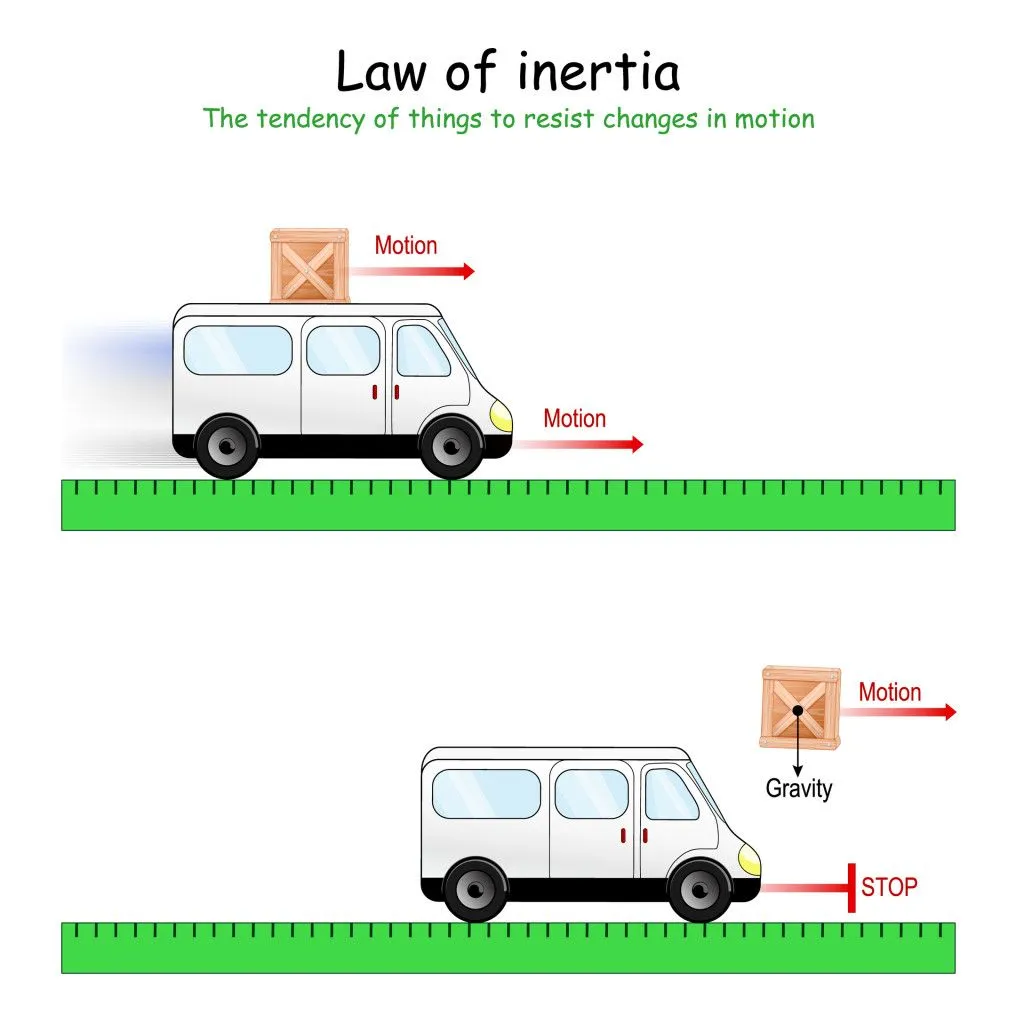
Inertia is nothing but the laziness of any object. That might sound nonsensical or silly, but it’s not. Technically, inertia is the property of any object to oppose the change in its motion.
An object, once pushed and set into motion, will keep moving indefinitely, unless something goes and stops it.
However, we have seen in everyday life that if we push something, it eventually stops on its own. So… what’s going wrong? Nothing! The objects in our daily lives stop because they experience friction and air resistance. If we push an object far from any planet, where there is no air to push against and no surface to rub against, it will keep moving in that direction indefinitely.
The flip side of inertia is just as familiar: the heavier the object, the harder it is to stop. That is precisely why a moving train can’t halt suddenly. A loaded passenger train weighs several hundred tonnes, and its carriages carry enormous forward momentum. Even with the brakes locked on, the wheels need a long distance, often several hundred meters (over a thousand feet), to bleed off all that momentum through friction with the rails. A car can stop in a few car lengths; a train cannot.
To learn more about inertia, you can watch this ‘The Science Asylum’ video on YouTube:
What Is A Frame Of Reference?
A frame of reference is a very important concept in physics. Without a frame of reference, we wouldn’t be able to study any phenomena in physics.
So what exactly is a frame of reference? You can think of it this way… you are inside a house and someone asks you to check on your friends, who are playing outside. Thus, you go to a window and look outside. When asked how far away they are and how fast they are running, you answer according to the reference of that window.

In physics, this window is made of scales that give us coordinates.
To understand a physical process, we need to look at it from one point (known as the origin) and we need a set of rulers (known as the coordinate axes) that can measure the movements of the system.
These coordinates and the origin represent a frame of reference.
There Are Two Types Of Reference Frames –
i) inertial frame of reference
ii) non-inertial frame of reference.
A frame of reference doesn’t have to be at rest; it can move as well. Any frame moving with a constant velocity (a constant speed in a straight line) is an inertial frame of reference, while any frame that is accelerating, speeding up, slowing down, or changing direction, is a non-inertial frame of reference.
When we observe anything in our life, we act as the frame of reference. We don’t need an actual scale to measure things, but us acting as observers gives us a frame of reference. Everything we experience is according to our frame of reference, whereas someone else might experience the same incident differently, since they have a different frame of reference (this is exactly what happens in relativity, but we won’t get into that today).

However, what we need to keep in mind is that whenever we walk, watch, sit, run, or jump, we’re always acting as a frame of reference.
Even when we travel on a train, we are in the frame of reference of the moving train, and it is this frame of reference that makes us lose our balance on a moving train. How? Let’s dig into it.
The Fictitious Forces
As mentioned earlier, an object resists any change in its motion. When we’re sitting in a car and the driver suddenly slams the brakes, we get thrown forward in our seat. Similarly, when we get off a moving train, we get pitched forward (in the direction the train was travelling) the moment our foot lands on the platform. In both cases, our lower body is rapidly brought to rest while our upper body, by inertia, keeps moving at the original speed.

Our motion is changing, even though no direct force is being applied to us. You can stop a rolling ball by putting your hand in front of it because you exert force on it, but there is no force being exerted by anything on us in both the cases mentioned above.
What makes us lose our balance then? A fictitious force.
Whenever the frame of reference we are riding in is non-inertial (in the case of the braking car, the deceleration makes the car a non-inertial frame), or whenever we suddenly switch from one frame to another (in the case of the train, we are in the moving frame of the train, but then our foot lands on the stationary platform), a fictitious force, also called a pseudo-force, appears to act on us. It is not a real push from any object; it is the bookkeeping needed to explain why our body keeps moving when, from inside that accelerating frame, it looks like nothing is pushing it.

It is this fictitious force, born from the abrupt change in the frame of reference, that makes us pitch forward and lose our balance as we step off a moving train. The same effect is what throws standing subway passengers forward when the train brakes sharply at a station.
Conclusion
We learned that an abrupt change in the frame of reference makes a fictitious force appear to act on us. It is this fictitious force, paired with our own inertia, that pitches us forward when we step off a moving train: our frame of reference jumps from one moving with the train’s speed to a stationary one on the platform, while our upper body, by inertia, still wants to keep going at the train’s speed.