Table of Contents (click to expand)
- The Role Of Gravity And Inertia
- That Funny Feeling When You Go Up Or Down The Elevator
- The Utricle And The Sacculus: Sensing Up, Down, Left And Right
- Elevator-Induced Dizziness
- Why Do Elevators Feel Creepy Or Make You Feel Weird?
- Is It Normal To Feel Dizzy After Getting Off An Elevator?
- Drowsiness After Take-off Or Landing Of An Airplane
When you enter an elevator when it is still stationary, you don’t feel anything unusual. This is because the forces acting on your body are all balanced and at equilibrium. Since the body is at rest, physics says (and so do we) that the body will want to continue to be in that state of rest. However….
The elevator was truly an ingenious invention when talking about buildings topping 20 floors, or even 5 floors, for that matter. Simply enter one of those moving rooms, press the destination floor number on the keypad, and ding! The door closes. Now, if it’s not a particularly crowded space, then a few seconds later, you’ll hear another ding, and you’ll be on your desired floor.
There is not one iota of doubt that elevators have made our lives infinitely simpler when it comes to scaling buildings, but there is still something a bit weird about them, right?
Just after the starting or stopping of an elevator, don’t you feel a bit different? A sensation in your head or stomach that just makes you feel a bit weird. Why is that?
The Role Of Gravity And Inertia
We know that Earth has a strong gravitational force, and in fact, gravity is the reason you’re sitting there with your laptop/phone in hand rather than floating aimlessly through the air. Gravity tends to pull everything towards it, and I do mean everything.
The second thing to remember is Newton’s first law of motion. Back to the classroom for a moment: Newton’s first law of motion states that “An object either remains at rest or continues to move at a constant velocity unless acted upon by an external force.”

This means that if a person is standing at rest unless a force, like a push, shove, pull, or simply their own motivation to walk, forces them into motion. The same thing applies to elevators.
That Funny Feeling When You Go Up Or Down The Elevator
Consider that you’re in an elevator. You are a stationary object in another object, the elevator that will begin to move. Since you are still stationary when the elevator moves, you and all the organs that make you up are jolted into motion. This is similar to what happens when you jerk backward when the car you’re in accelerates ahead.
Back in the elevator, in the split second that the elevator begins, it moves upwards, the fluid inside you jerks downwards, and a fluid in a particular organ is behind the funny feeling while traveling in an elevator.
The Utricle And The Sacculus: Sensing Up, Down, Left And Right
Within your ear are two tiny structures that sense whether you’re moving upward, downward, or side to side. In other words, it senses what orientation your head, and by extension, your body, is traveling in.
The saccule senses vertical movement (up and down), while the utricle senses horizontal movement (forward, backward, and side to side). The two organs are filled with fluid. For our elevator case, we’re interested in what’s happening in the saccule, since the elevator moves vertically. Both otolith organs work similarly, though.
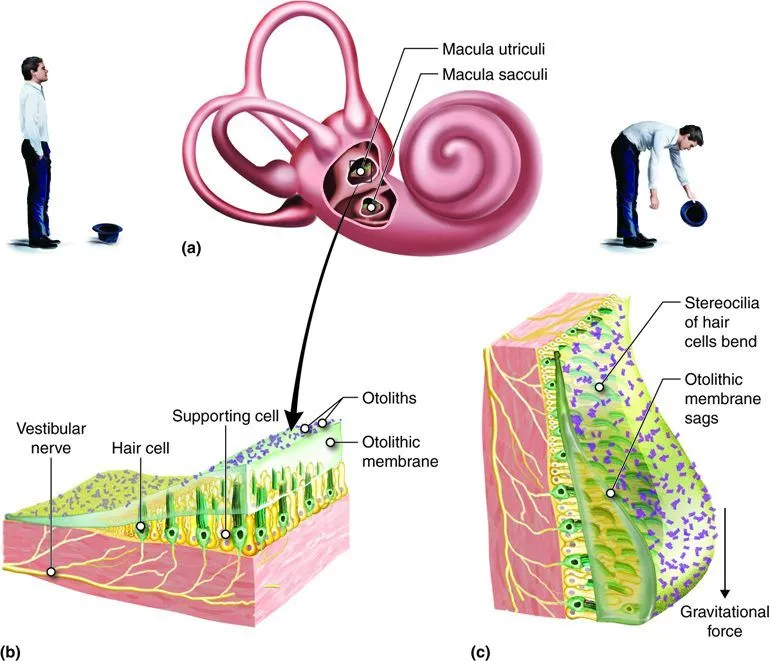
In the first jolt of the elevator moving, the fluid remains stationary, and so puts pressure downward as your body begins to move upward. The downward movement of the fluid disturbs little stones in the saccule called otoliths. The sensory neurons in the saccule sense the movement of the otolith and relay that information to the brain, which decodes it as “Moving up.” This is also what happens when you jump up.
Sensory information from the utricle and sacculus also informs the rest of your body. A slightly funny feeling is your body adapting to moving upwards. Again, this is similar to motion sickness in some people when they travel in cars, buses, or ships.
Once you’re moving at the pace of the elevator (since you are in the elevator itself), the forces again acting on your body have found their balance, making you feel completely at ease (provided the lift is not an old, rusty one that jerks and bumps all the way up!).
Elevator-Induced Dizziness
Some people, however, experience dizziness, light-headedness, or, more rarely, a mild headache from traveling in an elevator. This could be because of something called Benign Paroxysmal Positional Vertigo (BPPV).
That feeling only lasts for a short time, not more than a few seconds at most. Tiny calcium carbonate crystals called otoconia can become dislodged from the utricle and migrate into the semicircular canals. Once there, they disturb the fluid and send conflicting signals to the brain about the head’s position, which leads to feelings of dizziness and vertigo.
Eventually, the elevator comes to a halt. You will again experience a sudden jerk as you cease moving, and your head will feel funny for just a moment. Since you were in a state of motion, your body wanted to remain in that state of motion, but the sudden stop broke that motion, resulting in you feeling that odd sensation again.
This is why this sensation depends a lot on how the elevator moves. An elevator with smoother starts and halts will be more desirable than one that jerks every time it begins its climb or decelerates to a stop. People can even become physically sick due to these sudden jerks, as gravity messes with heads pretty badly at extreme heights.
Why Do Elevators Feel Creepy Or Make You Feel Weird?
Not all of that "weird" feeling is physics. A lot of riders report that elevators simply feel creepy, and that has more to do with psychology than with otoliths. An elevator is a small, sealed box that you cannot leave whenever you want, and being unable to exit at will registers in the brain as a loss of control. Pair that with the way strangers are forced to stand uncomfortably close, and you have a setting that quietly switches on the brain's social-monitoring and threat-detection circuits.

This is why people instinctively turn to face the doors, fix their eyes on the floor counter, and avoid eye contact. Personal space matters to us, and the elevator briefly removes it, so we manage the discomfort with these small, unwritten rituals.
For some riders the unease goes further and tips into claustrophobia, an intense fear of confined or enclosed spaces. Elevators are one of its most commonly cited triggers, alongside tunnels, small cars, and MRI machines. According to the Cleveland Clinic, claustrophobia is far from rare, affecting roughly 12.5% of people, and it can produce very physical symptoms: a racing heart, sweating, shortness of breath, and dizziness, all part of the body's fight-or-flight response firing in a situation that is objectively perfectly safe.
Is It Normal To Feel Dizzy After Getting Off An Elevator?
For most people, the dizzy or off-balance feeling lasts only a few seconds and fades as soon as the inner ear and brain agree again on which way is up. That brief wobble is normal. Occasionally, though, the sensation of still moving lingers after you have stepped out, as if you can faintly feel the floor rocking or swaying beneath you.

That persistent "I still feel like I'm moving" sensation is the hallmark of Mal de Debarquement Syndrome (French for "sickness of disembarkment"), a vestibular disorder in which the brain keeps perceiving motion after the motion has stopped. It is most often associated with getting off a boat or a long flight, but elevators, water beds, and virtual reality can occasionally set it off too. The leading explanation is that the brain adapts to the repeated motion and is then slow to recalibrate once that motion ends. For more on how these organs keep you upright, see how the ear maintains our sense of balance.
So when should you actually worry? A few seconds of post-elevator dizziness is nothing to be concerned about. The Cleveland Clinic notes that most people who get that rocking, swaying feeling recover within about 24 hours, and it is worth checking with a healthcare provider if the sensation of movement persists noticeably longer than that, or if it comes with red-flag symptoms such as severe vertigo, vomiting, hearing loss, ringing in the ears, or double vision.
Drowsiness After Take-off Or Landing Of An Airplane
The same basic laws apply in this situation. When an airplane takes off and ascends into the air, it essentially moves you against the force of gravity. The plane continues to ascend, and at a certain altitude, it stops changing. This is when you feel that slight ‘falling’ sensation. You’re not actually falling; it’s just the plane’s state of upward motion disappearing, allowing your body to feel normal again.
In addition to inertia, some people also get airsickness from the change in air pressure as they ascend.
This is a natural phenomenon that every human being feels, which makes me wonder: how does Superman feel every time he shoots up into the sky with a booming bang of sonic energy?
References (click to expand)
- Vertigo | UC Irvine Medical Center.
- On this page - www.dartmouth.edu
- Coping with motion sickness.
- Vestibular Transduction – Introduction to Sensation and ....
- The Otolith Organs: The Utricle and Sacculus. Neuroscience. NCBI Bookshelf.
- Claustrophobia. Cleveland Clinic.
- Mal de Debarquement Syndrome (MdDS). Cleveland Clinic.