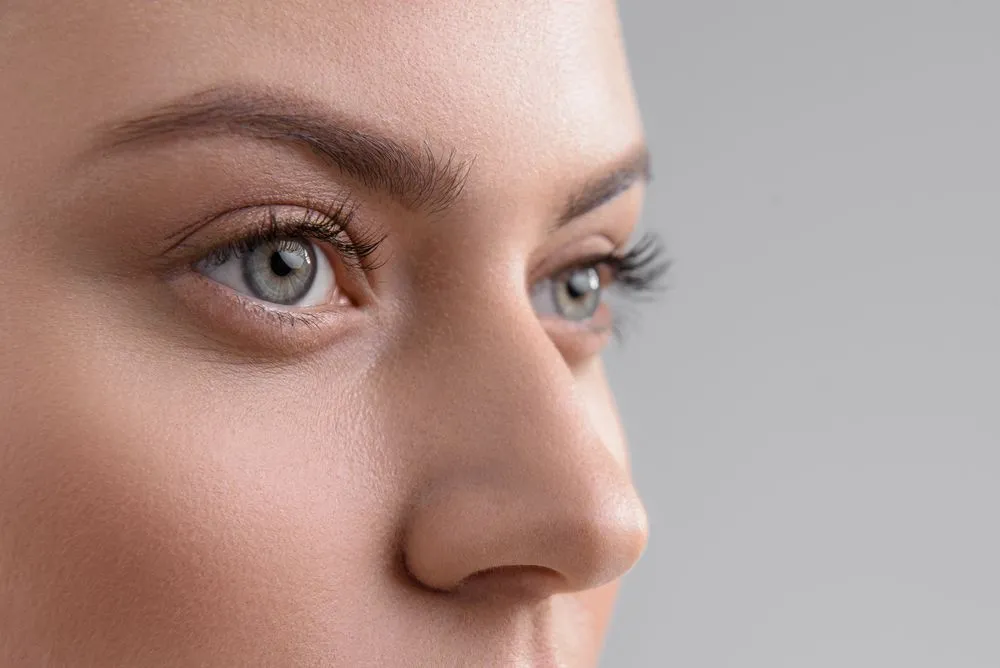
Yes, your nose is always inside your field of vision, but your brain edits it out. Two things are doing the work: neural adaptation, where neurons stop firing for a stimulus that never changes, and unconscious selective attention, where the visual system filters out predictable, unimportant signals so you can focus on what actually matters. The instant you concentrate on it (or close one eye), the nose pops right back into view.
What we see, smell and hear has a huge impact on how we live. If you see a beehive dangling in front of you, you know that you should stay as far away from it as possible. Similarly, if you smell something nasty or hear a blood-curdling scream, you know that you should keep your guard up.
Our sensory organs inform our brains about the outside world. This is how our brain always knows what is going on around us. Therefore, it seems logical to say that our brain should always pay attention to everything our senses tell us, right?
Well, if that’s the case, why does the brain ignore the nose?
It’s not that your eyes don’t see it, because when you do close one eye, you can definitely see your nose. So is your brain ignoring it? And if it is, does it ignore other things too?
I don’t know about you, but I’m glad I don’t see my nose all day every day. Or feel the glasses on my face all the time.
Our brain ignores ‘useless’ things, and this tendency is what keeps us sane and alive. Scientists call this phenomenon unconscious selective attention.
What Is Selective Attention?
Researchers define selective attention as “[…] the processes that allow an individual to select and focus on particular input for further processing while simultaneously suppressing irrelevant or distracting information.”
In other words, selective attention is what lets you focus on conversations with your friends over the blaring music of a party.
Think about it, if all sensory information was treated equally, you would never be able to get anything done. You would constantly feel yourself blink, breathe, and maybe even feel your heart beat. Cutting out such highly repetitive information, like seeing your nose or feeling your tongue, is a shortcut that allows us to better cope with the fast-paced world around us.
However, your brain often makes mistakes. Sometimes, if we focus really hard on the things right in front of us, we will miss the unexpected things.
For example, you may not have noticed that this sentence here has the the word ‘the’ repeated unnecessarily. When we miss these things, it’s called inattentional blindness, which is when you fail to notice unexpected things because you were focusing so hard on one object or task.
Another article on this website called How does the brain pay attention? does a very good job of explaining inattentional blindness in greater detail.

So, how does your brain decide what to ignore and what to pay attention to?
Let’s imagine a scenario to answer this question. You are sitting in a park drawing the beautiful lake in front of you. It seems like you’re lost in your own little world, having no idea that there is a group of small children playing beside you. You also seem to tune out the laughter and chitter-chatter among the children.
Suddenly, you hear a loud splash and a woman’s scream as a child falls into the lake. What made you notice the scream? It couldn’t be that you consciously paid attention to it, as the decision to notice this event was already made.
This is where your unconscious mind comes into play. Your brain ‘selectively selects’ what is important and can sometimes be biased based on our unconscious prejudices and preferences.
How To Test ‘Selectively Selective’ In Science?
Scientists tested the extent of our selectivity biases in a study by showing two different types of pictures to people. One picture was that of a neutral object, such as a lamp, while the other picture depicted a bloody and violent scene. Which one do you think they noticed more?

Without a doubt, the bloody picture captured people’s attention way more than the boring one. Something that causes an immediate emotional reaction will make you pay attention to it. On the flip side, something as mundane and useless as looking at our noses is easily ignored by our mind in order for us to focus on our more important tasks.
However, that’s not all. Researchers also say that how often you see certain images will dictate whether you notice something or not. They tested this by showing pictures of religious symbols to Catholics and Jewish people. Catholics tended to notice the cross more, while Jewish people identified the Star of David correctly.
No matter what the reason for such selection may be, we cannot deny that having the ability to streamline our focus lets us complete the tasks of living without getting overwhelmed.
Why Can You Suddenly See Your Nose, And Then Can’t Unsee It?
Here’s the annoying part: now that I’ve spent a whole article talking about your nose, you can probably see it, can’t you? And the harder you try to ignore it, the more stubbornly it sits there in the middle of your view. Welcome to the club. The moment your attention lands on the nose, whether because someone mentions it or because you read something like this, your visual system re-engages with a signal it had been quietly editing out.

There’s a tidy demonstration of the same machinery, an optical illusion called Troxler’s fading, first described by the Swiss physician Ignaz Troxler in 1804. If you fix your gaze on a single point and hold it perfectly still, an unchanging blob of color off to the side will gradually fade and vanish. It happens because neurons in your retina and visual cortex adapt to a constant, unmoving stimulus and simply stop reporting it, the same neural adaptation that erases your nose. Tiny involuntary flicks of the eye, called microsaccades, normally nudge the image onto fresh neurons and keep the world from dissolving, but a stimulus that stays put gets left behind.
Your nose is the ultimate steady stimulus: it never moves relative to your eyes, so your brain files it under ‘background’ and tunes it out. Attention is the switch that flips it back on, which is also why you can’t simply will it away again on command. Trying not to notice something is still a form of noticing it. Look at anything genuinely interesting for a while, though, and without any effort the nose quietly slips back out of awareness.
Is It Normal To See Your Nose, And How Do You Make It Go Away?
If you’ve suddenly become aware of your nose hovering in your vision and you’re wondering whether something is wrong, let me put your mind at ease: it is completely normal and harmless. Your nose has always been parked in your field of view, and so has everyone else’s. The only thing that changed is where your attention went. It says nothing about your eyes, and nothing about your brain malfunctioning.
Here’s the catch, though. Attention amplifies whatever it touches. The more you monitor the nose, and the more you worry about whether you’ll ever stop seeing it, the more present it feels, which makes you check yet again. For most people this little loop fizzles out within minutes. In a smaller number of people it can stick, and clinicians have a name for it: a sensorimotor or hyperawareness obsession. The exact same pattern shows up with breathing, blinking, swallowing and eye floaters. As the International OCD Foundation explains, this kind of selective attention to a normally automatic process “is not dangerous in and of itself,” and anxiety is what acts as the ‘glue’ that keeps the sensation pinned to conscious awareness.
So how do you make it go away? Not by fighting it, because resistance is just more attention in disguise. The trick is to let your focus drift naturally toward something absorbing and allow the awareness to fade on its own, the way it always has. If the fixation becomes genuinely distressing or refuses to let go, it is worth talking to a mental-health professional, since this kind of loop tends to respond well to cognitive behavioral therapy.
A Final Word
Our brain continues to be a mystery to us. This wondrous organ not only works like crazy to keep us alive, but also makes sure we don’t get overpowered by an immense amount of external information. The brain does this by unconsciously and selectively paying attention to what is deemed ‘important’ and ignoring useless information, such as sight of our nose, from our mind.
If you want to learn more about attention or what parts of the brain are involved in paying attention, I urge you to read the other article on this website mentioned above!
References (click to expand)
- Your Hidden Censor: What Your Mind Will Not Let You See. Scientific American
- Stevens, C., & Bavelier, D. (2012, February). The role of selective attention on academic foundations: A cognitive neuroscience perspective. Developmental Cognitive Neuroscience. Elsevier BV.
- Alpers, G., & Pauli, P. (2006, August). Emotional pictures predominate in binocular rivalry. Cognition & Emotion. Informa UK Limited.
- Motion-Induced Blindness and Troxler Fading: Common and Different Mechanisms. PLoS ONE.
- When Automatic Bodily Processes Become Conscious: How to Disengage from ‘Sensorimotor Obsessions’. International OCD Foundation.