Table of Contents (click to expand)
The automatic or bottom-up processing of faces is modulated by ‘commanding’ brain regions that bias our visual system to see faces when there are none. This bias exists to help us survive in human society, where the failure to recognize a face can have heavy consequences.
We often hear about people seeing faces in the most unexpected and unusual objects around us, like some seeing ‘Jesus’ in toast or ‘Elvis’ on a potato chip! There are several social media accounts devoted to this curious phenomenon where people post ‘faces’ they see around them in objects.
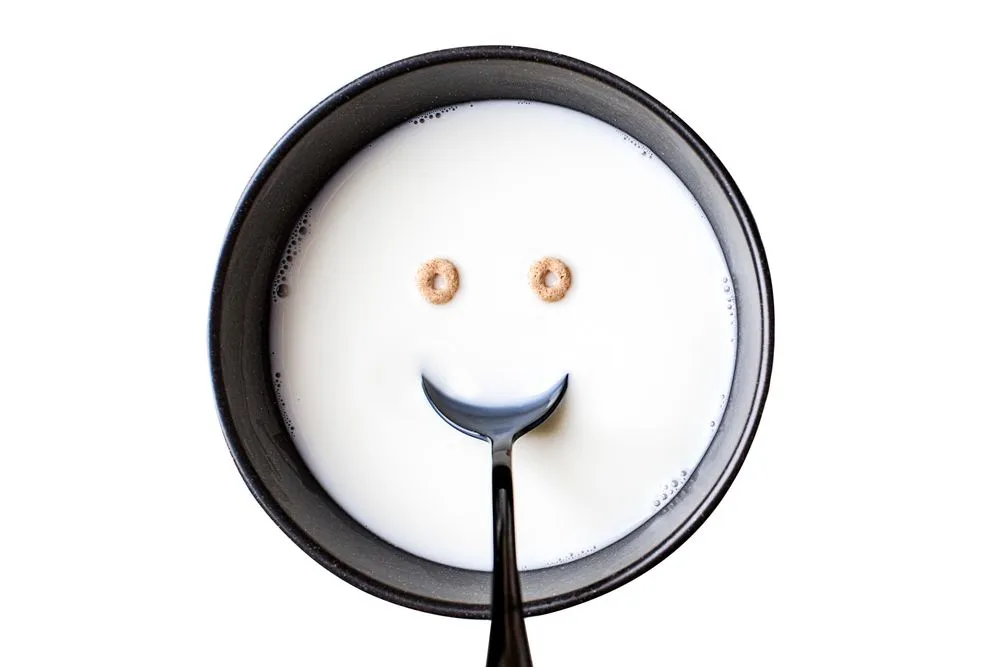
Although it sounds strange, this phenomenon (called ‘face pareidolia’) is extremely common. Children often lay around on lawns spending hours spotting faces in clouds, but why do we see faces everywhere… even when there are none? What is so special about a ‘face’ that our brain creates such common illusions? What goes on in our brains when this happens?
Let’s explore!
What’s In A Face?
You might be wondering why faces are so important to the brain that we see them even when there are none…
Human survival is extremely dependent on social interactions and cooperation, since we evolved as hunter-gatherer societies. This means that maintaining a mental record of our social relationships and networks is crucial to our survival. This, in turn, is dependent on our ability to identify, memorize and keep track of our peers; for that, we rely on our recognition of their faces.

Face recognition became so crucial to our survival that human faces started becoming more and more diverse in appearance throughout our evolution! The importance of face recognition in our survival becomes even more clear when we look at our brains. Human faces are the only visual stimuli that our brains evolved to specifically identify. In other words, our brains innately have a separate department in the brain set up to identify faces, called the fusiform face area (FFA).
Clearly, all of this points to the fact that failure to recognize a face can have a heavy impact on human survival.
Why Does It Happen?
The phenomenon of face pareidolia is not just extremely common, but it is also more evolutionarily primitive than previously thought. Scientists were able to identify the phenomenon occurring even in Rhesus monkeys. This shut down a very quirky theory that face pareidolia is a result of humans watching ‘cartoons’ where we increasingly anthropomorphize objects.
This phenomenon is shared among primates and has much more to do with the innate nature of our brains than our daily dose of imaginative television.
The brain has two methods of processing input (including faces). We can devote our attention to an object consciously and process the incoming sensory information from it, such as when we meet an old friend from school and try to recognize them from their face. This is called top-down processing.
The second method is more automatic and has no conscious control, in which the brain scans the environment for any important incoming sensory information or patterns without devoting attention to it. Seeing faces in a cloud is a good example of the result of this type of processing, called bottom-up processing. Because this process is unconscious and automatic, even when we consciously know that there is no face in a cloud, we can’t stop seeing it!
In the case of bottom-up processing, the incoming sensory information must be matched with a previously learned set of labels or categories for identification. If a pattern looks like a ‘face’, the information must be passed on to face-processing brain regions that will identify it.
Face pareidolia has been thought to be a case where a mismatch of labels for objects happens during bottom-up processing in the brain. The brain sees ‘toast,’ mistakenly labels it as a ‘face,’ and passes the signal to face-processing brain regions, resulting in us spotting mysterious faces on our breakfast!
The brain makes far more mistakes mislabeling objects as faces because we have much less to lose if we don’t recognize an object properly, as opposed to the face of a friend or foe! Your error in not recognizing a potato chip as such is not fatal, but not recognizing your enemy might cost you your life!
Brain Mechanism Underlying Face Pareidolia
Now we know that we see faces in objects because it is important for our survival, but what goes on in the brain when we see faces when there are none?
The processing and recognition of faces are performed by not just one region, but a network of frontal, temporal, and occipital regions of the brain. Among these, the ‘hub’ specific to faces, of course, lies in the FFA.
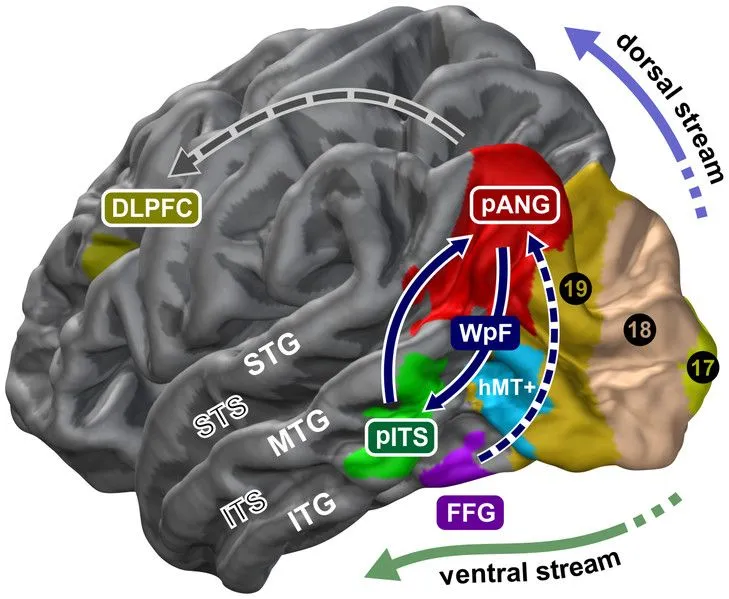
In a study that examined brain processes during face pareidolia, scientists subjected a group of people to brain scans while they viewed noisy images that they were told contain faces.
The results revealed that regions in the face-processing network of the brain that are ‘higher-up’ or upstream, such as the frontal cortex, sent signals and modulated the FFA activity only during illusions. In simple terms, in cases where participants ‘saw faces’, their prefrontal cortex was seen secretly ‘tipping’ their FFA that the incoming sensory information from the ‘lower’ visual regions was from a face.
This ‘expectation’ of a face also led to increased activity in the FFA in both sides of the brain during such illusions.
Therefore, it can be said that face pareidolia is a result of the modification of automatic or bottom-up processing of visual information by brain regions higher up in the face-processing hierarchy. This results in the FFA region misinterpreting the incoming information as a face.
Why Do The Faces We Imagine Usually Look Male?
Here is a strange twist: when we do conjure up a face that isn’t really there, our brains seem to have a default setting for it. In a large study published in PNAS in 2022, researchers asked thousands of people to rate the gender of hundreds of pareidolia faces (the ones we spot in handbags, drainpipes, and bell peppers). The result was lopsided: about 90% of the illusory faces were rated as male on average, while only around 9% came out female.
What makes this so interesting is that there was nothing male about the objects themselves. A face in a coffee foam has no biological sex, yet our perception still leans heavily one way. The effect couldn’t be explained by the shape of the objects or by any gender we might already associate with them. It seems the brain’s quick, ‘good enough’ template for a face is, by default, read as male, and adding the specific features that signal ‘female’ takes a little more visual evidence.
And this isn’t something we pick up as adults. A follow-up study found that children as young as 4 years old already show the same male bias when spotting faces in objects, suggesting it emerges early and reflects something basic about how our face-detection system works, rather than a lesson we are taught.
A Final Word
The brain is capable of both consciously and unconsciously processing information. This applies to the processing of faces as well. The automatic or unconscious processing of sensory input or bottom-up processing, in the case of faces, is modulated by other ‘commanding’ brain regions that bias our visual system to see faces when there are none. This bias exists to help us survive in human society, where the failure to recognize a face can have heavy consequences.
Therefore, our ability to see faces in clouds or on a potato chip is a quirky side effect of evolution deciding that humans cannot afford to miss a ‘face,’ even when there are none to be seen!
References (click to expand)
- Sheehan, M. J., & Nachman, M. W. (2014, September 16). Morphological and population genomic evidence that human faces have evolved to signal individual identity. Nature Communications. Springer Science and Business Media LLC.
- Kanwisher, N., McDermott, J., & Chun, M. M. (1997, June 1). The Fusiform Face Area: A Module in Human Extrastriate Cortex Specialized for Face Perception. The Journal of Neuroscience. Society for Neuroscience.
- Taubert, J., Wardle, S. G., Flessert, M., Leopold, D. A., & Ungerleider, L. G. (2017, August). Face Pareidolia in the Rhesus Monkey. Current Biology. Elsevier BV.
- Liu, J., Li, J., Feng, L., Li, L., Tian, J., & Lee, K. (2014, April). Seeing Jesus in toast: Neural and behavioral correlates of face pareidolia. Cortex. Elsevier BV.
- Zhen, Z., Fang, H., & Liu, J. (2013, March 20). The Hierarchical Brain Network for Face Recognition. (M. Ptito, Ed.), PLoS ONE. Public Library of Science (PLoS).
- Wardle, S. G., Paranjape, S., Taubert, J., & Baker, C. I. (2022). Illusory faces are more likely to be perceived as male than female. Proceedings of the National Academy of Sciences.
- Wardle, S. G., Ewing, L., Malcolm, G. L., Paranjape, S., & Baker, C. I. (2023). Children perceive illusory faces in objects as male more often than female. Cognition.