Yes, brain-imaging research finds real structural differences between trained artists and non-artists, most notably more grey matter in regions like the right precuneus (artistic training) and the left anterior cerebellum and right medial frontal gyrus (drawing skill). Functional imaging also shows artists recruit stronger connections between the default-mode and executive-control networks while planning creative work. Crucially, much of this difference appears to develop with practice, not just from being "born talented."
Accomplished painters can, with a few strokes of a brush, define trees, brooks, bridges, people on those bridges and the whole rest of the beautiful world. However, as a non-painter or artistic novice, you frustratingly scratch with your graphite to put a believable nose on a man that you need to draw for your art class. The end result is a strange cross between a human being and a Pokemon!
So what is the reason for this huge difference between accomplished artists and novices/non-artists?
Difference In Brain Structure
According to various research studies, the difference literally lies in the structure and functioning of the brain. A study published in the journal NeuroImage looked at differences in the brains of 44 graduate and postgraduate art and non-art students who were asked to complete various drawing tasks. Brain scans of these students were obtained and subjected to an analysis called voxel-based morphometry, which assesses the volume of grey and white matter in brain regions that are thought to be functional in those tasks. The scores obtained by students on the drawing tasks were then correlated with the regional grey and white matter volume in cortical and subcortical structures.
The authors actually drew a sharper distinction than is often reported. They found that drawing ability (regardless of whether the student was an art student) correlated with greater grey matter density in the left anterior cerebellum and right medial frontal gyrus, areas tied to fine motor control and procedural memory. Separately, art training itself (art students vs non-art students) correlated with greater grey matter in the right precuneus, a region linked to visual imagery and manipulating scenes in the mind’s eye. In other words, both raw skill and long hours of training appear to leave physical traces in the brain, just in different places. Greater grey matter is good news! It usually means more neuronal cells, which boost the functions those regions support.
These results mean that brain areas of artists that are involved and crucial in skilled performance related to drawing are more enhanced than those same areas of non-artists.
So… Are Artists Born Talented?
The answer to that question is tricky. So far, research has not chanced upon a methodology that will effectively determine the individual influence of genes/heritability versus the influence of circumstances/environment (commonly known as the “nature vs. nurture” debate in scientific circles). The increased grey matter volumes could be inborn or could result from exposure to training.
Artists View The World Differently
Art professors have long maintained that training students to see the world in a different way is critical to their development as an artist. Contrary to common belief, our visual system does not actually see objects, but rather shadows, contours, edges and other surface features that help us infer the identity of objects. Artists know this either intuitively or through training.
In a study published in the journal Perception, scientists tried to see where in the visual field artists and non-artists focus their gaze to comprehend what is being seen by using an eye tracker. In scientific terms, they tried to see whether there is a difference in the visual scan paths between artists and non-artists. In another session, both the groups again looked at pictures with the goal of remembering them later. The results showed that when passively viewing images, artists’ eyes tended to scan the whole picture, including apparently empty expanses of ocean or sky, while non-artists focused in on objects, especially people and faces. Non-artists spent significantly more fixation time on those concrete subjects, while artists distributed their attention more evenly across structural features such as edges, shadows and large background regions.
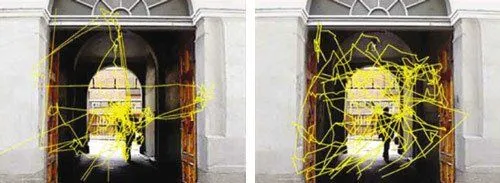
The results clearly suggest that non-artists were busy converting pictures into concepts, while artists were busy looking at contours and shadows. However, in the second phase, when they were explicitly instructed to remember pictures, artists could shift their scanning strategy and scan patterns to be more similar to non-artists. Even when imitating the scan path of a non-artist, artists were still able to recall more details than non-artists.
When common people draw, they try to draw an object, which is why it looks nothing like the one they see. Artists instead focus on the whole visual field and place the shadows and surfaces on the paper, along with the “subject”. The end result is a much more life-like picture. Fortunately, this paints an optimistic picture for novices, since one can develop this ability with sufficient awareness and training.
Essentially, all this research tells us that having an ‘artistic point of view’ is not a myth after all!
More Recent Findings: It Is Not Just Structure, It Is Connectivity
Brain-imaging since 2016 has added a more functional twist to the structural story. De Pisapia and colleagues, in a 2016 Scientific Reports fMRI study, scanned visual artists and non-artists while they planned a creative drawing. The artists showed stronger coupling between the default-mode network (associated with mind-wandering and spontaneous idea generation) and the executive-control network (associated with goal-directed planning), particularly in frontal and parietal regions. This is a reasonable mechanistic explanation for the structural differences seen by Chamberlain et al.: artists do not just have different brains, they use them differently when working creatively.
More recent work using machine-learning classifiers on grey-matter scans (Grecucci et al., 2023) was able to distinguish professional artists from non-artists with roughly 79% accuracy, with Heschl’s gyrus, the amygdala and the cingulate cortex emerging as the most informative regions, a slightly different anatomical set from the 2014 drawing study, which fits with the broader picture that "artist brain" is not one signature but several overlapping ones.
Are Artists Really "Right-Brained"?
If you have ever been called a "right-brained" creative type or a "left-brained" logical one, you have bumped into one of the most stubborn myths in all of pop psychology. The story goes that the left hemisphere handles logic, language and number-crunching, while the right hemisphere is the home of art, intuition and imagination, so artists must simply be running on their right side. It is a tidy idea. It is also wrong.

In 2013, neuroscientists at the University of Utah put the claim to a direct test. Writing in the journal PLOS ONE, Nielsen and colleagues used resting-state fMRI to map the brains of 1,011 people between the ages of 7 and 29, dividing each brain into more than 7,000 regions and measuring how strongly each one connected to the left or the right side. They were hunting for the tell-tale sign of the myth: individuals whose entire left network, or entire right network, was more connected. They never found it. Some functions genuinely do lateralize (language leans left, aspects of attention lean right), but this is a local property of particular circuits, not a whole-brain personality setting. Nobody in the study was globally "left-brained" or "right-brained."
This actually fits neatly with everything above. Remember that the drawing-skill study found extra grey matter in the left anterior cerebellum and the right medial frontal gyrus, while art training showed up in the right precuneus. Artistic ability is scattered across both hemispheres, not bottled up in one. So the honest answer to "what part of the brain controls artistic ability?" is: many parts, on both sides, working together. Calling someone right-brained is a charming figure of speech, not a fact of anatomy.
Do Artists Have A Different Kind Of Personality?
Brain scans are only half the story. Psychologists who study personality have their own answer to why artists can seem, well, a little different from everyone else, and it has a name: openness to experience. Of the "Big Five" personality traits, openness (a taste for novelty, fantasy, beauty and unconventional ideas) is the one most reliably linked to artistic creativity. People high in openness tend to chase new sensations and question settled ways of doing things, which is often exactly what reads to the rest of us as "weird."

A 2016 study in the Journal of Personality by Scott Barry Kaufman and colleagues sharpened this picture in a way that also settles a popular playground argument: artist versus scientist, who really has the more creative mind? Studying more than 1,000 people, they split openness into two flavors. Openness proper (imagination, aesthetic sensitivity and emotional depth) predicted creative achievement in the arts. Intellect (abstract reasoning and a hunger for complex ideas) predicted creative achievement in the sciences. Neither group is simply "smarter" than the other; they are pointed at different problems. The painter and the physicist can both be intensely creative, just fueled by different sides of the same broad trait.
There is a brain angle here too. People high in openness tend to show a more efficiently organized default-mode network, the very mind-wandering system that lit up in the connectivity studies above, along with stronger moment-to-moment coupling between that network and the brain's control regions. So the artist who seems to live a little more inside their own head is less a lazy stereotype than a personality profile you can partly read in the wiring.
References (click to expand)
- Chamberlain R, McManus IC, Brunswick N, Rankin Q, Riley H, Kanai R. Drawing on the right side of the brain: A voxel-based morphometry analysis of observational drawing. NeuroImage, 2014.
- Vogt S, Magnussen S. Expertise in pictorial perception: eye-movement patterns and visual memory in artists and laymen. Perception, 2007.
- De Pisapia N et al. Brain networks for visual creativity: a functional connectivity study of planning a visual artwork. Scientific Reports, 2016.
- Grecucci A et al. Machine-learning classification of professional artists from grey-matter features, 2023. PubMed Central.
- Artists "have structurally different brains" - BBC News coverage of Chamberlain 2014.
- Nielsen JA, Zielinski BA, Ferguson MA, Lainhart JE, Anderson JS. An evaluation of the left-brain vs. right-brain hypothesis with resting state functional connectivity MRI. PLOS ONE, 2013.
- Kaufman SB, Quilty LC, Grazioplene RG, Hirsh JB, Gray JR, Peterson JB, DeYoung CG. Openness to Experience and Intellect differentially predict creative achievement in the arts and sciences. Journal of Personality, 2016.
- Beaty RE, Kaufman SB, Benedek M, Jung RE, Kenett YN, Jauk E, Neubauer AC, Silvia PJ. Personality and complex brain networks: the role of openness to experience in default network efficiency. Human Brain Mapping, 2016.