Table of Contents (click to expand)
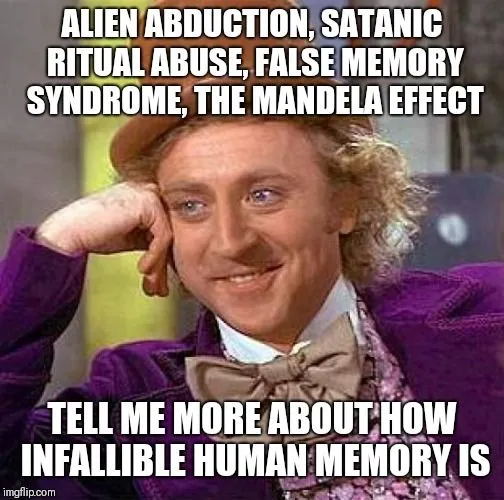
No, human memory is not very accurate. Recall is reconstructive rather than a recording, so memories get reshaped by biases, leading questions and the schemas we use to store information quickly. Even vivid, emotional ‘flashbulb’ memories drift over time, and people can confidently accept entirely false memories as true.
Memories are precious things, allowing us to connect to the past, muse on those we love, and relive some of the happiest moments of our lives. However, what if I were to tell you that memories aren’t always accurate, or even real!
Don’t take it personally, as this happens to everyone. Our memory is like a game of ‘Chinese whispers’ (or ‘telephone’, as it is known in the US). I’m sure you all played that game as children, and it might help us understand this phenomenon a bit better…so let’s take a walk down memory lane, shall we?
Imagine you are standing in a circle and are whispering information to the person next to you, which was passed to you from the first person; by the time it reaches the last person, the information has become twisted and not accurate. Just for fun, when you get to the bottom of this article, try to remember the very first line, word for word… it won’t be that easy!
So what are the reasons for such lapses in memory? It can be attributed to various biases and our need to form schemas to store information quickly. So, does this mean that eyewitnesses to a crime cannot be trusted in court because their memory can’t be entirely accurate? And what about traumatic memories… how can we inaccurately remember something that has affected us emotionally? Is it possible that we make up stories and narrate things that didn’t actually even happen?! Let’s find out.
Cognitive Biases
Although our cognition plays a very important role in encoding, rehearsing and storing information, it can also lead to some distortions that cause errors in judgment.
Source Monitoring
Have you ever come across a situation where it became difficult to identify whether something actually happened or if you had just dreamt about it? Sometimes, dreams are so realistic that it becomes difficult to identify the source and distinguish it from reality.
Rassin, Merckelbach, and Spaan (2001) found that about a quarter of students (roughly 26% in their larger sample) reported having had at least one experience where they couldn’t tell a vivid dream from something that had really happened. In other cases, we read something from a magazine or a source we know cannot be relied on factually (cough *Wikipedia* cough), but later forget about the source and only remember the information, thus believing it to be true. This is known as the sleeper effect, an attitude change that occurs when the source of information is forgotten but the message sticks.

Schematic Processing: Filling In Memories Based On Expectations
Schemas help us mentally organize the information we receive. However, since we’re so adapted to information fitting into mental boxes in our mind, we fail to challenge these assumptions based on our expectations. This leads to confirmation bias, wherein we believe the information to be true because it was more likely to happen.
Confirmation bias refers to verifying information based on existing beliefs, rather than challenging them factually. For example, a group of friends meet and talk about their college days. One of them remembers an incident of someone cracking a hilarious joke in class, and we all confirm it, even though we don’t remember it clearly, because that person was the class clown, so it seems very likely that they would have been the one to crack the joke.
In other words, our schemas quietly fill in the gaps with what we expect to have happened, so the memory ends up shaped more by the script in our head than by what actually took place.

Misinformation Effect
This refers to errors in memory that occur when new information alters an already existing memory. Loftus and Palmer (1974) conducted an experiment in which participants viewed a car accident and were asked to guess the speed of the car. All the participants saw the same accident and were asked the same question: “About how fast were the cars going when they hit/smashed/contacted each other?” The researchers only changed the verb, but saw answers shift based on the intensity of the action suggested by the verb.
The participants with the word ‘smashed’ guessed the highest speed, as compared to the word ’contacted’. This shows that eyewitnesses can alter their memories based on what question is asked and how it may be asked in court.
Can There Be Memory Distortions In Extremely Traumatic Memories?
Recent research studies have revealed that even some excruciatingly painful situations (9/11 attacks or sexual abuse) can also cause memory lapses. Memories that have intense emotions attached to them are known as flashbulb memories. Talarico and Rubin (2003) wanted to test the accuracy of flashbulb memories, so the day after the attacks they asked a group of students to describe the moment they first heard the news, what they saw, and what ordinary activity they were doing at the time. The same students also recorded an everyday memory from around the same period, to serve as a comparison.
The students were tested again 1, 6, or 32 weeks later. Their flashbulb memories of 9/11 felt far more vivid, and they were far more confident in them, yet they were no more accurate or consistent than the ordinary memory. People kept changing details for both kinds of memory at the same rate; the only real difference was how sure they felt.

In fact, a study by Greenberg (2004) tracked how President George W. Bush described first hearing of the 9/11 attacks. On separate occasions Bush recalled watching the first plane hit the tower on live television before he entered the classroom, something that was impossible, as no footage of the first impact aired that day. His accounts differed in detail, showing that not even the president can escape the distortions of flashbulb memories.
Can We Create False Memories?
In the most widely accepted research study, the Deese-Roediger-Mcdermott paradigm (DRM paradigm) created a critical lure (sleep) and asked participants to repeat the words they listed, e.g., bed, pillow, nap, tired etc., all of which were related to sleep, but the word itself was not mentioned. However, many participants also included ‘sleep’ as part of the list that actually wasn’t there.
However, we cannot attribute this research in saying that childhood sexual abuse memories have been falsely made. That’s stretching it, right? Yes, there are varying levels of intensity when it comes to memory; therefore, another study was conducted to check the accuracy of childhood memories.
In their famous ‘lost in the mall’ study, Loftus and Pickrell (1995) asked the parents of each participant to provide three real memories of their child and one false one, namely getting lost in a shopping mall as a young child, an event that never actually happened. The participants were then told to remember all the details related to these events and write them down. 6 out of 24 subjects also wrote about the false memory that didn’t actually happen when they were a child, showing that we may have a tendency to accept a false memory. In a separate study, Wade and colleagues (2002) showed participants a doctored childhood photograph of themselves riding in a hot air balloon. After a few interviews, about half of them began ‘recollecting’ details of that ride, even though their parents confirmed it had never happened.
So, coming back to our initial challenge. The first line said, “Memories are precious things, allowing us to connect to the past.” Or perhaps it was, “Memories are valuable pieces of the past, allowing us to connect to people and experiences we love.”
Can you remember? Give it a try, and then scroll up and see for yourself! Although this subject needs more research, it can certainly be said that, although a memory has a strong emotional association, the person is confident while narrating it and the memory is very detailed, all of that does not necessarily make it true! It would be wrong to say that memories are entirely false, but safe to say that they are not entirely true.
References (click to expand)
- Accuracy and Inaccuracy in Memory and Cognition. Introduction to Psychology. BCcampus Open Textbooks.
- Your Memory is like the Telephone Game. Northwestern University Feinberg School of Medicine.
- Loftus, E. F., & Palmer, J. C. (1974). Reconstruction of automobile destruction. Journal of Verbal Learning and Verbal Behavior. American Psychological Association (PsycNet).
- Talarico, J. M., & Rubin, D. C. (2003). Confidence, Not Consistency, Characterizes Flashbulb Memories. Psychological Science. SAGE Publications.
- Greenberg, D. L. (2004). President Bush’s false [flashbulb] memory of 9/11/01. Applied Cognitive Psychology. Wiley.
- Loftus, E. F., & Pickrell, J. E. (1995). The Formation of False Memories. Psychiatric Annals. Semantic Scholar.
- Wade, K. A., Garry, M., Read, J. D., & Lindsay, D. S. (2002). A picture is worth a thousand lies. Psychonomic Bulletin & Review. University of Victoria.
- Laney, C., & Loftus, E. F. (2005). Traumatic Memories are Not Necessarily Accurate Memories. The Canadian Journal of Psychiatry. SAGE Publications.