Table of Contents (click to expand)
Your native language can nudge abilities that feel purely objective, including color perception. Russian speakers, who use separate words for light blue (goluboy) and dark blue (siniy), tell those shades apart faster than English speakers do. This supports the weak version of linguistic relativity: language shapes how we think, without fully determining it.
The rainbow contains all the colors of the world in a continuous spectrum. There are an infinite number of colors, yet we are able to distinguish between even mild differences in hues with our eyes.
Even so, we don’t have names for every color; instead, we group colors into categories and name the categories.
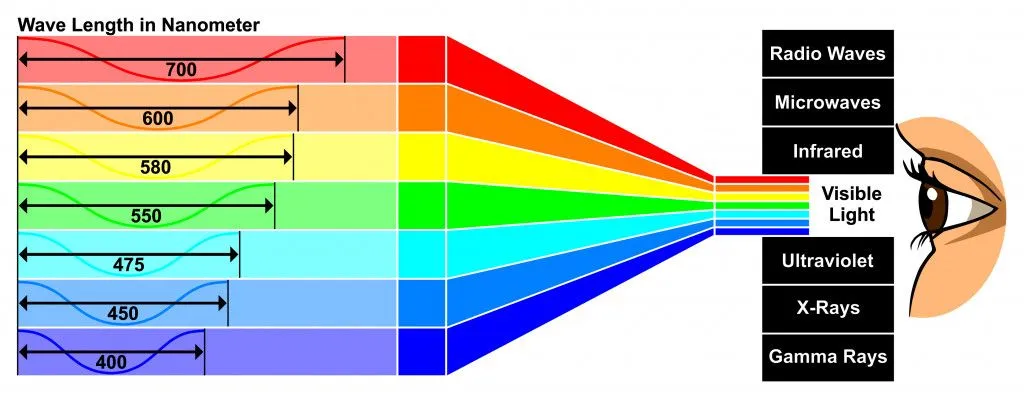
For example, we teach children only a few color labels or categories, such as the seven in the rainbow – VIBGYOR (Violet, Indigo, Blue, Green, Yellow, Orange, Red). These are the commonly used categories in English. Colors that fall between these categories are grouped into whichever color category it is nearest.
These color names vary in different languages. Some languages have categories that do not exist in others, so how does this affect their color discrimination? Furthermore, does the perception of color vary based on the languages we speak?
Whorfian Hypothesis
The idea that the language we speak can influence thought to some extent is called the Whorfian hypothesis of linguistic relativity (also known as the Sapir-Whorf hypothesis). This is a theory in psychology positing that language can influence cognition or thought, suggesting that speakers of different languages think a little differently.
It comes in two flavors. The strong version, called linguistic determinism, claims that language outright dictates thought and that you cannot think about something your language has no words for. Almost no researcher accepts this today, since people clearly form concepts that their language never named. The weak version, which most scientists do accept, says that language gently shapes and biases our thinking without locking it in. The experiments below all point to that weaker, more believable claim.
Scientists who investigate this theory want to know how language can alter our perception and thought. Some of them use color perception or discrimination as a window into how language shapes our thought. This is because color provides a neat test case, as the categories we carve out of the rainbow vary from one language to the next.
Color Names Vary Based On Language
Color names are not universal. In English, we commonly use about 11 basic color names to describe the world around us, the count that linguists Brent Berlin and Paul Kay identified as the full set English draws on (white, black, red, green, yellow, blue, brown, purple, pink, orange, and gray). However, this number varies a lot by language. The Pirahã language, spoken by a small community in the Brazilian Amazon, has no fixed words for individual colors at all. Instead, speakers describe a hue by comparing it to something familiar, much like saying "blood-like" for red.
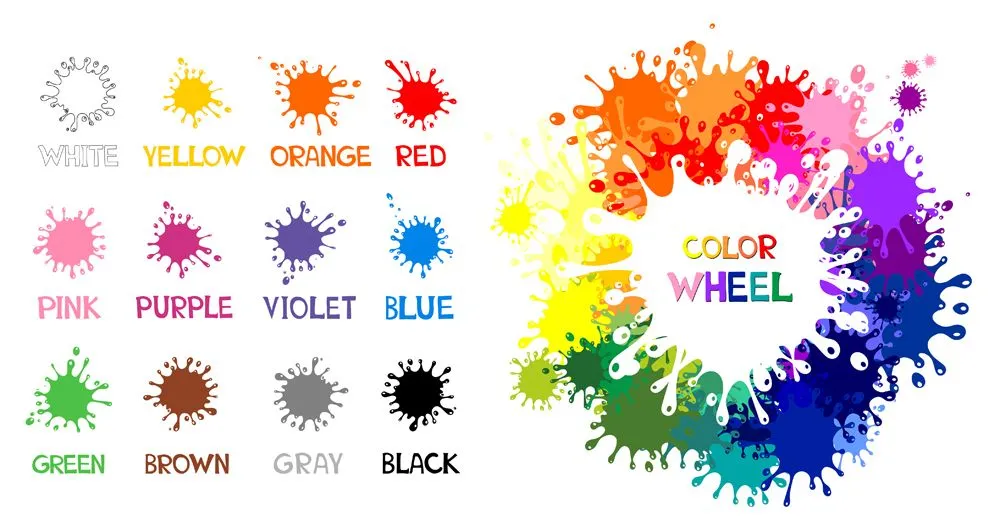
Some other languages have categories that don’t exist in English. For example, the Korean language has a category or label for the blue-green color (Cheongnok) in addition to blue (Parang) and green (Chorok) labels. The Russian language has separate color names for light (Goluboy) and dark blue (Siniy).
This diversity in color naming is why color perception is a convenient process to study in order to understand whether language affects perception.
The ‘Russian Blues’ Experiment
Shades of blue form a continuous category for English speakers. We use the term ‘blue’ to define all colors in that spectrum. We distinguish colors within it using terms such as ‘dark/light’. However, the Russian language doesn’t have a single word for ‘blue’. As mentioned before, they use entirely separate terms for light blue and dark blue.

Scientists exploited this difference in languages in an experiment on color discrimination in English and Russian speakers. In this experiment, they made Russian and English speakers perform a color discrimination task using three squares of blue color. The participants were presented with three blue squares, with one square on top and two at the bottom. They were asked which of the bottom squares matched the color of the top square.
Here’s the catch! In some trials of the experiment, one of the bottom squares was light blue, in some both were light blue, and in others both were dark blue. To an English speaker, this wouldn’t make any difference, because they’re all just shades of ‘blue’. But to a Russian speaker, some trials required distinction between a Siniy and Goluboy, whereas others required distinguishing between two Siniys or two Goluboys.
Not surprisingly, results of the experiment showed that Russian speakers were faster in discriminating colors when they fell in two different categories (siniys and goluboys) than when they were in the same category (both siniy or both goluboy). Distinguishing colors that fell in the same category (both siniy or both goluboy) was arguably more difficult and time-consuming for them. On the other hand, no such effect was found in English speakers, as all tasks were equal to them – the task of discriminating between ‘blues’.
Although the task did not require the participants to use any language, it clearly reflected their ability to discriminate colors! The Russians used a language that consistently made them draw a boundary between dark and light blue shades, which made them faster in discriminating these categories. English speakers don’t habitually make this distinction in their everyday life, so they showed no such effects in color discrimination.
The researchers also showed that language was doing the work: when participants had to repeat a string of digits during the task (a "verbal interference" load that ties up the language system), the Russian advantage vanished. A non-verbal spatial load did not erase it. This provided evidence for the weak Whorfian hypothesis that language can nudge non-linguistic abilities, so people who speak different languages can perceive certain things a little differently. Language can leave a fingerprint even on perceptual processes we usually think of as ‘objective’, such as color perception.
Several other studies have reported similar findings. Korean speakers showed a discrimination advantage at a green boundary their language marks (between yeondu, a yellowish green, and chorok, green) that English does not, while English speakers showed no such edge there. A later study in Greek speakers, whose language has separate light and dark blue terms (ghalazio and ble) much like Russian, used brain recordings to show that this color-category effect appears early and automatically, before conscious attention kicks in.
Ending Note
We often think of language as just one small corner of our mental life, but psychologists have long suspected that it reaches into many non-linguistic abilities, since it colors how we think. Experiments using color perception as a test case suggest that our perception really is nudged by the language we speak.
In addition to these revelations, scientists have shown that language can affect a wide range of our abilities, including our spatial analogies, perception of motion, numbers, our understanding of false beliefs, object categories, perception of gender, etc.
For example, the word for apple is grammatically masculine in German but feminine in Spanish. In one classic study, speakers more easily remembered an object paired with a person's name when the name's gender matched the object's grammatical gender, so a German speaker might link ‘apple’ with a male name like Patrick, while a Spanish speaker links it with a female name like Patricia. (Some grammatical-gender effects have proven hard to replicate, so this remains an active, debated area of research.) Examples of language gently steering thought keep turning up.
The take-home message is that our native language can shape even abilities that feel completely objective, such as color perception. Our thinking is not imprisoned by the words we use, but it is quietly and cleverly shaped by the language we speak.
References (click to expand)
- Hunt, E., & Agnoli, F. (1991, July). The Whorfian hypothesis: A cognitive psychology perspective. Psychological Review. American Psychological Association (APA).
- Winawer, J., Witthoft, N., Frank, M. C., Wu, L., Wade, A. R., & Boroditsky, L. (2007, May 8). Russian blues reveal effects of language on color discrimination. Proceedings of the National Academy of Sciences. Proceedings of the National Academy of Sciences.
- Roberson, D., & Hanley, J. R. (2007, August). Color Vision: Color Categories Vary with Language after All. Current Biology. Elsevier BV.
- Thierry, G., Athanasopoulos, P., Wiggett, A., Dering, B., & Kuipers, J.-R. (2009, March 17). Unconscious effects of language-specific terminology on preattentive color perception. Proceedings of the National Academy of Sciences. Proceedings of the National Academy of Sciences.
- Wolff, P., & Holmes, K. J. (2010, October 27). Linguistic relativity. WIREs Cognitive Science. Wiley.
- Gentner, D., & Goldin-Meadow, S. (Eds.). Language in Mind: Advances in the Study of Language and Thought. The MIT Press.