An object looks black because its surface absorbs nearly all the wavelengths of visible light rather than reflecting them, so almost no color reaches your eye. A black object can still look glossy because its smooth surface reflects the little light it does send back in one concentrated direction (specular reflection), producing a bright highlight.
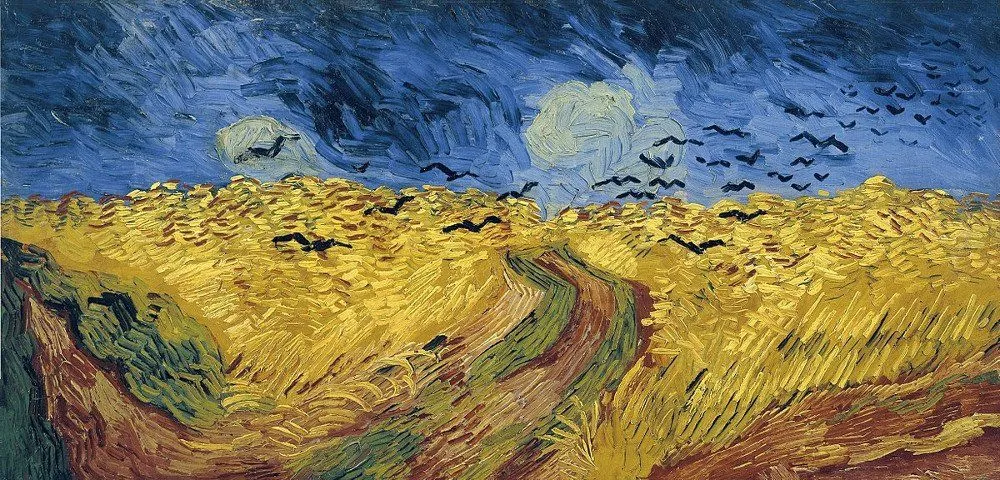
If there is one word to describe Van Gogh’s use of black in his Wheatfield with Crows, it is but haunting. The interminable trail of pitch black crows flying above the copious wheat field can be seen emerging from the dark-blue horizon, as if the tides of a turbulent sea reflecting the clouds of the storm above it, splintered, came to life and fled away. It is often called the last work Van Gogh painted before his death, and although art historians now place several canvases after it (his letters date it to around July 10, 1890, some two and a half weeks before he died), it quite fittingly limns the doom we have always read into it.
The impression of colors has always been visceral first and intellectual second. It has long dominated our perceptions of what is admirable and what is repulsive. While white was long associated with nobility and royalty, black was particularly associated with the devil, sin and death. However, a more suitable notion to describe black is secrecy. Black conceals, literally.
Why Are Objects Black?
Isaac Newton was the first to study color rigorously. His antics with a prism in the 1660s showed that white light is a blend of colors, which he chose to group into seven (red, orange, yellow, green, blue, indigo and violet). It is the absorption and reflection of these constituent wavelengths that give objects their color.

Light, an electromagnetic wave, is a cluster of wavelengths. However, our eyes are only sensitive to one part of this cluster, the range of wavelengths that we can see, known as the visible range. The visible range itself is a set of tightly cluttered wavelengths, and despite being non-contiguous, they can be crudely divided into the seven colors that Newton observed.
The statement that objects absorb and reflect these constituent wavelengths means that objects of a certain color, say a red-colored shirt, radiate that particular color because, due to some electromagnetic phenomenon, the atoms and molecules of the dye reflect the wavelength associated only with red and absorb the remaining wavelengths associated with colors other than red. Think about it like throwing 7 different colored balls at a wall such that the color of the wall is determined by the ball that the wall reflects. But what does this say about black and white?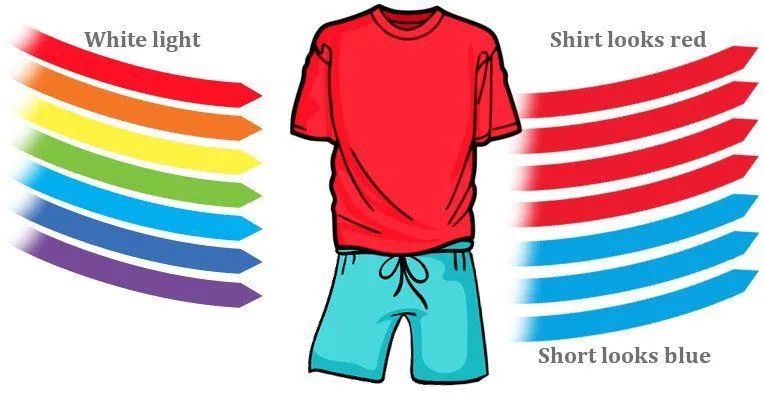
Where white is the reflection of all colors together, black is the complete opposite: near-total absorption. So a black surface isn’t simply an absence of light; a black pigment is a substance engineered to soak up the wavelengths of the visible spectrum more or less equally instead of bouncing them back. The absorbed light energy doesn’t vanish, it is re-emitted as heat. This is why black shirts are frowned upon in the summertime, as they are excellent thermal collectors.
However, while the plethora of brighter hues can be attributed to the reflection and intertwining of multiple wavelengths, what about the different shades of black?
The Difference Between Matt And Gloss
While culturally, the notion of black has vacillated between depicting horror and suavity, my favorite has always been its impression on white paper. The high contrast between black and white rendered black to be the most favorable ink to write and read. Still, the black of a gel pen isn’t like the black of a panther. Unlike the depth of matte black, it gleams, like an 8-ball on a green carpet.

In fact, the origin of the word “black” can be traced to a Proto-Indo-European root bhleg, meaning ‘to burn, gleam or shine’. However, if black represents the absorption of all wavelengths, why does it still shine as though it somehow manages to reflect? This peculiarity comes down to two factors: the amount of incident light and the surface of the reflecting object itself.
In the absence of sufficient light, even red can be perceived as black. Furthermore, the difference between matte and gloss black can be traced to the ratio of absorption and reflection of incident light. This ratio is gravely influenced by the surface of the object. Only ideally black objects can absorb every speck of incident light and reflect absolutely nothing. An example of this is a black hole, whose stark attraction even light cannot escape. Practically speaking, minute surface irregularities always allow some light to reflect and escape.

For instance, rough or irregular surfaces pave the way for diffuse reflection, where the reflected light scatters haphazardly in every direction. The divergent nature of this reflected light causes the object to appear darker, more matte. On the other hand, smooth surfaces reflect light in a narrow, concentrated manner. This causes the appearance of bright or glossy spots on a material. This reflection is called specular reflection, and it is what gives a glossy black object its bright highlights even while the surface beneath absorbs almost all the light that reaches it.
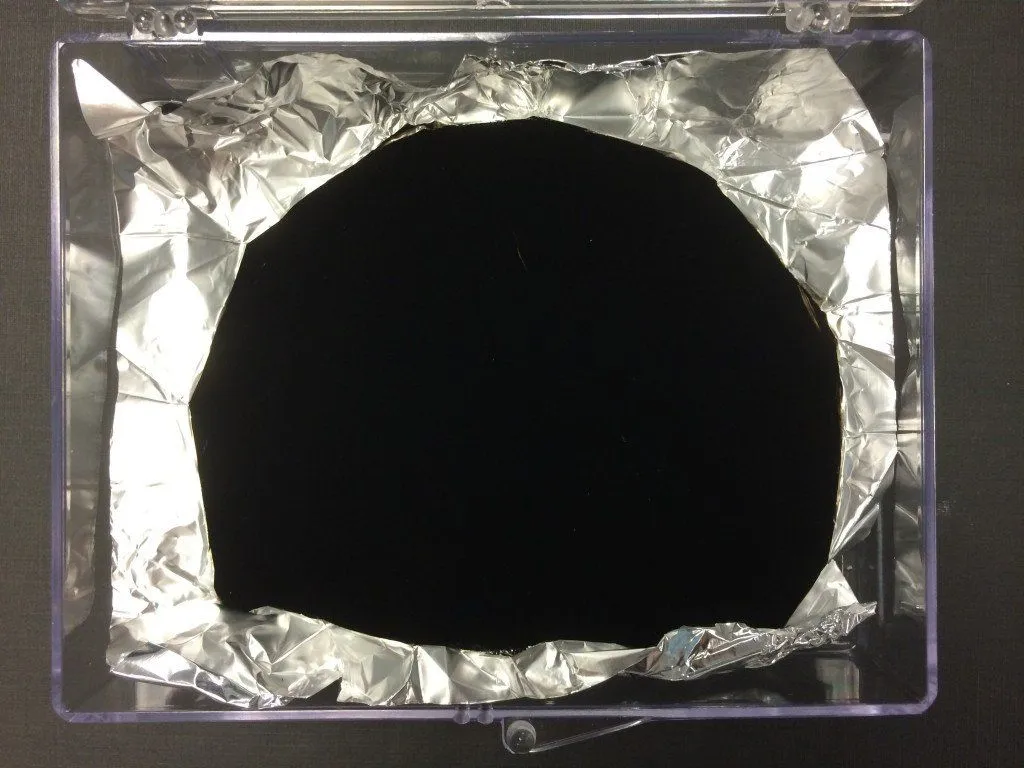
In 2014, the world went bonkers when British nanotech firm Surrey NanoSystems unveiled what was then the blackest material ever made. Known as Vantablack, the substance is a forest of vertically aligned carbon nanotubes; light that wanders between the tubes is bounced around and absorbed before it can escape. The material is so dark that on a white background, it appears to be a wormhole to some remote corner of deep, outer space. It reflects only about 0.035% of incident light, meaning it absorbs roughly 99.965%. Vantablack held the record only briefly: in 2019, engineers at MIT reported a carbon-nanotube coating that absorbs around 99.995% of light, about ten times less reflective still. Yet, of course, even that isn’t quite as dark as Edgar Allan Poe’s Black Cat.
What Colors Does A Black Object Reflect?
There is a tempting piece of playground logic that says a black object must be quietly reflecting every color at once. It sounds clever, and it is precisely backwards. An object that bounces back every wavelength of visible light does not look black at all; it looks white. As the University of Kentucky's physics primer puts it, white objects appear white because they reflect back all the visible wavelengths that fall on them. Black is the mirror image of that statement: it swallows the whole spectrum roughly evenly and returns almost nothing.
So the honest answer to the question "what colors does black reflect?" is, ideally, none. Physicists rate a surface's reflectivity on a scale called albedo, where 0 marks a perfect absorber that soaks up all incoming light and 1 a perfect reflector. Fresh snow sits near 0.9, throwing back roughly nine-tenths of the light that strikes it, while a stretch of fresh asphalt sits near the bottom, reflecting very little. A flawless black would be a clean zero.
Real blacks never quite reach zero, and here lies the subtlety. A true black surface does reflect a little light, but it does so fairly evenly across the reds, greens and violets rather than favoring any single band. Because that faint trickle carries no dominant wavelength, it has no color of its own, which is why deep black reads as a dim, colorless charcoal rather than a tinted hue. Reflect the spectrum unevenly and you would no longer have black, but a shade of some color. This is also why the popular claim that "black reflects all colors" actually describes white, and gets the physics exactly reversed. If you are curious whether that color even lives in the object at all, we explore whether color is a property of matter or generated in our brain separately.
Do Black Objects Get Hotter Than Lighter Ones?
Since a black surface absorbs nearly the entire visible spectrum, that captured light cannot simply vanish. It is re-emitted as heat, which is why a black car seat or a black t-shirt bakes in direct sun while a pale one stays comparatively cool. A light surface reflects much of the sunlight straight back before it can be turned into warmth. On a still, sweltering afternoon, a snug black shirt really will feel hotter than a white one.
Yet nature complicates the tidy rule, as a much-loved study reminds us. In 1980, Amiram Shkolnik and colleagues published a paper in Nature with the irresistible title "Why do Bedouins wear black robes in hot deserts?" Measuring a volunteer in air temperatures between 35 and 46 degrees Celsius (95 to 115 degrees Fahrenheit), they found that a black robe absorbed about 2.5 times as much solar radiation as a white one. Common sense says the black-robed wearer should have roasted. Instead, the heat that actually reached the skin turned out to be the same for both robes.
The trick is airflow. The robes are loose and billowing, so the extra heat soaked up by the black cloth is swept away by convection, rising and escaping in the gap between fabric and body before it ever touches the skin. That result rested on a single volunteer, and the effect leans on the garment being loose and on a bit of breeze, so black clothing does not beat white for keeping cool; at best it ties. The lesson is that color decides how much heat a surface gathers, but shape and airflow decide how much of it you ultimately feel. It is the same instinct that shaped how our ancestors kept cool in hot climates long before air conditioning.
References (click to expand)
- Specular vs. Diffuse Reflection. The Physics Classroom
- Colours of light - Science Learning Hub. sciencelearn.org.nz
- Vantablack - Wikipedia. Wikipedia
- MIT engineers develop the “blackest black” material to date. MIT News
- The Physics of Light: Color. University of Kentucky, Department of Physics and Astronomy
- Albedo Values. My NASA Data, NASA Langley Research Center
- Why Bedouins wear black robes in the desert (on Shkolnik et al., Nature, 1980). The Christian Science Monitor