Table of Contents (click to expand)
In the dark, an orange has no color at all. Color is not a property of the orange; it is created in your brain from the light bouncing off the fruit. In very dim light, only the rods in your eye are active, and rods cannot tell colors apart, so the orange simply looks like a shade of gray.
If you keep a ripe orange in one corner of your room that gets variable amounts of light as the day passes, you will see different intensities of the color orange on the piece of fruit. Perhaps the difference isn’t too evident for you, since you won’t be staring at the orange all day, but another exercise you can try is holding the orange under the warm glow of an old-fashioned incandescent bulb. Believe it or not, the orange will look noticeably redder and more intense!
Now put that same orange under a blue light and it will look brown, almost black. Has your orange turned into a chameleon? No, of course not, but why is it changing color? The orange looks brown under blue light because an orange reflects orange wavelengths and absorbs most others. When the only light around is blue, there is barely any orange light for the fruit to bounce back to your eye, so it appears dark. In short, the orange changes color in all these situations because, as vision scientists put it, color is not a property of an object. Color exists in our head!

In vision science jargon, color is a psychological phenomenon, not a physical one. For example, the biggest illusion constructed by nature is the sky. As many of us know, the sky is not blue, nor any other color. It only appears that way because the gas molecules in the atmosphere scatter sunlight, and the shorter, bluer wavelengths get scattered far more than the rest (an effect known as Rayleigh scattering). However, if the blue sky isn’t blue, then how can you be sure that the orange in your hand is orange? Some exasperated readers will surely argue, ‘But it clearly looks orange!’
Let’s first try to understand what makes the orange in your hand appear to be “orange”. To begin with, how is anything visible to you? Light or a unit of light (photon) bounces off the surface of objects and strikes your eye. This light, which now has information about the object’s surface, is absorbed through your pupil and falls on the retina, the portion of the eyeball with a collection of specialized cells that are stimulated/excited by light. These cells will convey the message to the region of your brain (occipital lobe) that processes visual information. The output of that process is the image of the outside world in your head.
How Do We See Color?

Understanding how we experience color has two important points: how physical light differs and how humans perceive that difference. The smallest unit of light, a photon, is a tiny packet of electromagnetic energy. This tiny particle has a property called its wavelength, which is measured in units of distance and ranges from very small to very large. The visual system of humans is designed to see only a small band within this wide range, stretching from only about 380 to 700 nanometers (1 nm = 10-9 meters). That narrow band explains why humans cannot see X-rays, whose wavelengths are far shorter, or radio waves, whose wavelengths are far longer, since both fall outside this visible window.
Colored light has many photons of different wavelengths, and when they are perceived by the human eye, they are expressed as color. For illustration, an object that looks “red” to us may reflect light made up of a collection of X, Y and Z photons, but with greater quantities of X than Y or Z, which leads our brain to interpret it as the color red.
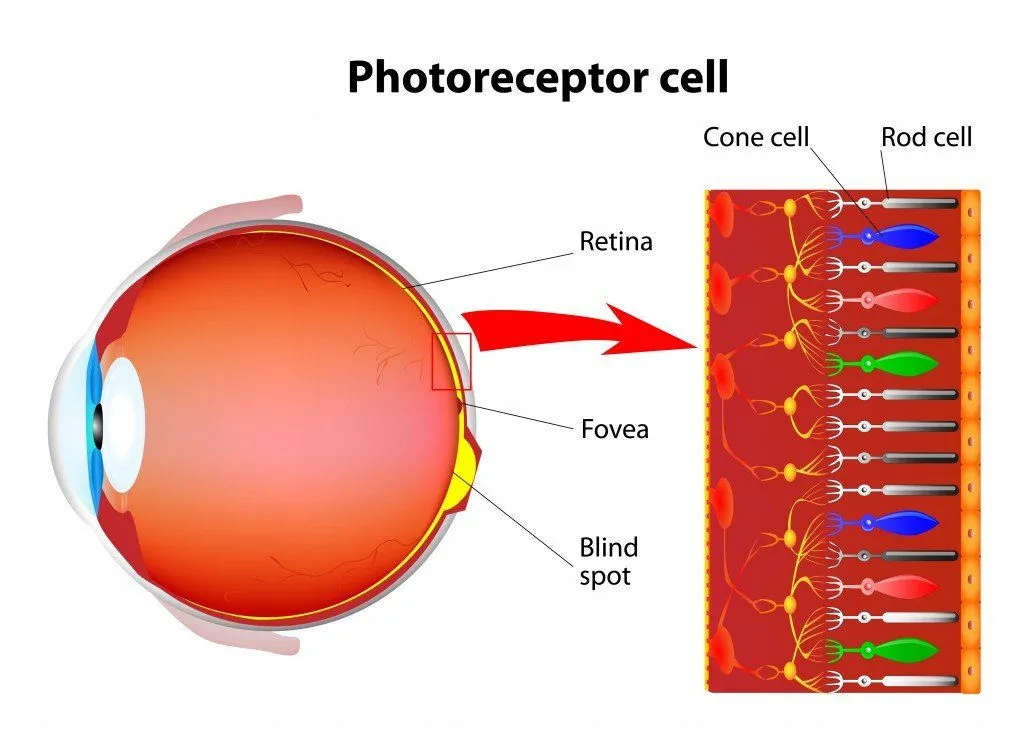
As mentioned before, the retina contains a collection of cells, and one of these cell varieties is photoreceptors (retinal cells that directly receive light). There are two types of photoreceptors: rods and cones. Cone cells help us experience our world in color. The actual process is quite different, but simply put, the cones register information regarding differences in wavelengths coming in from the environment and then send these codes to our brain for interpretation. However, cones require bright light to become excited. In the dark or under low levels of illumination, our cones do not get excited and do not provide color information.

Orange In A Dark Room
Now that we know what allows to us see color, we can try to answer some questions based on our knowledge of the visual system. What color do trees appear under moonlight (very low illumination)? Can you see the green leaves and the brown bark, or just shapes that look like a tree in lighter and darker tones of gray? At night, only the rods in the retina are providing you with information from the environment. Similar logic applies to our original orange kept in a dark room question.

In a very dark room with absolutely no source of illumination, you won’t be able to see anything, let alone an orange. However, with a small amount of light in the room, the shape of the fruit in some darker shade of gray will be visible. As the level of illumination increases, the gray will become lighter as more light bounces off the orange. At a particular threshold of illumination, the gray may start turning to a darker brown, which will be the level/threshold of illumination at which your cones start functioning.
There is a neat wrinkle in this handover from rods to cones, and it affects our orange in particular. As the light fades to that in-between, twilight level (what vision scientists call mesopic vision), your eye’s peak sensitivity shifts from the yellow-green part of the spectrum toward the blue-green. This is the Purkinje effect, named after the Czech anatomist Jan Evangelista Purkyně. Because of it, warm colors like red and orange are the first to drain away into darkness as the light drops, while blues and greens hang on to their apparent brightness for longer. So as dusk settles, your orange goes dull and dark sooner than the blue mug sitting right next to it.
In the dark, every color appears to be some shade between black and white, depending on the level of light being reflected off its surface.
My advice is, next time you find yourself with an orange in a dark room…stop worrying about what color it is and just eat it!