Table of Contents (click to expand)
Fats are the body’s preferred energy store because they pack far more energy into less weight than carbohydrates. A gram of fat yields about 9 kcal (and roughly 106 ATP per fatty acid) versus only about 4 kcal per gram of carbohydrate, and fat is stored anhydrous, while glycogen carries about 3 grams of water per gram.
Fats are very misunderstood biomolecules. They are demonized for being unhealthy, and there was once a targeted strategy telling everyone to eat less fat.
However, fat is essential to the body.
Fat molecules are the superstars when it comes to giving the body energy, especially when your body is low on carbohydrates (like the time between meals). Then, why are fats stored as the body’s energy reserves? Why would this be different than carbohydrates, which are also a common source of energy for the body?
Fats Give More Energy When Broken Down
When it comes to comparing the amount of energy between sugars and fats, fats definitely win.
The most basic unit of all fats in the body is a fatty acid. These fatty acids are linked to other types of molecules, such as carbohydrates, phosphates, proteins or glycerol, which explains the diverse types of lipids that are found in our body. Chemically, a fatty acid is composed of a long chain of carbons (called a hydrocarbon chain) and a carboxyl group (which gives the molecule a slightly acidic nature) at one end. It looks something like this:
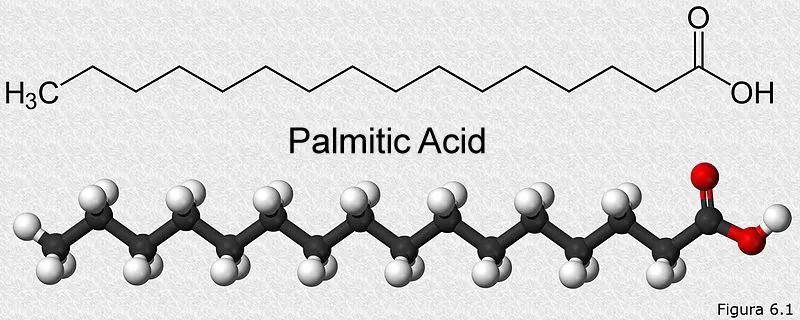
The length of the carbon chain is variable. In our bodies it can be as short as 4 carbons and as long as about 28, almost always an even number. The chain can have only single bonds, in which case it is a saturated fatty acid, or it can have one or more double bonds, which makes it an unsaturated fatty acid.
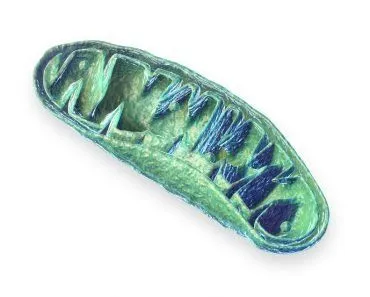
Let’s consider palmitic acid, a simple 16-carbon fatty acid, pictured above. Its catabolism happens in two stages. b-oxidation of fatty acids is the first metabolic pathway to act on it. Running palmitic acid through the b-oxidation pathway chops it into 8 acetyl-CoA molecules, while also harvesting the electron carriers (NADH and FADH2) that the cell later cashes in for ATP. Those 8 acetyl-CoA molecules are then funneled into the citric acid cycle happening in the mitochondria. Add up everything the cycle and the electron transport chain produce, then subtract the small energy cost of activating the fatty acid in the first place, and the complete oxidation of one palmitic acid molecule nets roughly 106 ATP. In terms of calories, fat delivers about 9 kcal per gram.
1 glucose molecule, on the other hand, when broken down by glycolysis, the citric acid cycle and the electron transport chain, yields only about 30 to 32 ATP molecules. (For the uninitiated, ATP is known as the energy currency of the cell. The energy to do work comes from breaking a bond in this molecule.) In terms of calories, 1 gram of carbohydrate carries roughly 4 kcal, less than half of what fat contains.
Fats Can Be Stored In Less Space Than Glucose
Besides the large difference in energy, fat molecules take up less space to store in the body than glucose does.
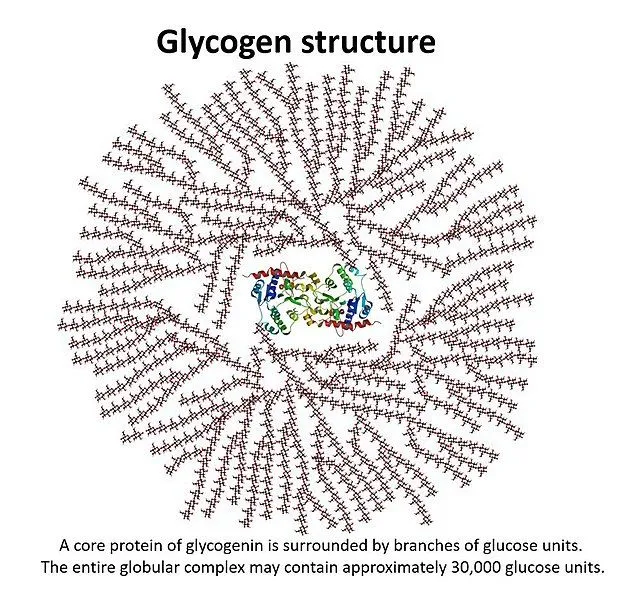
The body stores glucose by polymerizing it into a polysaccharide called glycogen. The structure of glycogen is similar to that of starch, with glycogen being more branched than starch. The glycogen is stored in the liver and muscles in b-granules. A single b-granule tops out at about 42 nm across; it doesn’t grow any larger than that, because the structure would otherwise be too big to realistically fit inside a cell. All told, a well-fed adult stores roughly 100 g of glycogen in the liver and about 400 g in skeletal muscle.
Fats, on the other hand are stored as triglycerides (3 fatty acids linked to a glyceride molecule) in vacuoles in adipocytes. These adipocytes can grow to large sizes as more fat accumulates. As each triglyceride molecule is not covalently linked to the other in a vacuole, they can be packed close together. These adipocytes can increase (or decrease) in size to accommodate more fat needing to be stored.
Fats Need Less Water To Be Stored
Fats are hydrophobic, which literally means they are “water fearing”. This is evident in the fact that oil and water refuse to mix together. Therefore, when fat is stored, no water is dragged along with it. Glycogen, on the other hand, brings the weight of water with it. Each gram of glycogen is stored bound to roughly 3 grams of water (source: Lehninger). That extra water weight adds up fast as glycogen stores grow, which is one reason the body can never bank as much energy as glycogen as it can as fat.
The separate purposes of fat and glucose:
Glycogen, though not the preferred storage molecule of the human body, still plays an important role in maintaining blood sugar levels, especially between meals. The body maintains a stable blood sugar level so that all cells of the body get access to the energy that glucose provides. When blood glucose levels begin to deplete, glycogen is broken down to stabilize blood sugar levels back to where they started. Furthermore, some parts of the body, like the brain, only use glucose as an energy source.

Fats come into play when glycogen reserves aren’t adequate to supply the whole body with energy. Their breakdown, which is less rapid than that of glucose, will then supply cells with the energy they need. However, fats aren’t only there as energy reserves.
Lipids compose the cell membrane of every cell in the body. They are also the precursors of many hormones, such as steroid hormones. Bears and other hibernating animals carry a thick layer of fat that serves as an energy reserve to see them through their hibernation period. Lipids do plenty of jobs that have nothing to do with fuel: the spermaceti organ in a sperm whale’s head, for instance, holds up to roughly 1,900 liters of a waxy lipid that researchers think helps with echolocation and, by partly solidifying as it cools, may fine-tune the animal’s buoyancy on deep dives.
When it comes to the body, fats and carbohydrates have different but equally important functions. Without either of them, life would be pretty tasteless (not to mention probably non-existent!).
References (click to expand)
- Nelson D. L.,& Cox M. M. (2017). Lehninger Principles of Biochemistry. W. H. Freeman
- Prats, C., Graham, T. E., & Shearer, J. (2018, May). The dynamic life of the glycogen granule. Journal of Biological Chemistry. Elsevier BV.
- Wasserman, D. H. (2009, January). Four grams of glucose. American Journal of Physiology-Endocrinology and Metabolism. American Physiological Society.