Yes, food and drinks go down the same pipe - the esophagus - and into the same stomach. But water and other simple fluids do not need 'digestion'. Water molecules are small enough to diffuse straight through the cells lining the gut. About 80-90% of the roughly 10 liters of fluid that pass through the digestive tract each day (around 2 L from drinks and food, plus about 8 L of saliva, gastric, pancreatic, bile, and intestinal secretions) is absorbed by the small intestine; the large intestine mops up most of the rest, leaving only a small amount in the stool.
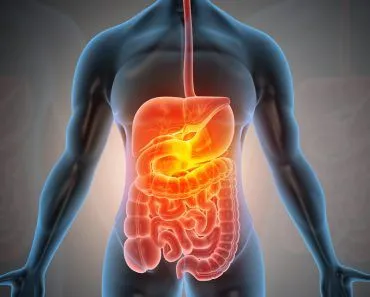
We know that the food we eat goes straight down our esophagus (a.k.a., the food pipe) and into our stomach. We have already covered the entire journey of food through the long digestive system in this article.
Several readers have recently asked us what happens to water and other liquids such as tea, coffee, and alcohol in the gut. Do they follow the same route as “solid” foods, or do they have another, quicker route for digestion, especially because they are liquids?
The Basics Of Digestion
Usually, people consume about 2 liters of dietary water daily through various means, including drinking water directly or via food and other beverages. Additionally, the volume of gastrointestinal secretions, including gastric, saliva, pancreatic, intestinal, and bile fluids, is about 8 liters, which means that 10 liters of fluid enter the intestines every day (Source). This is a considerable amount of fluid that must be processed – or more precisely absorbed – within the body.
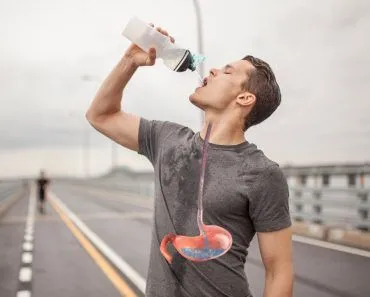
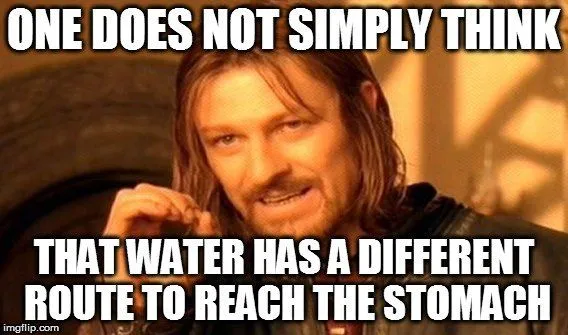
When we talk about the digestion/absorption of the things we consume, the first thing we should always remember is that everything we eat enters the stomach via the same route – the esophagus. Liquids such as water, tea, and alcohol do not go any other way.
The initial digestive phase is similar to pouring the meal (liquids included) into a blender. Just like in a blender, everything we consume is mixed together and forms a fine mess in the stomach. However, so that you know, the breakdown of food begins before it is in the mouth itself. Our teeth mechanically pulverize the food, while the saliva in the mouth chemically breaks down fat and starch. This happens with solid foods that contain large complex molecules such as proteins and carbohydrates.
Absorption Of Water Molecules
On the other hand, water is a very simple molecule, so our body does not have to break it into smaller, simpler molecules. In fact, water molecules are so small that they have no problem diffusing through the cell membrane. This cell membrane consists of small channels or pores through which water and ions, such as sodium, enter the cell, meaning that water is absorbed directly through the epithelial cells that cover the human intestinal tract. In short, it means that the intestines are responsible for absorbing most of the water we consume.
The Role Of The Small Intestine In The Absorption Of Liquids
Fortunately for us, the small intestine is more than up to the task. It’s quite an extensive organ, boasting a length of around 20 feet (6 meters). It also has a large inner surface area of roughly 30 square meters – about the floor space of a studio apartment, not the often-quoted tennis-court figure (a 2014 study in the Scandinavian Journal of Gastroenterology revised the older textbook number of 180-300 m2 downward). (Source) This large surface area helps to absorb water and other liquids quickly and efficiently.
Of the almost 10 liters of water that enters our stomach every day, 80-90% is absorbed by the small intestine. The remaining 10% (amounting to 1 liter of water) is passed on to the large intestine, which absorbs as much water as possible from the waste substances ready to be excreted from the body as feces.
Does Your Stomach Separate Liquids From Solids?
Here is where the “everything goes into a blender” picture needs a small correction. Your food and your drink really do land in the same stomach, but they do not stay mixed together for long. The stomach quietly sorts them by their physical properties and, in effect, decides the order in which things move on: liquids leave first, then solids, and finally fats.

Liquids need no grinding, so they take a shortcut. Thin fluids run along a narrow furrow on the inner (lesser) curve of the stomach, a temporary channel that researchers have nicknamed the Magenstrasse, or “stomach road.” It funnels water from the upper stomach almost straight toward the exit, typically within about 10 to 20 minutes.
Solid food gets no such express lane. It settles into the lower stomach, where the muscular antrum churns and grinds it in a process called trituration. The pylorus, the ring of muscle at the stomach’s outlet, then acts as a sieve: it lets only particles smaller than roughly 1 to 2 mm slip through into the small intestine, holding everything larger back for more grinding. So your body does not consciously “know” the difference between food and drink. It simply sorts them by size and texture, and water, being the easiest thing to move, is shown the door first.
How Long Does It Take To Digest Water?
Because water does not have to be broken down at all, it moves through the system remarkably quickly. On an empty stomach, water empties fast: studies of healthy adults show that only about half of a plain glass of water remains in the stomach after roughly 10 minutes, and it has usually cleared the stomach within about 20 minutes. A liquid “half-emptying time” of under about 22 minutes is considered perfectly normal. Once the water reaches the small intestine, that vast lining absorbs it within minutes.
This is why liquids seem to “digest” faster than solids, even though water is never truly digested in the chemical sense. A solid meal has to be ground down and released in small batches, so it can linger in the stomach for a few hours. A glass of water, by contrast, is mostly gone within the hour. There is one catch, though: if you drink while there is already food in your stomach, the water is held up along with the meal and leaves more slowly, for the same reason that a full stomach slows how quickly alcohol reaches your bloodstream.
Absorption Of Other Liquids
The non-water fluids that we normally consume daily are nothing more than chemicals suspended in water. Fruit juice, for example, consists largely of water and sugar, along with several other ingredients such as preservatives, vitamins, and minerals in small quantities. Sugar is broken down by enzymes in the mouth and small intestine, where it is also absorbed into the body. Vitamins may or may not be broken down but are eventually absorbed in the small intestine; the same applies to minerals.
The same is true of beverages such as tea and coffee. Sugar and fat, when milk is used, begin to break down in the mouth. The stomach will churn everything and begins to break down proteins, again from milk that might be present. As soon as the food reaches the small intestine, the vitamins and minerals are absorbed. Tea and coffee also contain chemicals classified as antioxidants, some of which can be absorbed into the body. Amino acids are also a part of tea and coffee, and they fulfill their absorbed fate in the small intestine.
When alcohol (ethanol) is consumed, it first enters the stomach, where it can be absorbed into the bloodstream. If there is already food in the stomach, the absorption of alcohol into the bloodstream slows down considerably. If one has alcohol on an empty stomach, the absorption of alcohol into the bloodstream takes only a few minutes.
However, alcohol absorption is also linked to other foods: Eating a meal high in fat or protein before drinking decreases alcohol absorption. One reason for this is that eating such foods quickens the transition of food from the stomach to the small intestine, which is known as gastric emptying. When fats reach the small intestine, it initiates gastric emptying. Since the stomach absorbs most of the alcohol, the faster the alcohol gets out of the stomach, the less drunk you will be.
All in all, everything we consume in our diet is broken down into its components by digestion, so whether you eat a sumptuous meal or a simple glass of juice, everything is treated more or less the same after ingestion.
References (click to expand)
- (1981) Observations on the relation between alcohol absorption and .... National Center for Biotechnology Information
- Absorption of Water and Electrolytes - Vivo.Colostate.edu. Colorado State University
- L Kravitz. Water: Nature's Most Important Nutrient. The University of New Mexico
- How is Alcohol Absorbed into the Body? - Sites@Duke. Duke University
- Goyal RK, Guo Y, Mashimo H (2019). Advances in the physiology of gastric emptying. Neurogastroenterology & Motility
- Gastric Emptying Scan. StatPearls, National Center for Biotechnology Information
- Grossmann et al. (2025). Does the appearance of the Magenstrasse depend on the amount of water consumed? International Journal of Pharmaceutics: X