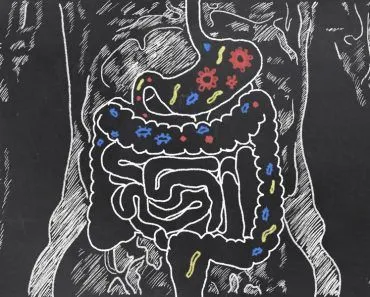
Food doesn’t get digested strictly in the order you ate it. After being chewed in the mouth, food travels through the esophagus to the stomach, then enters the small intestine first (duodenum → jejunum → ileum) where most nutrients are absorbed, before passing into the large intestine, which absorbs water and electrolytes. Different parts of the digestive system handle food differently rather than purely first-in, first-out.
If you eat a donut and then eat a pizza, will your stomach digest the donut first and then move onto the pizza?
To answer the question, let’s look at the process of breaking down food into its smallest components and seeing how the digestive system actually works.
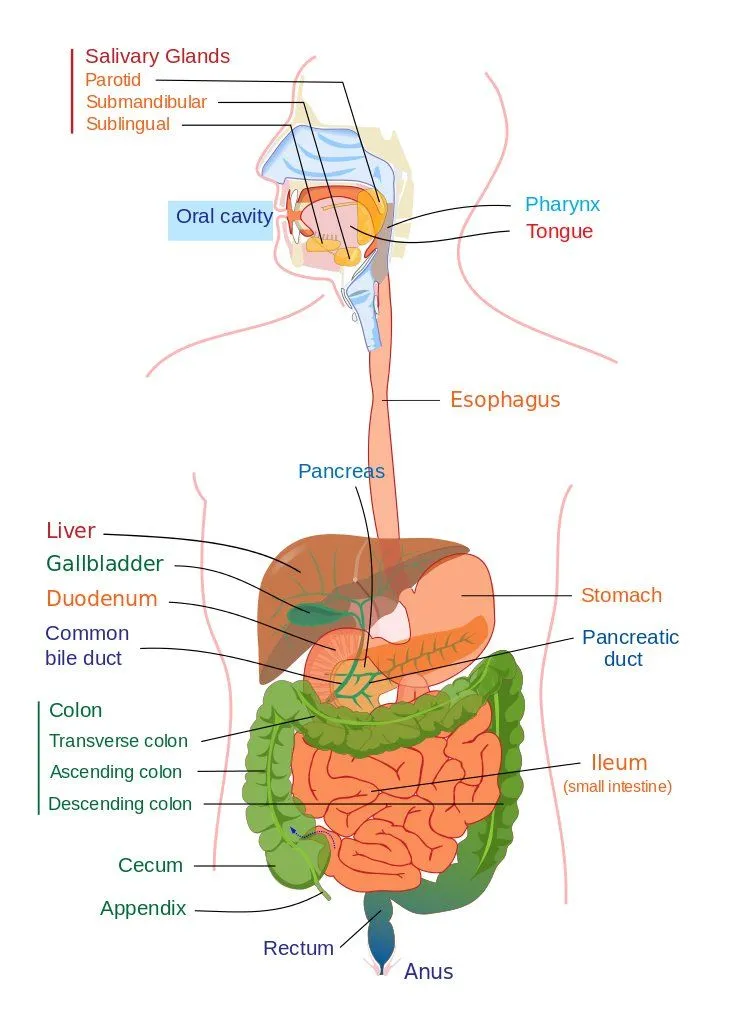
Digestion Begins With The Mouth
The process of digestion starts from the very first bite that a person takes. The teeth grind larger food particles into smaller bits.
The saliva produced in the mouth, along with the mechanical act of chewing, begins the process of digestion. Saliva contains the enzyme amylase, which starts breaking starch down into smaller sugars; a small amount of lingual lipase is also secreted, though in adults it plays only a minor role in fat digestion. After chewing the food, this mass of incompletely broken-down food is called a bolus.
The bolus then moves into the stomach via the esophagus.
The Stomach Digests Anything That’s Inside It
A lot more digestion occurs in the stomach. Several enzymes are secreted in the stomach that further break down the constituents of food, such as pepsinogen, which when converted to pepsin, its active form, breaks down proteins into smaller peptides. The stomach also produces hormones like gastrin, which primarily stimulates HCl secretion from parietal cells and pepsinogen secretion from chief cells, and also increases gastric motility.
The hydrochloric acid secreted by parietal/oxyntic cells in the stomach plays several digestive roles. First, it kills most of the pathogens that hitched a ride with your food. Second, the low pH (about 2 in a fasted stomach) denatures dietary proteins, unfolding them so enzymes can attack the peptide bonds. And third, that same acid bath converts inactive pepsinogen into active pepsin, the workhorse enzyme of stomach protein digestion.
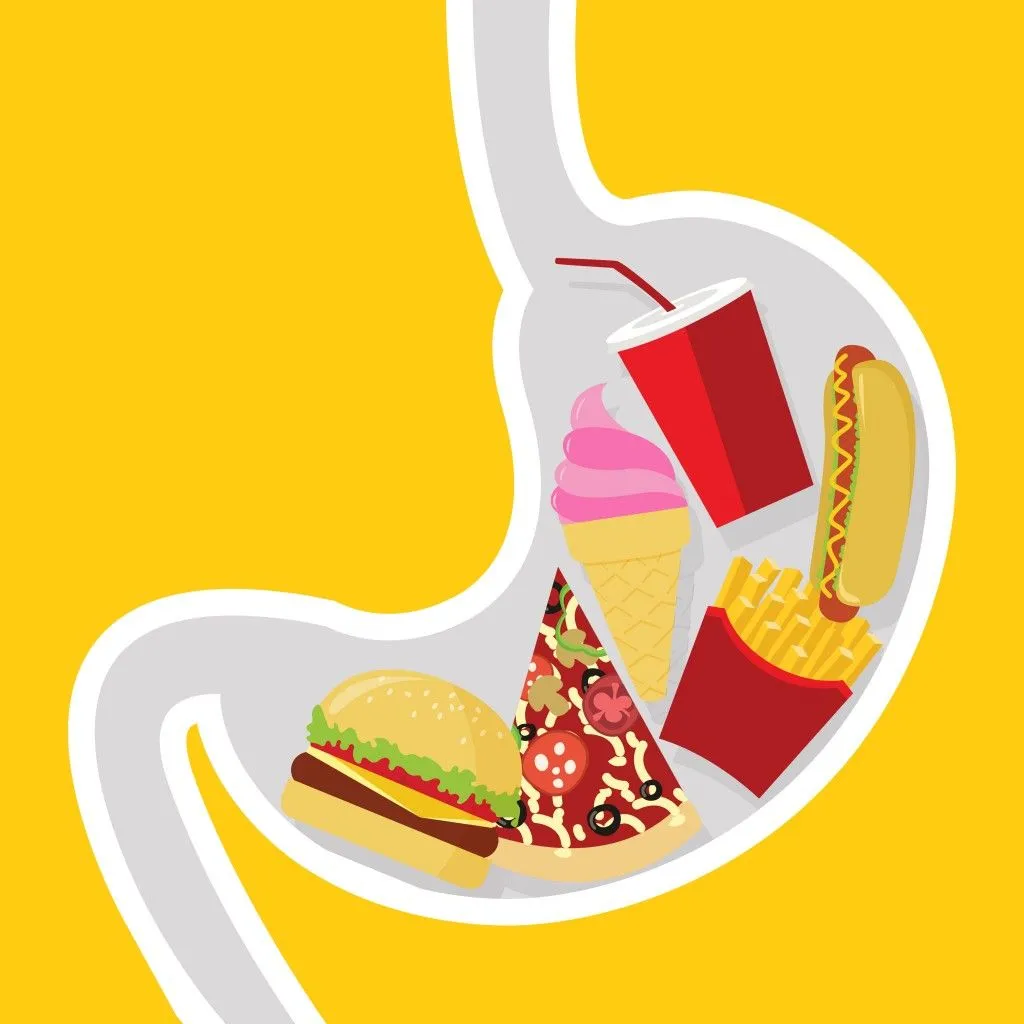
The stomach’s main job is to mix everything up. If you had a donut immediately followed by a pizza, the stomach would mix everything up until the pizza was indistinguishable from the donut. The muscles of the stomach are strong and produce powerful contractions that churn the food into chyme.
But here, it is important to consider timing. If you ate a pizza mere moments after you ate the donut, then everything will get converted to chyme. But if you ate the pizza an hour or two after the donut, the stomach has already started digesting the donut by then. The pizza would now simply be folded into the stomach’s ongoing digestion.
The Small Intestine
The small intestine is where most nutrients are absorbed and just like the stomach, the small intestine doesn’t distinguish between when a food was eaten.
As the chyme enters the small intestine, several things happen.
Briefly, the liver secretes bile salts via the gallbladder, while the pancreas secretes bicarbonate and various digestive enzymes into the duodenum. The bicarbonate ions neutralize the acidic chyme and make it more basic. The bile salts serve to emulsify the fat so that lipases can effectively break down fat.
Most digestive enzymes are secreted by the pancreas, such as peptidases like trypsin, chymotrypsin and carboxypeptidases (which break down peptides into amino acids), lipases (which break triglycerides down into free fatty acids and monoglycerides), pancreatic amylases, and nucleases (which break down nucleic acids like DNA and RNA).
The small intestine also has its own digestive enzymes. These are called brush border enzymes, as they are present on the cells of the small intestine.
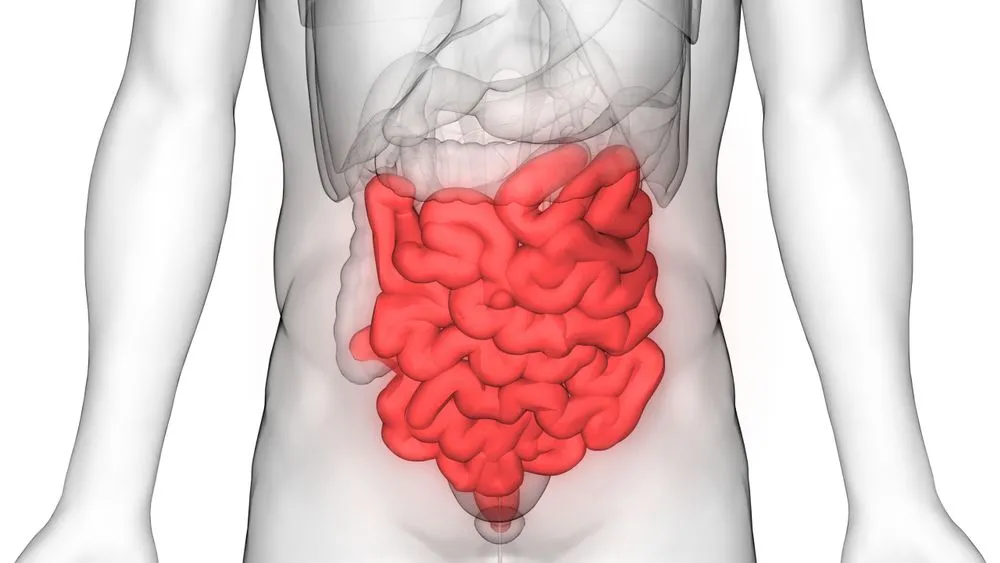
But the small intestine does prefer to absorb some nutrients first. The three parts of the small intestine (the duodenum, the jejunum and the ileum) absorb different nutrients and have different capacities. Most of the nutrient absorption occurs in the duodenum and jejunum of the small intestine, but the ileum is also important for the absorption of certain nutrients.
As the food enters the large intestine, most nutrients have already been absorbed. The large intestine now mops up the remaining water and electrolytes, and absorbs vitamins (like vitamin K and several B vitamins) produced by the resident gut bacteria. It then converts the leftover chyme into feces by secreting mucus, while the gut microflora (the bacteria present in the gut) ferments residual carbohydrates and changes it chemically. After all this, the end product is our fecal matter (poop) that remains to be excreted.
Why Does Food Need To Be Digested At All?
It is worth stepping back to ask why the body bothers with this elaborate process in the first place. Your cells run on small, simple molecules: sugars, amino acids and fatty acids. The food on your plate, however, arrives as enormous ones. Starch is a long chain of thousands of sugar units, a protein is a folded ribbon of hundreds of amino acids, and dietary fat comes in bulky globules. These molecules are far too big to slip across the lining of your gut and into your blood.

Digestion is simply the body’s way of chopping these giant molecules down to a size it can absorb. It does this in two ways at once. Physical actions, such as chewing in the mouth and churning in the stomach, break food into smaller and smaller pieces, while chemical actions, using stomach acid, bile and a battery of enzymes, split the molecules apart through a water-driven reaction called hydrolysis. Carbohydrates are reduced to simple sugars, proteins to amino acids, and fats to fatty acids and glycerol.
Only once food has been shrunk this far can specialized cells lining the small intestine ferry the nutrients across into your bloodstream, which then delivers them to cells throughout the body for energy, growth and repair. Without digestion, you could eat all day and still starve, because none of those nutrients could ever get in.
How Long Does The Whole Process Take?
If the stomach and intestines work through your meal in sequence, how long does the full journey actually last? According to the Mayo Clinic, it takes roughly six to eight hours for food to pass all the way through your stomach and small intestine. That is the busy stretch, where most of the breaking down and nutrient absorption happens.
The leftovers then move into the large intestine, and this is where the clock really slows down. Food takes about 36 hours to travel through the colon alone. Added together, the whole trip from the moment you swallow to the moment the remains leave your body as feces takes somewhere between two and five days, depending on the person. Digestion time varies from one individual to the next, and even between men and women.
So the honest answer to “how long does it take to digest a meal?” is that the interesting part is over within a working day, while the slow final leg through the colon is what stretches the total out to a couple of days.
Can You Make Your Food Digest Faster?
After a heavy meal, plenty of people go looking for a trick to speed things up. The slightly deflating truth is that the core enzymatic work runs largely on its own schedule, and there is no food or drink that will instantly dissolve a pizza. What you can do is help your gut keep things moving comfortably and on time.

The simplest lever is a gentle walk. Light movement gets the muscles of the gut going, and timing matters: a 2023 review in the journal Sports Medicine concluded that exercise such as about 20 minutes of walking, done as soon as possible after a meal, has an acute beneficial effect on the blood-sugar spike that normally follows eating. The key word is gentle, though. A hard workout straight after a big meal tends to divert blood away from the digestive tract towards your working muscles, which can slow digestion down rather than speed it up.
Chewing your food thoroughly also helps, since it does the mechanical part of digestion up front and leaves your enzymes a smaller target to work on. And over the longer run, fiber and fluids keep the traffic moving through the intestines. Health authorities suggest adults aim for roughly 22 to 34 grams of fiber a day, along with plenty of water, to keep stools soft and easy to pass.
Conclusion
To answer the primary question in the title of the article, yes and no. The digestive system does not work in the order of the food you have eaten. That being said, if you eat a burger and then scarf down a donut an hour later, the digestive system will digest the burger first.
The digestive system does begin the break down of some nutrients before others. As we saw above, carbohydrates begin digestion in the mouth (salivary amylases), but enzymatic protein breakdown begins in the stomach.
So, the next time you have both a burger and a donut, remember that they’ll eventually both become one large pulp of nutrients and exit the body as brown nutrient-barren blobs.
References (click to expand)
- Gropper S. S.,& Smith J. L. (2008). Advanced Nutrition and Human Metabolism. Cengage Learning
- Seeley R. R., Stephens T. D.,& Tate P. (2006). Anatomy and Physiology. McGraw-Hill Higher Education
- Absorption of Nutrients. nutrientsreview.com
- Your Digestive System & How it Works. National Institute of Diabetes and Digestive and Kidney Diseases (NIDDK)
- Digestion: How long does it take? Mayo Clinic
- Engeroff, T. et al. (2023). After Dinner Rest a While, After Supper Walk a Mile? Sports Medicine
- Constipation: Eating, Diet, & Nutrition. National Institute of Diabetes and Digestive and Kidney Diseases (NIDDK)