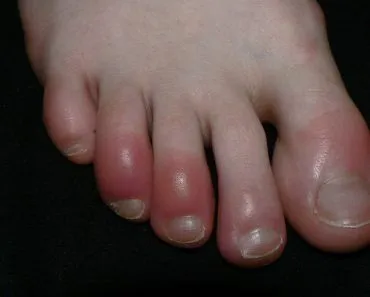
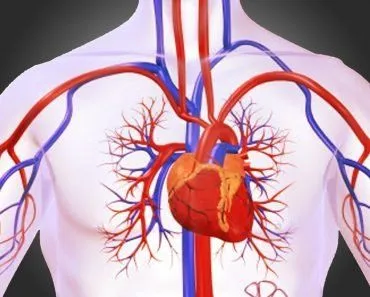
Human blood is always red: bright cherry red when oxygenated (in arteries), dark crimson when deoxygenated (in veins). Veins look blue or green because of how light interacts with skin: red light penetrates several millimetres into the skin, while blue is mostly absorbed and scattered near the surface. For veins sitting half a millimetre or more below the skin, the surrounding tissue reflects more red light than the vein itself, and our brain interprets that contrast as the vein being blue. The blood inside the vein never actually turns blue.
Oxygenated and Deoxygenated Blood
You might already know that the heart is the central organ of our circulatory system. It is also one of the most critical organs of the body, located above the lungs and slightly to the left, and beats as long as a person lives. It’s also arguably the hardest-working organ in the body.
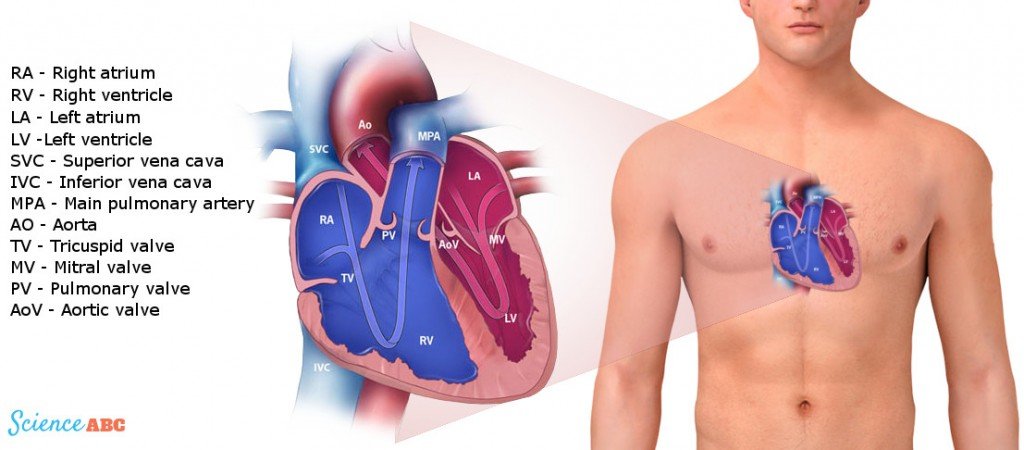
The heart pumps oxygenated blood (i.e., blood that is rich in oxygen) throughout the body with the help of arteries (which transport it to thousands of tissues). Similarly, deoxygenated blood flows back to the heart, which then transports it to the lungs, pulling the waste carbon dioxide out of the blood and expelling it from the body along the way.
Is Venous blood blue in color?
Contrary to what many people think, the blood in our veins, i.e., deoxygenated blood, is not blue. In fact, no kind of human blood is blue. If anything, deoxygenated blood is even redder than regular, oxygenated blood. If you have ever had your blood drawn and noticed its color, you would clearly know that deoxygenated blood is a dark red.

Deoxygenated blood is darker than ‘regular’ blood. (Photo Credit : César Astudillo / Wikimedia Commons)
So, it’s amply clear that venous blood is indeed red. Yet the veins we see in our arms, wrists, hands and other parts of the body seem to have a greenish, bluish tinge. Why is that?
Vein color is attributed to how light interacts with the layers of skin
Human skin doesn’t absorb light of any wavelength, but blood absorbs the light of all wavelengths. However, it absorbs red light a little less than others. The thing with blue light is that it doesn’t penetrate the skin as well as red light does (Source).
As a result, if a blood vessel is close to the surface of the skin, almost all blue light is absorbed by the skin (as blue doesn’t penetrate the skin), which makes the vessel appear red. However, if the vessel in question is located a little deeper (0.5 millimeter or more), not as much red or blue light will be absorbed. In this case, the ratio of blue light reflected to red light reflected would be around 2:3 (Source), and the vein would thus appear greenish-blue.
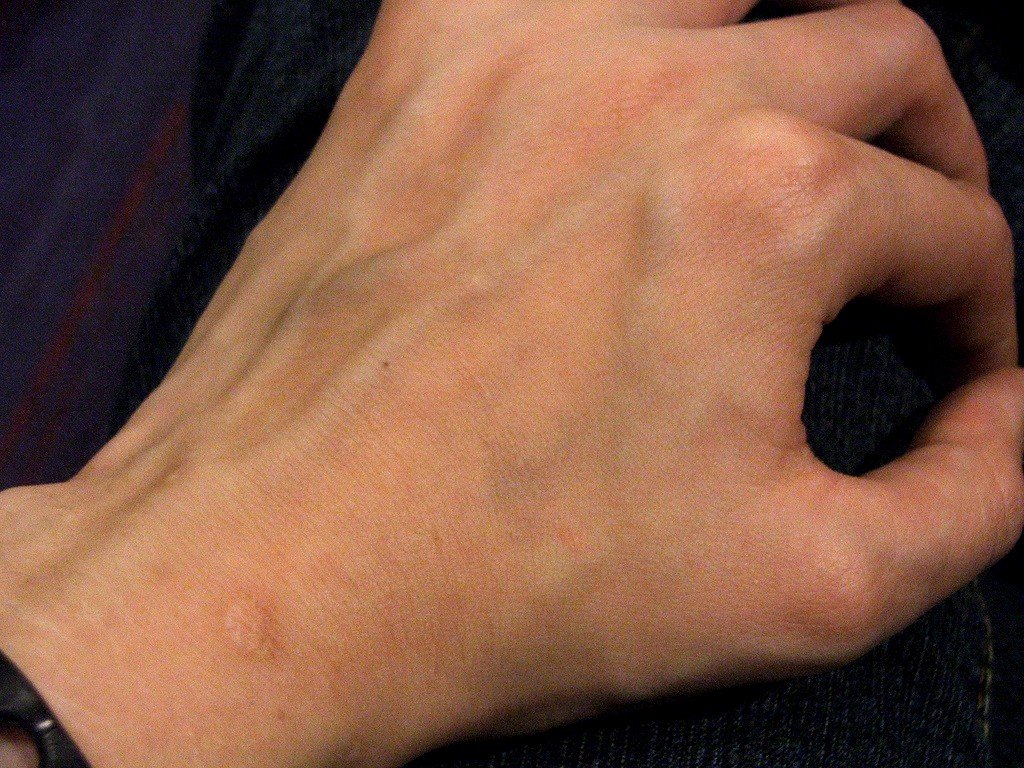
Greenish blue veins on a man’s wrist (Photo Credit : Flickr)
Interestingly, such ‘deeper’ vessels appear blue despite reflecting more red light (than blue). This strange phenomenon is attributed to relative color perception, or, in other words, how we perceive colors relative to other colors present in the surroundings.
Why Are Veins Drawn Blue And Arteries Red In Diagrams?
If your blood is always red, why did every biology textbook you ever opened paint the arteries bright red and the veins a tidy shade of blue? This is where a lot of the ‘blood is blue’ confusion comes from. The red and blue you see in an anatomy diagram are a color-coding convention, a labeling shorthand, and not a literal portrait of what is flowing inside you. The colors are chosen to tell two networks apart at a glance: red marks the oxygen-rich blood that arteries carry away from the heart, and blue marks the oxygen-poor blood that veins return back to the heart. Think of a subway map where one line is drawn red and the other blue. The colors are there to keep the routes straight in your head, not because the trains are actually painted those shades.

So why red and blue specifically? Red is the honest one: oxygen-rich arterial blood really is a bright, cherry red. That color comes from hemoglobin, the iron-bearing protein in your red blood cells. When the iron in hemoglobin grabs onto oxygen, the molecule absorbs blue-green light and reflects red light back to your eye, which is why oxygenated blood looks vivid red. Blue, on the other hand, is not the real color of anything in your bloodstream. Deoxygenated venous blood does change shade once it has dropped off its oxygen, but it darkens to a deep, dark red, never blue. Diagram makers simply needed a second, strongly contrasting color to label the return half of the loop, and blue does that job perfectly. The convention stuck because it genuinely helps when you are learning the circulatory system. The catch is that, taken too literally, it leaves generations of students convinced their veins are full of blue blood that magically turns red the instant it hits the air. It doesn’t. The blood was dark red the whole time, and the bluish tint you see through your skin is the light-and-skin trick described above, not the color of the blood itself.
Can A Human Ever Have Blue Blood?
Here’s where the story gets genuinely strange. We’ve established that your blood is always some shade of red. So can a human ever literally have blue blood? Not blue in the textbook sense, but yes, human skin and blood can take on a striking blue-grey cast in a rare condition called methemoglobinemia. The culprit is a faulty version of hemoglobin. Normally the iron at the heart of hemoglobin sits in the ferrous (Fe2+) state, which can grab and release oxygen. In methemoglobin, that iron has been oxidized to the ferric (Fe3+) state, and ferric iron simply cannot carry oxygen. When enough hemoglobin is stuck in this useless form, the blood darkens to a chocolate-brown color and the skin and lips look bluish, a sign doctors call cyanosis. Cyanosis can become visible with methemoglobin levels as low as 10%, and very high levels can be dangerous (Source).

The most famous case is the ‘Blue People of Kentucky’, the Fugate family. Starting in the early 1800s, descendants of Martin Fugate and Elizabeth Smith near Troublesome Creek were born with vividly blue skin. The cause was an inherited shortage of an enzyme called cytochrome b5 reductase (also known as diaphorase), which normally keeps converting methemoglobin back into working hemoglobin. Because the trait is recessive and the community was small and isolated, the gene kept pairing up, and so blue children kept appearing. In the 1960s a hematologist, Madison Cawein, treated several family members with methylene blue, an old dye that helps reduce that ferric iron back to its oxygen-carrying form, and their skin promptly turned pink (Source). So the one time a human really does look blue, it isn’t the romantic ‘blue blood’ of royalty. It is a quirk of chemistry, and even then the blood underneath is brown, not blue.
Which Animals Actually Have Blue Blood?
If no animal with red blood is ever truly blue, you might assume blue blood is pure myth. It isn’t. Step away from mammals and you’ll find creatures whose blood really does run blue, just not because of iron. Octopuses, squid, many crustaceans and the horseshoe crab carry oxygen using a copper-based protein called hemocyanin instead of the iron-based hemoglobin in your veins. Hemocyanin is colorless when it has dropped off its oxygen, but it turns a distinct blue when oxygen binds to the copper (Source). That is the mirror image of what happens in you: your hemoglobin is reddest when loaded with oxygen, while their hemocyanin is bluest when loaded with oxygen. Copper-based blood is especially handy in cold, low-oxygen seawater, which is part of why it shows up so often in deep-sea and polar species. If you want the full story of why cephalopods went the copper route, we have a whole piece on why squids and octopuses have blue blood.

The horseshoe crab is the standout example, and its blue blood is genuinely valuable to medicine. Its blood clots dramatically in the presence of toxins from certain bacteria, and that reaction is the basis of the LAL (Limulus Amebocyte Lysate) test, which the pharmaceutical industry uses to check that vaccines, injectable drugs and medical implants are free of bacterial contamination (Source). So while your own ‘blue’ veins are nothing more than a light-and-skin illusion, there really are animals walking the seafloor with blue blood in their bodies, and one of them quietly helps keep human medicine safe.
References (click to expand)
- (1996) Why do veins appear blue? A new look at an old question. ilm-ulm.de
- So Why *Do* Our Veins Look Blue? - approach.rpi.edu
- Why are veins blue? | Science Questions with Surprising .... West Texas A&M University
- Blood in your veins is not blue: here’s why it’s always red. The Conversation
- If blood is red, why do veins look bluish? Live Science
- Methemoglobinemia. StatPearls. NCBI Bookshelf.
- Blue Fugates. Wikipedia.
- Neurological Features of CYB5R3-Related Hereditary Methemoglobinemia. PMC (NCBI).
- Animal blood comes in a rainbow of colors. National Geographic.
- Blood Collection from the American Horseshoe Crab, Limulus Polyphemus. PMC (NCBI).
- Octopuses Survive Sub-Zero Temps Thanks to Specialized Blue Blood. Scientific American.