Table of Contents (click to expand)
- What Could Happen When You Try To Stop A Sneeze?
- But, Isn’t A Loud Sneeze Embarrassing?
- Pressing Under Your Nose Can Help!
- How Is This Possible?
- Can You Sneeze In Your Sleep?
- Why Does Bright Sunlight Make Some People Sneeze?
- Why Do You Sometimes Get The Urge To Sneeze, But It Will Not Come Out?
- Why Do Some People Sneeze After A Big Meal?
- Conclusion
Pressing a finger under your nose can stop a sneeze before it starts, because the touch signal "closes the gate" on the irritation message heading to your brain. It can delay or cancel the reflex, but it doesn't work every time. Fully suppressing a sneeze by pinching the nose shut is riskier and can rarely injure the ears, throat or blood vessels.
It’s a beautiful morning, full of warm sunlight and a breezy wind. All of a sudden, your eyes close involuntarily, a fine spray rockets out at speeds estimated as high as 160 km/h (100 mph) with a weird sound “Ahh-Chooo!” and everyone within twenty feet looks over at you. Yes, you just sneezed!
We all sneeze when we have allergens or irritants in the nose, or when we have a cold or other illness. Sneezing occurs in response to irritation in the nasal cavity, and a single sneeze is estimated to expel tens of thousands of tiny droplets. However, most of the time, it is very brief, although in some cases you might go into a sneezing attack with a long string of sneezing in a row. Fortunately, sneezing is actually beneficial to our health, since it removes foreign particles from the body.

Trying to stop a sneeze can result in a number of complications in the body. The risk of injuring yourself when stopping a sneeze is low, but far from impossible, and in unlucky cases, it can be brutal. It’s important to know the difference between controlling the urge to sneeze and actually stopping a sneeze.
What Could Happen When You Try To Stop A Sneeze?
- Injury to the diaphragm.
- Breaking of blood vessel in the white part of the eye, causing bruising of the areas around the iris.
- Weakening of blood vessels in the brain, causing them to rupture due to the elevation of pressure.
- Tearing of the soft tissue in the throat. In one documented case (reported in BMJ Case Reports in 2018), a man who pinched his nose and clamped his mouth shut during a sneeze ruptured the back of his throat, trapped air in his neck and needed a week in hospital.
Suppressing a sneeze by holding the mouth or nose closed leads to an increase in airway pressure roughly 5 to 24 times greater than what is found in a normal sneeze. With nowhere to escape, that pressure is forced back into the head, nasal cavity, ears and throat. In rare, severe cases it can rupture delicate structures in the inner ear, causing hearing loss. So while a halted sneeze almost never kills anyone, the safest move is simply to let it out.
But, Isn’t A Loud Sneeze Embarrassing?
Sitting in a silent room, examination hall or in a meeting, it can definitely feel embarrassing to sneeze loudly and turn everyone’s attention to you. Thankfully, there is a method to control sneezing in unavoidable situations, with no collateral damage. Keeping your fingers pressed under your nose actually prevents sneezing! Believe it or not, it really works.
Pressing Under Your Nose Can Help!
When you press your fingers under your nose, you add a strong touch signal that competes with the irritation signal heading to your brain. If the touch signal wins, the brain backs off the sneeze and it is temporarily held off. Sometimes that is the end of it, but often the relief is brief, and a giant outburst of air arrives two to three seconds after you remove your fingers.
How Is This Possible?
The trigeminal nerve is located in the face and runs throughout your forehead, nose, mouth and jaw. It is the nerve responsible for sensation in your face. It also controls the motor functions, such as chewing, talking and sneezing! It is the largest of the cranial nerves, with very long branches. Specifically, the part serving your nose is called the maxillary nerve, one of the three main branches of the trigeminal nerve. When the maxillary nerve picks up an allergen, such as dust, pollen or a chemical, it sends a signal to the brain that ultimately results in a sneeze.
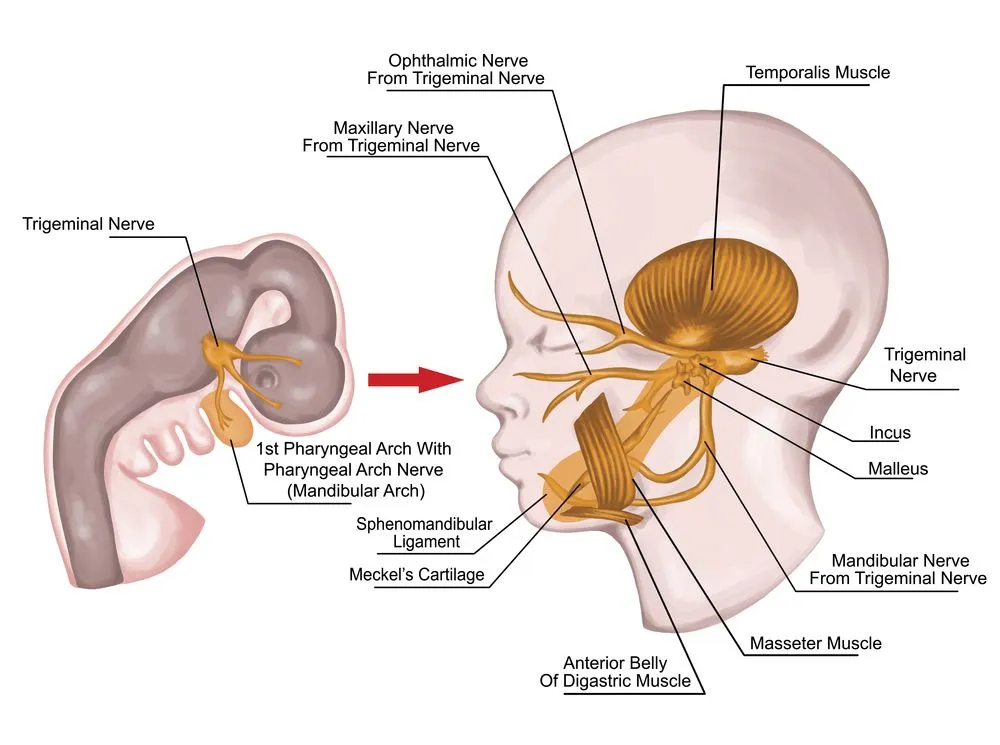
Now, pressing your upper lip with a finger feeds a fresh touch signal into the same trigeminal nerve. The touch fibers that carry it are wider and faster than the fibers carrying the irritation signal, so they can reach the gateway nerve cells in the brainstem first and effectively "close the gate" on the sneeze message. Neuroscientists call this the gate control theory, and it is the same idea that explains why your first instinct, after you bump your knee on a table, is to rub it. You are unintentionally flooding the nerves with a competing touch signal so the pain has a harder time getting through. Pressing under your nose works the same way, which is why it might head off a sneeze, though it certainly will not stop every one of them.
Can You Sneeze In Your Sleep?
Here is a quirk of the same reflex: you almost certainly do not sneeze once you are properly asleep. During REM sleep, the stage in which most vivid dreaming happens, the brain switches off most of your muscles, a safety feature called REM atonia that stops you from acting out your dreams. The motor commands needed for a sneeze are paused along with everything else. The chemistry helps too, as the release of the irritation messenger histamine drops during sleep, so an allergen that would set you off while awake often gets no response at all. If an irritant is strong enough to break through in lighter sleep, it usually wakes you first, so the sneeze actually happens in those waking moments rather than mid-dream.
Why Does Bright Sunlight Make Some People Sneeze?
If stepping out of a dark cinema into the afternoon sun makes you sneeze on the spot, you are not imagining it. Somewhere between 18% and 35% of people have what scientists call the photic sneeze reflex, which doctors have playfully renamed ACHOO syndrome, short for Autosomal Dominant Compelling Helio-Ophthalmic Outburst. It is an inherited trait, so if one of your parents sneezes at bright light, you have roughly a 50% chance of doing the same.

Nobody has fully cracked how it works, but the leading explanation comes back to the same wiring we met earlier. When a sudden flood of light hits your eyes, your optic nerve fires a strong signal to the brain. The circuits that handle vision sit right next to those of the trigeminal nerve, the one that governs sensation in your nose, and the two are thought to "cross-talk". For a moment the brain misreads the burst of light as an irritation in the nose and answers with a sneeze, even though nothing is actually tickling your nostrils. Most people sneeze just once or a few times before the reflex settles.
It is harmless, but it is not always convenient. Sneezing fits have been flagged as a small hazard for drivers heading into bright sunlight, and the reflex is worth mentioning to your doctor or dentist before any procedure done under bright lights, so a sudden "Ahh-Chooo!" does not catch anyone off guard.
Why Do You Sometimes Get The Urge To Sneeze, But It Will Not Come Out?
We have all been trapped in that maddening in-between state: your nose prickles, your eyes begin to water, you tilt your head back... and then nothing. The sneeze retreats. A sneeze only fires once the irritation signal travelling up the trigeminal nerve builds to a certain tipping point. If that signal fades just short of the mark, you are left hanging with the urge but no release.
The way to finish the job is to feed the trigeminal nerve a little more input until it crosses the line. Doctors suggest a few harmless nudges: gently twirling the rolled tip of a tissue just inside one nostril, taking a careful sniff of black pepper (the compound piperine irritates the nerve endings in your nasal lining), lightly massaging the bridge of your nose, or, if you happen to have the photic reflex, glancing up toward a bright light. Each of these works by adding sensation to the very nerve that sets off the reflex. Two sensible cautions apply: never look straight at the sun, and do not push anything deep into your nose or inhale a face full of pepper, or you will trade a stalled sneeze for a genuinely sore nose.
Why Do Some People Sneeze After A Big Meal?
Here is one final quirk of the sneeze reflex: some people fire off a volley of sneezes right after finishing a large meal. The phenomenon even has a name, snatiation, a blend of the words "sneeze" and "satiation". The trigger is not the food itself but a very full, stretched stomach, which is why it can follow a big plate of almost anything rather than one particular dish.

Snatiation is completely harmless and appears to run in families, which hints at a genetic component, though its exact wiring is still unclear. It should not be confused with gustatory rhinitis, the runny nose and sneezing that hot, spicy food can bring on. That reaction comes from the fiery chemicals in the food irritating your nose, whereas snatiation is a response to fullness alone. There is no cure, but the simple fix is to eat smaller, slower meals so your stomach never stretches enough to set the reflex off.
Conclusion
When you feel the urge to sneeze, it is better to just go ahead and do so. This is because your body is actually helping you get rid of harmful and unwanted particles. Sneezing helps you clear your nose, so this is a much better way to handle the instinctive responses of your body than to go against it and harm yourself, unless you value your image more than your health!
References (click to expand)
- Sneezing: MedlinePlus Medical Encyclopedia. MedlinePlus
- Hello hay fever - why pressing under your nose could stop a sneeze but why you shouldn't. The Conversation / University of Wollongong
- Can Holding in a Sneeze Cause Hearing Damage? UAMS Health
- Can You Sneeze in Your Sleep? Sleep Foundation
- Achoo Syndrome: Why the Sun Makes You Sneeze. Cleveland Clinic
- ACHOO Syndrome - Medical Genetics Summaries. NCBI Bookshelf
- How to Make Yourself Sneeze: 9 Ways. Healthline
- Sneezing after eating: Causes and prevention. Medical News Today