You should always cover your mouth when you sneeze in order to avoid spreading germs to other people. A sneeze ejects thousands of tiny droplets carrying viruses and bacteria, and MIT research shows the surrounding gas cloud can carry the smallest of them up to 8 meters (27 feet). Covering up keeps those droplets off other people and shared surfaces.
As children, it’s rather common for our parents to chastise us when we forget to cover our nose when we sneeze or cough. Obviously, by covering your mouth, you are blocking the flight of small particles and germs that are expelled during a violent sneeze. Remember, sneezing and coughing are typically the result of irritation in the throat tissues and sinuses, often caused by foreign objects or pathogens.
When we sneeze or cough, we are essentially ejecting these particles out into the world, free from our bodies, but that means they can land on other surfaces or be inhaled by other people, thus spreading potential infections. For decades, researchers believed that the “germ radius” of a sneeze wasn’t more than a few feet, with the larger droplets being the most dangerous, as they experience ballistic motion and had significant momentum, due to their mass. Unfortunately, that belief has recently been proved incorrect. The question is… how far can a sneeze really travel?
Short Answer: Unlike earlier beliefs of just a few feet, the warm gas cloud from a sneeze can carry droplets up to about 8 meters (27 feet). Mid-sized droplets (around 100 micrometers) travel roughly 5 times farther than once assumed, while the very smallest drops (around 10 micrometers) can travel up to 200 times farther.
The Science Of A Sneeze
When you feel that tickle start to come at the back of your nose, you probably don’t think much about science or mathematical models, but when researchers were trying to understand the true aerodynamics of a sneeze, they needed to make some calculations. See, in the past, the droplets that are shot out of your nose when you sneeze were treated as independent particles, with no interaction. Therefore, their trajectories and distance could be calculated based on their mass and velocity.
A study at MIT, however, used high-speed imaging to capture the detailed activity within the cloud of gas and particles that you expel during a noisy sternutation (the fancy word for a sneeze). Aside from the particles themselves, which you can usually catch in a tissue or the crook of your elbow, there is also a large gas cloud that is pushed out during a sneeze. Within that cloud, there are actual currents, which can sweep many of the smaller drops up and circulate them back through the cloud as it moves in a given direction. By re-suspending these drops and carrying them along, the cloud lets germs and micro-particles ride far beyond the old few-feet estimate. The MIT team found this cloud can stay aloft and carry droplets as far as 8 meters (27 feet) across a room.
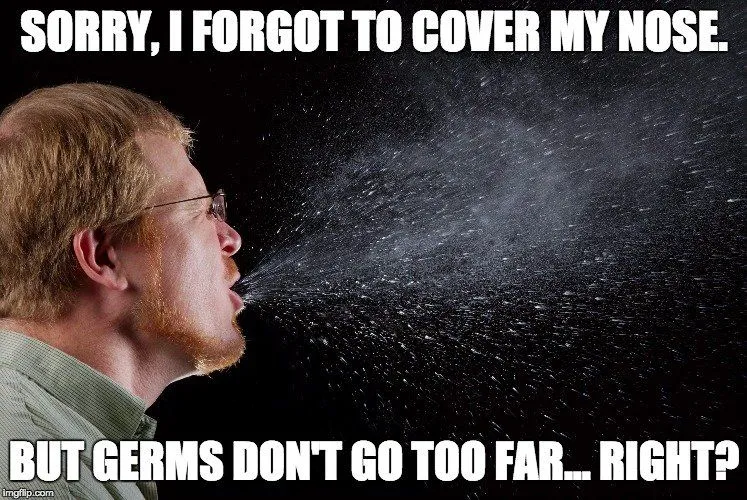
The gas cloud is scientifically referred to as a multiphase turbulent buoyant cloud, since it is not solely composed of gases expelled during the sneeze. This gas cloud will then interact with the ambient air, mixing and blending with it, and also being affected by any currents of airflow within the surrounding atmosphere. This gives the germs and particles released during a sneeze an extremely unpredictable travel pattern.
Researchers used to think that the “germ radius” only consisted of droplets that could be physically seen, so the range of potential infection was rather limited (a few feet at most). This recent discovery proves that the range for containment and possible spread of germs is much larger. In other words, if you have the sniffles, or a hacking cough, forgetting to cover your mouth isn’t just gross for the people sitting next to you, but for everyone in the entire room!
New Sneeze Knowledge = Huge Implications?
While this isn’t a world-changing revelation, it does have certain ramifications for people worried about the spread of germs, particularly in a professional setting. In places that rely on air filtration systems to cut down on airborne pathogens, such as airplanes or hospitals, this information changes their perspective completely. The “pathogen footprint”, namely where a pathogen goes once it is released from a person’s body, is incredibly important to understand in the battle against infectious diseases and their spread.
If these microscopic droplets can spread across an entire room in a matter of moments, they can also be sucked into air vents and spread to other locations, potentially infecting people in other rooms or wings of buildings. By understanding how germs are spread, defenses can be tightened, such as more regular cleaning of air vents or the development of air filtration systems that can capture tiny droplets as small as 10 micrometers.
Using the crook of your arm or a tissue is certainly preferred, but now that researchers understand the true range of a germ-filled sneeze, they may be able to take steps to further minimize the spread of infectious diseases! Who knew that the world of sneezes was so dynamic! Gesundheit!
What’s The Right Way To Cover A Cough Or Sneeze?
So we’ve established that a single sneeze can fling germs clear across a room. But here’s the part most of us get slightly wrong: how you cover up matters almost as much as whether you cover up. A sneeze isn’t a polite little puff. According to a 2025 review in Frontiers in Neuroscience, one sneeze can release up to 40,000 droplets loaded with viruses and bacteria, the airflow can reach nearly 100 km/h (about 62 mph), and the smallest droplets can drift for 7 to 8 meters (23 to 26 feet) and hang in the air for up to 10 minutes. That is a lot of biology to launch into a shared office, bus, or kitchen.

The Centers for Disease Control and Prevention (CDC) spells out the technique in two simple steps. First choice: cover your mouth and nose with a tissue, then throw the used tissue in the trash and wash your hands. Backup, if no tissue is handy: cough or sneeze into your elbow, not your hands. That last detail is the one people skip. If you sneeze into your palm, those 40,000 droplets are now on the very hand you will use to open a door, shake hands, or grab a shared coffee pot, transferring the germs to every surface you touch. Your elbow, by contrast, rarely makes contact with anything else, so it traps the spray and keeps it out of circulation.
And whichever you use, the CDC stresses one follow-up: wash your hands with soap and water for at least 20 seconds afterward, or use a hand sanitizer that is at least 60% alcohol if a sink isn’t nearby. Covering the mouth blocks the launch, but clean hands stop the relay.
Is It Bad To Hold In Or Stifle A Sneeze?
If covering up is the goal, you might be tempted to go one step further and just stop the sneeze entirely, pinching your nose shut and clamping your mouth closed to muffle it in a crowded room. Resist that urge. A sneeze is a pressurized blast of air with somewhere to go, and if you seal off both exits, that pressure has to spend itself inside your head and chest instead.
The most dramatic case on record is a genuinely alarming one. A 2018 report in BMJ Case Reports, memorably titled “Snap, crackle and pop: when sneezing leads to crackling in the neck”, described a 34-year-old man who pinched his nose and held his mouth shut to halt a forceful sneeze. He felt a popping sensation, his neck swelled up, and he could barely speak or swallow. He had actually ruptured the back of his throat (a perforation of the pyriform sinus), allowing air to track down into his neck and chest. He needed a hospital stay, tube feeding, and antibiotics before he recovered. The authors’ verdict was blunt: halting a sneeze by blocking the nose and mouth is "a dangerous manoeuvre and should be avoided."
That case is rare, but it isn’t the only risk. Specialists at the Cleveland Clinic note that the trapped pressure can be forced up the Eustachian tube toward the middle ear, potentially causing ear infections or even a ruptured eardrum, and can briefly raise the pressure inside your eyes and sinuses. In the most extreme reports, doctors have even linked stifled sneezes to ruptured blood vessels. The reassuring news is that for most people the odds of serious harm on any given sneeze are low. But there is simply no upside to forcing it back in. The science points one way: let the sneeze out, point it into a tissue or your elbow, and you protect both the room around you and the plumbing inside your own head. (If you’re curious whether you can stop a sneeze more safely, we’ve looked at the old trick of pressing under your nose separately.)
References (click to expand)
- Healthy Habits: Coughing and Sneezing. Centers for Disease Control and Prevention (CDC).
- Chu, J. (2014, April 8). In the cloud: How coughs and sneezes float farther than you think. MIT News (on Bourouiba, Dehandschoewercker & Bush, Journal of Fluid Mechanics).
- Gao, N., Niu, J., & Morawska, L. (2008, December). Distribution of respiratory droplets in enclosed environments under different air distribution methods. Building Simulation. Springer Science and Business Media LLC.
- Nuwer, R. (2014, June 17). Know the Jargon. Scientific American. Springer Science and Business Media LLC.
- Hygiene and Respiratory Viruses Prevention. Centers for Disease Control and Prevention (CDC).
- Rui, Y., et al. (2025). The sneeze reflex in physiological and pathological states: a mini review. Frontiers in Neuroscience.
- Yang, W., Sahota, R. S., & Das, S. (2018). Snap, crackle and pop: when sneezing leads to crackling in the neck. BMJ Case Reports. PMC.
- Is It Bad To Hold in a Sneeze? Cleveland Clinic Health Essentials.