Table of Contents (click to expand)
Myostatin, or growth differentiation factor-8 (GDF-8), is a protein that limits how big your muscles can grow. It acts as a negative regulator of skeletal and cardiac muscle, so the more myostatin you have, the lower the ceiling on your muscle mass. Animals and people with a broken myostatin gene grow strikingly muscular.
The human body does have a limit for certain aspects of its growth. For instance, we stop increasing in height after a certain age. Similarly, our muscles have a control mechanism that sets a limit as to the size that our muscles can grow.

What Is This Control Mechanism?
One alphanumeric designation: GDF-8.

Growth differentiation factor-8, more commonly known as myostatin, is the protein responsible for controlling the growth of our muscles. It is essentially a negative regulator of skeletal and cardiac muscle; meaning that the more myostatin you have, the lower the limit of your muscle mass.
The effect of myostatin was established when it was observed that mice with a disruption in the gene responsible for myostatin production (Mstn) attained a significant increase in their muscle mass.
The effects of myostatin have also been observed in natural settings. A particular type of cattle, the Belgian Blue, has enormous muscle mass thanks to a natural 11-base-pair deletion in the myostatin gene that switches the protein off. The same thing shows up in whippets: a dog carrying one broken copy of the gene runs faster than its peers, while a dog with two broken copies becomes a grotesquely muscled "bully whippet."
Humans are not exempt. In 2004, doctors in Germany described a baby boy who looked unusually muscular from birth, with muscles roughly twice the normal size and about half the usual body fat. He carried a loss-of-function mutation in both copies of his myostatin gene, and his mother, a former professional sprinter, carried one copy. Cases like his are why myostatin is sometimes nicknamed the "Hercules gene."

How Does It Work?
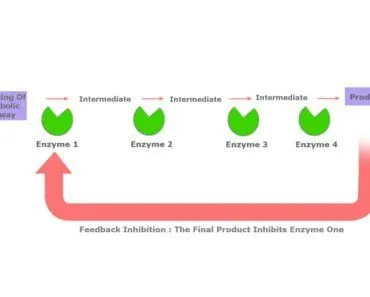
Myostatin, like most other control mechanisms in the body, works via negative feedback. It is a chalone: a soluble protein secreted by the cells of an organ (the muscle cells, known as myocytes, in this case) that negatively regulates the growth of that organ. As our muscle mass increases, so does the amount of myostatin. Therefore, after a certain point, when our muscles are large enough, the myostatin concentration reaches a point where it is high enough to stop muscle growth.
When it comes to the size of our muscles, there are two elements that matter:

No, not those two.
Our muscle mass is determined by the number of fibers that our muscles have, and the size of those fibers. The number of muscle fibers we have usually does not change after development. On the other hand, the size of these fibers can, of course, increase or decrease depending on:

Okay, yes, now those two apply.
When the gene responsible for producing myostatin was deleted in developing mice, it resulted in the mice experiencing an increase in muscle mass due to both elements mentioned above: the number of muscle fibers increased (called hyperplasia), as did the size of these fibers (called hypertrophy). These effects remained observable throughout the life of these mice. This experiment was actually the one that established the effect of myostatin on muscle mass.
Meanwhile, in another experiment, it was observed that adult mice that had myostatin inhibitors injected into them, or those mice that had prenatal deletions of the myostatin gene, ended up having increased muscle mass.

These experiments showed us that myostatin worked on two levels. First, it controls the muscle fiber number during embryogenesis and, second, it controls muscle fiber size in adults.
If blocking myostatin bulks up mice, cattle and the odd whippet, why not bottle it as a drug? Researchers wondered the same thing, and several companies built antibodies and decoy receptors to switch myostatin off in people with muscle-wasting conditions like muscular dystrophy and age-related muscle loss (sarcopenia). The results have been humbling. Trials of drugs such as Pfizer's domagrozumab and Acceleron's ACE-031 in boys with Duchenne muscular dystrophy did add a little lean mass, but they failed to make the patients meaningfully stronger or faster on their feet, and the programs were shelved by 2018. It turns out that more muscle bulk is not the same thing as more usable muscle power, and the body has plenty of backup brakes besides myostatin.
So, try as hard as you may, your muscle mass won’t increase beyond a certain limit due to your body’s inherent myostatin level. However, don’t let this negative feedback (pun intended) affect you. Push the limits of your myostatin and get your body in the best shape you can!
So How Big Can Your Muscles Get Naturally?
Myostatin sets a genetic ceiling, but you do not need a gene test to get a rough sense of where your own limit sits. Sports scientists have a handy yardstick for this called the fat-free mass index, or FFMI. It takes your lean body mass (everything except fat) and adjusts it for your height, much like BMI but with the fat stripped out, so it measures how much muscle you carry on your frame rather than how heavy you are.
The number that matters comes from a 1995 study by Kouri and colleagues at Harvard Medical School, published in the Clinical Journal of Sport Medicine. They measured 157 male athletes and found that the drug-free athletes topped out at a remarkably sharp FFMI of about 25, while many of the steroid users sailed past it, some beyond 30. Translated into a real person, an FFMI near 25 looks like a lean, genuinely muscular man of around 1.8 m (5 ft 11 in) carrying roughly 90 kg (about 200 lb) at low body fat. That is the practical answer to "how big can I get naturally": impressively built, but a clear notch below the freakish proportions you see at the very top of professional bodybuilding.

Two more brakes explain why that ceiling is so hard to push past. First, as we saw, the number of muscle fibers you have is largely locked in during early development, so growing bigger means thickening the fibers you already own rather than minting new ones. That thickening leans on satellite cells, the muscle's own repair stem cells, which donate fresh nuclei to a growing fiber; their ability to multiply tends to fall off with age, which is part of why building muscle gets harder as the years pass. Second, the body shows steep diminishing returns: a beginner can pack on muscle fast, but as a 2025 review in Frontiers in Physiology notes, trained lifters approach a physiological "ceiling" where each extra block of training buys progressively less growth. Between your inherited myostatin levels, a largely fixed fiber count and these diminishing returns, your natural maximum is real, even if reaching it takes years of consistent, hard work.
References (click to expand)
- Elkasrawy, M. N., & Hamrick, M. W. (2010). Myostatin (GDF-8) as a Key Factor Linking Muscle Mass and Skeletal Form. Journal of Musculoskeletal and Neuronal Interactions.
- Schuelke, M., et al. (2004). Myostatin Mutation Associated with Gross Muscle Hypertrophy in a Child. New England Journal of Medicine.
- Mosher, D. S., et al. (2007). A Mutation in the Myostatin Gene Increases Muscle Mass and Enhances Racing Performance in Heterozygote Dogs. PLoS Genetics.
- The Failed Clinical Story of Myostatin Inhibitors against Duchenne Muscular Dystrophy: Exploring the Biology behind the Battle. (2020). Cells. NCBI PMC.
- Elliott, B., Renshaw, D., Getting, S., & Mackenzie, R. (2012, February 17). The central role of myostatin in skeletal muscle and whole body homeostasis. Acta Physiologica. Wiley.
- Saini, A., Faulkner, S., Al-Shanti, N., & Stewart, C. (2009, October). Powerful signals for weak muscles. Ageing Research Reviews. Elsevier BV.
- Kouri, E. M., Pope, H. G. Jr., Katz, D. L., & Oliva, P. (1995). Fat-Free Mass Index in Users and Nonusers of Anabolic-Androgenic Steroids. Clinical Journal of Sport Medicine. PubMed.
- Aslam, S., Habyarimana, J. D., & Bin, S. Y. (2025). Neuromuscular Adaptations to Resistance Training in Elite Versus Recreational Athletes. Frontiers in Physiology.
- Kaczmarek, A., et al. (2021). The Role of Satellite Cells in Skeletal Muscle Regeneration: The Effect of Exercise and Age. Biology (Basel). NCBI PMC.