Table of Contents (click to expand)
A mutation is a sudden, heritable change in a DNA or RNA sequence. Mutations can be helpful, harmful, or have no effect. The main types include point mutations (substitution, missense, nonsense, silent) and frame-changing mutations (insertion, deletion, duplication, inversion); deletions and insertions of non-multiple-of-three bases cause frameshift mutations that misread everything downstream.
Technically, a mutation is defined as any sudden change in the genes. A mutation may or may not be beneficial to the organism and/or species. Different types of mutation include deletion mutation, insertion mutation, duplication mutation, substitution mutation, missense mutation, nonsense mutation etc.
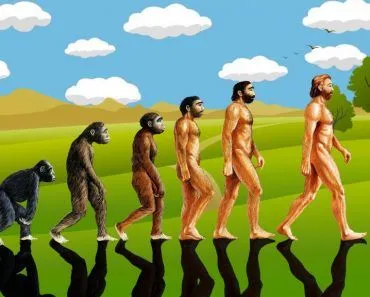
Evolution is the basis of growth. It was evolution that took us from single celled organisms to the complex, multicellular organisms we are today. It is to evolution that we owe our existence, our survival and our virtue of being the smartest creatures on the planet.
One of the biggest subset of evolution is mutation. From green eye colour to lactose tolerance in adulthood, many human traits are gifts of mutation. Molecular biology is a fascinating field of study. However, before one divulges into advance topics, let’s get our fundamentals right.
The Genetic Code
All our genetic information is stored and passed on in the simple arrangement of 4 basic nitrogenous bases – Adenine (A), Guanine (G), Thymine (T) and Cytosine (C). In RNA, the Thymine is replaced by Uracil (U). Adenine and Guanine are called purines, while thymine, cytosine and uracil are pyrimidines.
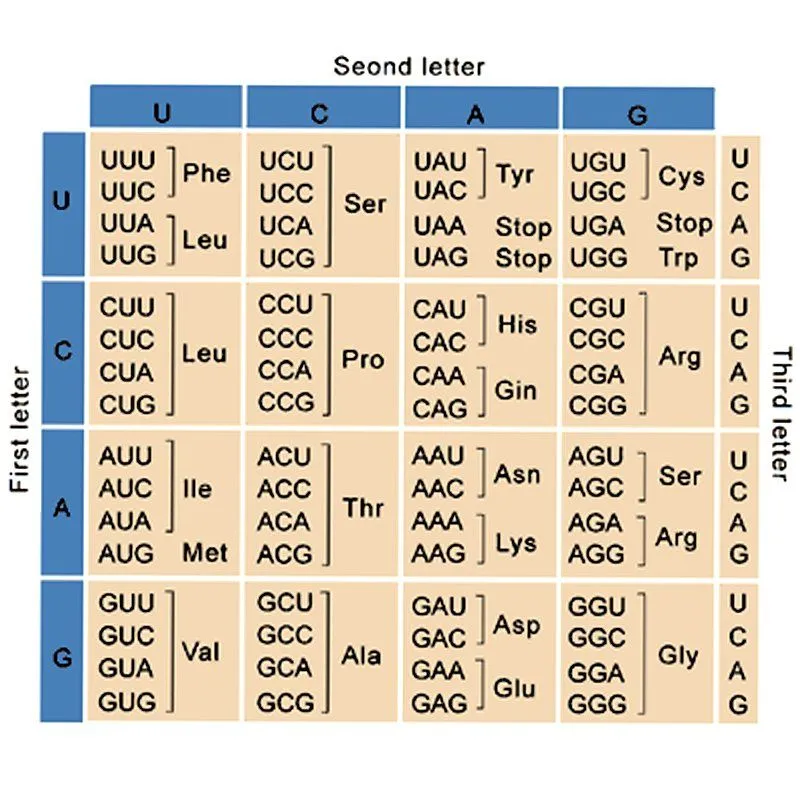
The arrangement of these 4 bases in various combinations eventually gives rise to proteins. The nitrogen bases are read in sets of 3, called codons. The codons determine the order of arrangement of the amino acids which undergo folding and more folding to create proteins.
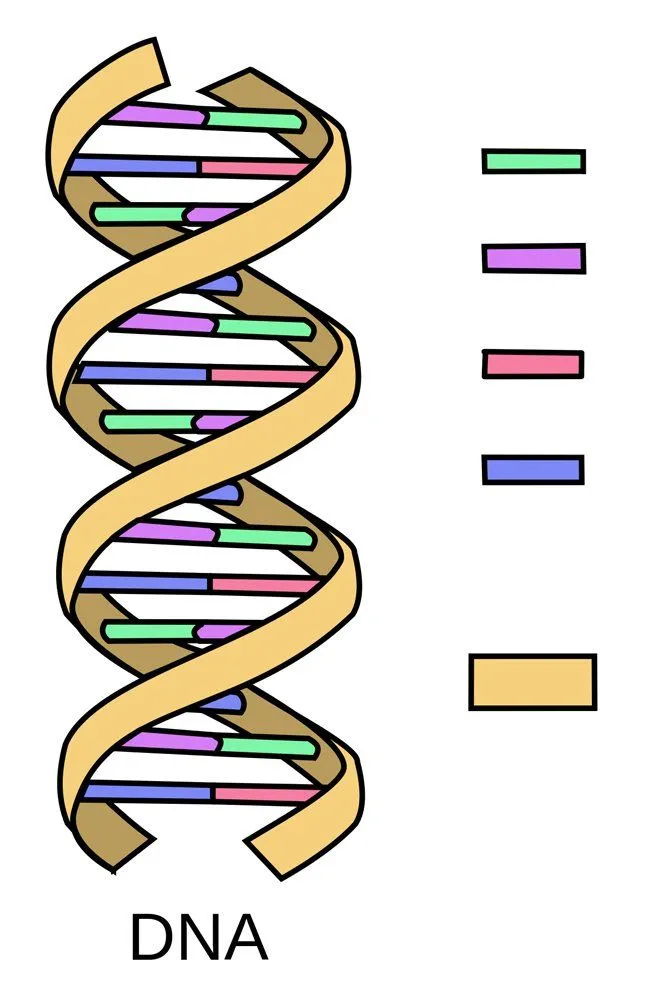
There a total of 64 codons – 43 = 64 (four bases read in sets of three). Of these, there is one START codon and 3 STOP codons.
Consider the following sequence : AUGCCAGCA
If the reading starts from A, the codons will look like this : AUG CCA GCA
If the reading starts from U, the codons will look like this : A UGC CAG CA
If the reading starts from G, the codons will look like this : AU GCC AGC A
The same arrangement of bases gives rise to different amino acids. Therefore, the START codon is a universal codon from where reading begins. Similarly, the STOP codon does the reverse, i.e. it determines where the reading for a protein will stop, and the next one will begin. The START codon is AUG, and the STOP codons are UAG, UAA, UGA.
Mutation Definition
Technically, a mutation is any sudden change in the genes. Conversely, evolution is a change in the gene which takes places over a prolonged period and is for the survival of the species. A mutation may or may not be beneficial to the organism and/or species.
Considering the intricacy of our genetic code and genes, there are a number of ways that these mutations can occur.
Types Of Mutation
Deletion Mutation
When one or more bases in the DNA are deleted, it causes deletion mutation. For instance, AUGGGACGA becomes AUGGACGA. The G base gets deleted from the middle.
Insertion Mutation
This is the opposite of deletion. In this type of mutation, a base gets added into the sequence. Like so. AUGACGAGA becomes AUGAACGAGA. The A gets added in the middle of the sequence.
Duplication Mutation
This is somewhat similar to insertion mutation. A part of the gene sequence gets duplicated and copied multiple times into the sequence.
AGCGGACGA becomes AGCGGAGGAGGAGGACGA.
The length of the duplicated sequence can vary from a single codon to multiple codons.
Substitution Mutation
In this type, a single base pair gets substituted with another. For instance, ACAGCCAGC becomes ACAGGCAGC – the C gets substituted with a G.
Inversion Mutation
Sometimes, a part of the DNA strand may break off from the middle. This segment, before getting reattached to the main strand, sometimes turns 180 ° before reattaching. This is known as inversion mutation. While there is no loss or addition of any bases, the order changes which can lead to a significant change in the protein it codes for.
Frameshift Mutation
Let’s take a simple example to understand this. Consider the deletion mutation we spoke of above wherein AUGGGACGA becomes AUGGACGA. Now let’s see how these will be read according to the genetic code.
Original sequence (with codons grouped): AUG GGA CGA
After deleting that single G: AUG GAC GA…
The first codon (AUG) is fine, but every codon after the deletion is shifted by one base and read as something completely different. A tiny change in the strand misreads everything downstream. That is a frameshift mutation. Insertions and deletions cause frameshifts only when the number of bases added or removed is not a multiple of three; duplications do the same when they fall out of frame.
Effects Of Mutation
Not all mutations cause undesirable changes in our genes. Based on this, there can be 3 types of mutations.
Missense Mutation
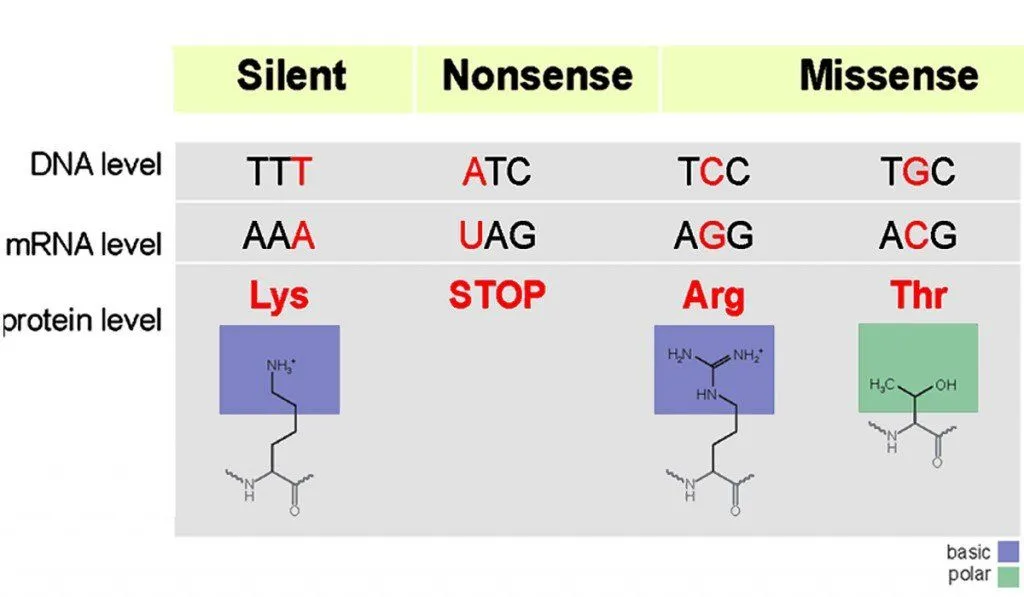
Some changes cause a change in our amino sequence. These could bring about slight changes, or major changes. However, they definitely cause a change in our amino acid sequence. This is a missense mutation.
Nonsense Mutation
Some mutations lead to the coding of a STOP codon, instead of a normal amino acid. This leads to formation of shorter protein sequences which maybe dysfunctional, or not functional at all. These are nonsense mutations
Silent Mutation
In the genetic code, the third base is less important. AAA and AAG both code for lysine. Therefore, when there is a change in the last base of a codon, the amino acid remains the same. This is due to the degeneracy of the genetic code. These mutations don’t cause any change in our proteins, and hence are called silent mutations
Mutation may not always bring about undesirable changes. The are an essential part of molecular biology, and hence it is necessary to understand their basics. A large number of diseases, like sickle cell anemia, Huntington’s disease, fragile X syndrome, etc. are caused due to such mutations.