Table of Contents (click to expand)
Only partly. Traveling forward in time is consistent with Einstein’s relativity (move fast enough or sit deep in a gravity well and your clock runs slow). But the film’s core conceit, traveling backward in time and rewriting your own past in a single timeline, has no support in current physics; even the multiverse “alternate timeline” that the trilogy invokes is speculative.
Time travel has been part of movies and literature for a long time now. There have been countless movies and books on the subject, but one of the most famous works in this genre is the movie Back to the Future directed by Robert Zemeckis.
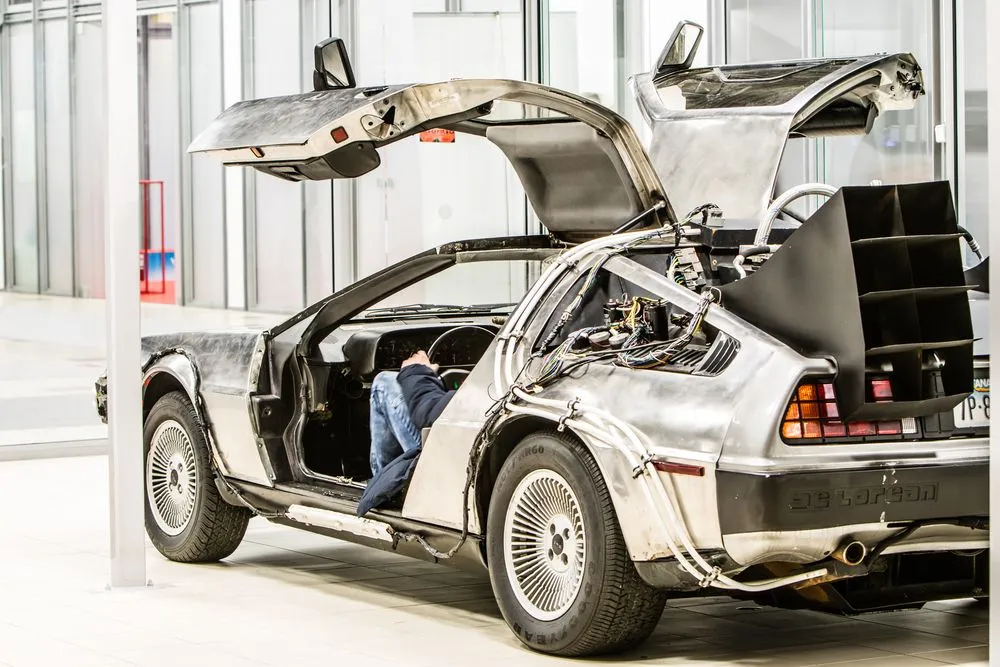
The original Back to the Future was released back in 1985, and was followed by two sequels (Part II in 1989 and Part III in 1990).
People often say the trilogy was way ahead of its time because of the predictions Part II made about what 2015 would look like, including flying cars, self-drying jackets and hover-boards.
Now, we all know that we don’t have those things yet, but we still need to applaud the creators of the movie for their ambitious vision.
Time Travel
There has been a lot of debate over the years on the scientific accuracy of the movie and whether the concepts used in the movie are true?
Well, to answer that, according to theoretical physicist Michio Kaku, time travel is theoretically possible.
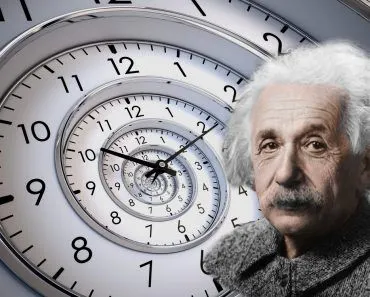
Anyone who has read about the Theory of Relativity, developed by Albert Einstein, knows that whenever a body moves closer to the speed of light in space, time passes slowly for that body, thus proving the fact that traveling to the future is a possibility.
However, traveling backward in time is still disputed by mathematicians and physicists, but this happens a lot in this movie.
That means the time-traveling done by Marty and Doc in the future can be explained, but the part where they travel back in time is still theoretically impossible.
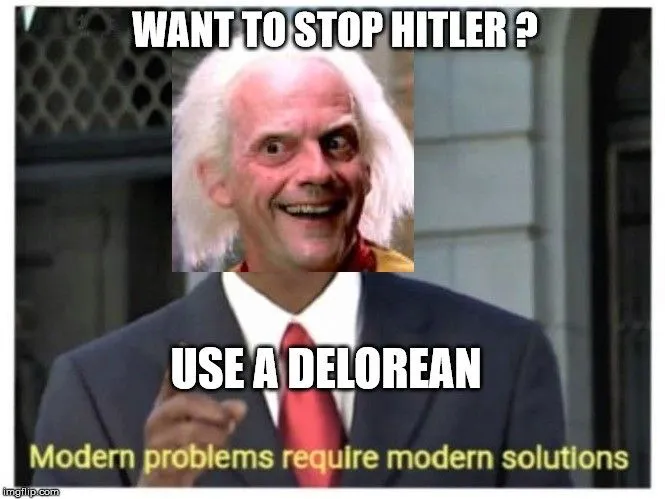
Hitler, Who?
One more important aspect of time traveling is the ‘timeline’, which is the representation of all historic moments. Suppose there is a timeline ‘A’ where we exist. If we somehow acquire the technology to travel back in time and decide to go to the past, we might undo a certain event!!
For example, a popular example is stopping Adolf Hitler before he could take over Germany by informing the countries that will eventually be known as the ‘Allies’ against the German-lead ‘Axis’ powers.
If this were to happen, the timeline from which we had gone to the past (timeline ‘A’) would cease to exist and a new timeline would be created, timeline ‘B’.
In this timeline, Hitler never took over Germany and World War II never took place.
When we returned to the year from which we had come, everything would be different; in fact, it would be possible that we might cease to exist in the new timeline, so we would simply fade away.
This is exactly what happens in the first part of the movie, when Marty travels back in time and Marty’s mother Lorraine falls in love with him (her son in the future) instead of his father, George.
Thus, in this case, she would never marry George, so the timeline from which Marty had come would not exist and would be replaced by another timeline where there is no Marty!
This is why Marty starts to fade away in the movie because of the alteration of the events in his original past.
Along the stretch of the three movies, so many different timelines are created that it becomes nearly impossible to keep track.
Another theory in the movie is that if we go to the future and meet our future selves, it will cause space-time to stop and thus bring about the end of the universe, according to Doc. However, in reality, if we go to the future to meet our future self, nothing inherently bad would occur; rather, our future self would be ready for us because he has already met himself in his timeline.
Hence, this would be his second meeting with himself, so he would be prepared to answer all the questions that his past self would have asked him.
Yet in the movie, when Jennifer (Marty’s girlfriend from the present) meets her future self (Marty’s wife), her future self should have been prepared to meet her past self, because she has already met her future self in her past.

It’s confusing, right? But this is time travel we’re talking about… it’s supposed to be complicated!
Did Back to the Future Predict 2015 Correctly?
When Marty travels to October 21, 2015 in Part II (the film was released in 1989), the future is full of gadgets. Some of them now look uncannily on the mark, and some still belong firmly to Hollywood. So how did the movie actually score?

It got a surprising amount right. The film showed wall-mounted, widescreen flat-panel televisions with several channels on screen at once, video calls between family members, hands-free video games, wearable devices, tablet-style computers, and a world saturated with cameras and unmanned flying drones used for newsgathering. Marty even pays with a fingerprint. Three decades later, video calls, smart TVs, tablets, fitness wearables, biometric unlocking and camera drones are all part of ordinary life.
Where it missed, it missed big. We still do not have flying cars on a "skyway", and co-writer Bob Gale has admitted those were always more wish than forecast. The hoverboard remains fiction; the two-wheeled gadgets that sold as "hoverboards" in 2015 roll along the ground rather than float. The one prop that crossed over into reality is Marty's self-lacing Nike sneakers, which Nike eventually produced as a limited "power-lacing" shoe, though not in time for the film's deadline. For a screenplay written in the late 1980s, getting roughly half its predictions right is a strong showing, even if the most iconic gadgets are still missing.
The Grandfather Paradox and What Physics Says About It
The chaos Marty causes by changing his parents' past has a formal name in the science of time travel: the grandfather paradox. The classic version asks what happens if you travel back and prevent your own grandfather from meeting your grandmother. If you succeed, you are never born, so you never travel back to interfere, so your grandfather does meet your grandmother after all. The logic eats its own tail, which is exactly why Marty starts to fade from the family photograph.

General relativity does, on paper, allow paths through spacetime that loop back to the past, known as closed timelike curves; a traversable wormhole is the textbook way to build one. But physicists studying these solutions have largely concluded that they would not let you create a paradox in the first place. The Novikov self-consistency principle, set out in a 1990 study of spacetimes with closed timelike curves, argues that only self-consistent histories are physically possible. In that picture, anything you did in the past would already be part of how the past actually happened, so you simply could not stop your own birth. The harder problem, philosophers of physics note, is not paradox but the opposite: too many consistent endings to choose from.
Stephen Hawking went further. In a 1992 paper he proposed the chronology protection conjecture, the idea that the deeper laws of physics conspire to forbid closed timelike curves entirely, "making the universe safe for historians", as he put it. By that reasoning, the single rewritten timeline at the heart of the movie is the one part the science most firmly rules out. The grandfather paradox is never resolved on screen; it is simply outrun by the plot.
Conclusion
The creators of the movie tried hard to wrestle the concepts of time travel and use them in the movie, but they couldn’t provide a proper scientific explanation for a few things in the movie.
Still, what they achieved back in the year 1985 is just amazing. This is one of the best time-traveling movies in history, even if it isn’t perfect.
References (click to expand)
- BACK TO THE FUTURE!!! – A critique – Scientific Scribbles - blogs.unimelb.edu.au
- Science Behind the Fiction, Special Edition: Back to the Future .... anl.gov
- The Physics of Back to the Future's DeLorean Time Machine. scienceandfilm.org
- Welcome back to the future - Science Museum Blog. The Science Museum
- How 'Back to the Future: Part II' Scored on 2015 Predictions. ABC News
- Time Travel and Modern Physics. Stanford Encyclopedia of Philosophy
- Hawking, S. W. (1992). Chronology protection conjecture. Physical Review D, 46(2), 603. (NASA ADS)
- Back to the Future Part II. Wikipedia